情感AI

Search documents
有37℃体温,超逼真机器人即将众筹,想成为你的“第四种关系”
机器人大讲堂· 2025-12-28 06:58
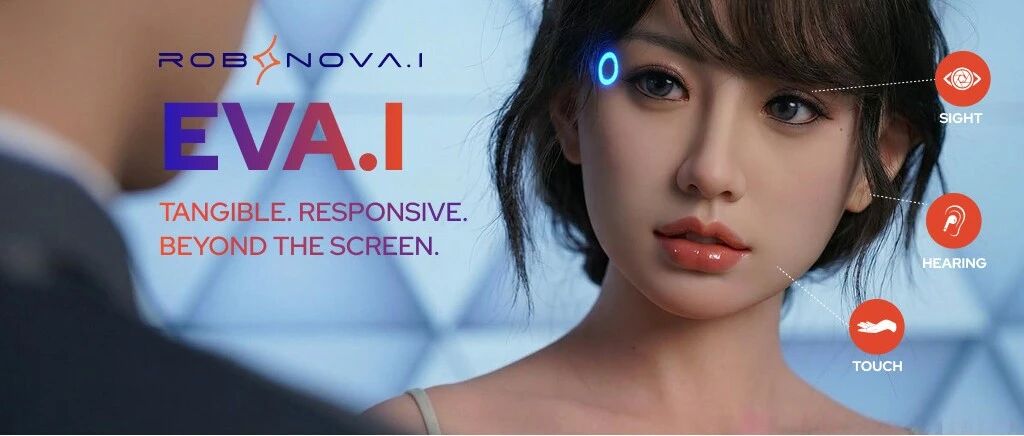
Core Viewpoint - The article discusses the launch of the AI companion robot Eva.i, which features a constant body temperature of approximately 37°C, aiming to create a new dimension of "realistic tactile" interaction and emotional connection with users [1][4][6]. Group 1: Technology and Features - Eva.i utilizes two patented technologies: a high-sensitivity flexible printed circuit (FPC) bionic electronic skin that can sense pressure and temperature changes, and a graphene temperature control system that maintains a surface temperature close to human body temperature [7][9][10]. - The robot is equipped with 24GB LPDDR5X memory, a neural network processor (NPU), and 256GB storage, supporting Wi-Fi 6 and Bluetooth 5.2, with 21 independent motors for natural posture transitions [12]. - Eva.i employs a multimodal interaction system that integrates visual, audio, and tactile technologies to interpret basic expressions and tones, evolving over time to provide personalized responses [15]. Group 2: Emotional Connection and Relationship - The design philosophy of Eva.i emphasizes creating a "fourth type of relationship" that exists between humans, pets, and objects, allowing users to engage without the burden of reciprocation [18][20]. - The robot is intended to provide emotional support and companionship, accepting all emotions without judgment, and is designed to be a non-intrusive presence in users' lives [20][21]. Group 3: Application Scenarios - Eva.i targets various application scenarios, including providing emotional support for urban dwellers, serving as a social center for digital natives, being a companion for the elderly, acting as a personalized receptionist in high-end venues, and functioning as an emotional co-pilot in autonomous vehicles [25][27]. - The robot's data processing is designed to prioritize user privacy, with local algorithms and encrypted sensitive interaction data [24]. Group 4: Market Position and Future Plans - Eva.i plans to launch a crowdfunding campaign on Kickstarter, with a limited release of 200 units, aiming for hardware delivery by April 2026 [29]. - The global emotional AI market is projected to grow at a compound annual growth rate of 22.7%, positioning Eva.i as a novel attempt to create a new form of companionship rather than making machines more human-like [29].

2026年值得期待的十大技术应用
Ke Ji Ri Bao· 2025-12-04 00:55
Core Insights - The article highlights the rapid advancements in technology expected by 2026, including emotional AI, wearable health devices, renewable energy innovations, and more, which are set to transform daily life and work environments. Group 1: Emotional AI - The next generation of emotional AI assistants is surpassing traditional ones like Siri and Alexa by understanding human emotions through tone, expression, and wording, providing personalized relaxation recommendations and enhancing customer care [2] - Emotional AI is becoming a partner in daily life, playing a significant role in mental health support and personal growth [2] Group 2: Wearable Devices - By 2026, wearable devices are expected to evolve into "life guardians," with smart skin patches monitoring hydration, stress hormones, and nutrition levels, while AI watches can predict heart disease risks days in advance [3] - These innovations are shifting healthcare from reactive treatment to proactive prevention [3] Group 3: Renewable Energy - New night-time solar panels will capture infrared radiation, allowing for continuous power supply even in darkness, while advancements in lithium-sulfur and solid-state battery technologies will enhance energy storage for electric vehicles [4] - 2026 may mark a historical turning point for the decline of fossil fuels as the dominant energy source [5] Group 4: Brain-Computer Interfaces - Brain-computer interface technology is moving from medical applications to everyday use, enabling paralyzed patients to control devices with their thoughts and enhancing work efficiency through instant data retrieval [6] - By 2026, these interfaces will be integrated into daily life, impacting prosthetics, rehabilitation, and augmented reality experiences [6] Group 5: Space Economy - The space economy is set to flourish, with suborbital flight prices dropping below $100,000 and companies developing zero-gravity hotels, indicating a new era of space exploration and commercialization [7] Group 6: AI in Education - AI-driven personalized education is emerging, adapting courses to individual learning styles and helping adults with career transitions, fundamentally reshaping educational approaches [9] Group 7: Quantum Computing - Quantum computing is expected to solve complex problems beyond the capabilities of classical computers, significantly reducing drug development timelines and optimizing supply chains [10] Group 8: Smart Cities - Cities will become smarter by 2026, with AI traffic systems alleviating congestion, IoT-enabled waste management, and predictive security systems enhancing urban living [11] Group 9: Robotics - Robotics will become ubiquitous in households and various work environments, with cooking robots, construction robots, and personal care robots transforming daily tasks [12][13] Group 10: Bioprinting - The bioprinting field is anticipated to achieve significant advancements, enabling the creation of disease models, personalized medicine, and potentially addressing organ donation shortages [14]
一句“你还好吗”值40亿?斯坦福博士出走xAI,押注AGI共情力
3 6 Ke· 2025-11-13 11:08
Core Insights - The article discusses Eric Zelikman's departure from xAI to create a new company, Humans&, focusing on developing AI that understands human emotions rather than just performing tasks [1][3][10] - Zelikman believes that the next step for AI is to achieve emotional intelligence, which he sees as essential for true wisdom in AI [2][10] Company Overview - Eric Zelikman, a former core member of xAI, founded Humans& with a vision to bridge the gap between AI and human understanding, aiming for a valuation of $4 billion and raising $1 billion in funding [1][5][10] - The company seeks to create AI models that incorporate emotional understanding into their responses, moving beyond traditional metrics of accuracy and reasoning depth [7][10] Industry Trends - The shift in investment focus from computational power to emotional intelligence in AI is highlighted, with significant funding being directed towards companies that prioritize understanding human emotions [8][12] - The article notes that while AI can recognize emotions, it still lacks the ability to genuinely understand or experience empathy, indicating a gap in current AI capabilities [12][13] Future Vision - Zelikman envisions a future where AI is not just a tool for efficiency but a partner that can empathize and connect with humans on a deeper level [10][14] - The article suggests that the ultimate goal of AI development may shift from merely achieving high performance to fostering better human understanding and connection [15][16]

喝点VC|YC对谈美国知名风投家Kirsten:在消费级AI领域先行者确有优势,但真正支撑长期发展的仍是好的产品
Z Potentials· 2025-07-24 03:09
Core Insights - The emergence of consumer-level AI is seen as a significant trend, with rapid user adoption exemplified by the success of ChatGPT, which has millions of daily users [3][4][5] - The next phase of AI development is focused on creating context, moving beyond single interactions to building long-term contextual understanding [5][9] - The current phase of consumer AI is characterized as a "chaotic creative stage," where experimentation and iteration are crucial for finding resonant solutions [12][17] Group 1: AI Development and Consumer Adoption - The rapid acceptance of AI technologies by consumers is unprecedented, with ChatGPT being a prime example of a product that has achieved remarkable growth [3][4] - The shift from focusing on results and attention to relationships and emotional connections marks a new paradigm in consumer interactions with technology [4][5] - The potential for AI to create long-term contextual understanding will lead to intuitive predictions based on accumulated memory, which is still in its early stages [5][6] Group 2: Market Dynamics and Consumer Relationships - The core value of entering the market lies in understanding what experience users associate with a product, necessitating thoughtful expression across all channels [9][12] - Building emotional connections with users is essential for loyalty and retention, as the shift from transactional to relational interactions is more meaningful [10][15] - The evolution of consumer behavior, particularly in the fast-moving consumer goods sector, has seen a significant increase in sales driven by word-of-mouth, rising from 4% to 48% in recent years [18][19] Group 3: Future Trends in AI and Consumer Products - The integration of AI tools in consumer sectors is accelerating, with companies leveraging AI to enhance search functionalities and user experiences [19][20] - The future of AI in healthcare and personal safety is promising, with opportunities for proactive health management through AI-driven insights based on personal data [22][23] - The emergence of "emotional AI" presents significant opportunities in building relationships, as current platforms may struggle to integrate these capabilities effectively [26]