具身AI

Search documents
人形机器人新篇章! 德州仪器(TXN.US)携手英伟达(NVDA.US)融合AI与传感 点燃“物理AI”革命
智通财经网· 2026-03-06 01:24
Core Viewpoint - The collaboration between Texas Instruments (TXN) and Nvidia (NVDA) aims to enhance humanoid robot systems by integrating advanced technologies, moving beyond simple robot manufacturing to building a robust infrastructure for physical AI applications [1][2]. Group 1: Collaboration Details - Texas Instruments and Nvidia are combining their technologies to create a comprehensive solution for humanoid robots, focusing on real-time control, sensing, and AI reasoning systems [3][4]. - The partnership is expected to bridge the gap between Nvidia's AI computing capabilities and practical applications, allowing developers to validate humanoid operating systems more efficiently [2][5]. Group 2: Technological Advancements - The integration of Texas Instruments' millimeter-wave radar technology with Nvidia's Jetson Thor platform aims to provide low-latency 3D perception and safety awareness, crucial for the development of humanoid robots [3][6]. - This collaboration enhances object detection, localization, and tracking capabilities, improving the real-time decision-making abilities of humanoid robots [3][6]. Group 3: Industry Context - The humanoid robot sector is witnessing significant advancements, with various companies, including Tesla and Figure AI, developing high-end embodied AI robots for industrial and consumer applications [7][8]. - The market for humanoid robots is projected to grow significantly over the next decade, with estimates suggesting that the annual revenue could exceed $5 trillion by 2050 [9].


特斯拉巨鲸廖凯原购入100万股英伟达股票,称人工智能正处起步阶段
Jin Rong Jie· 2026-03-05 05:29
Core Viewpoint - Billionaire Liao Kaiyuan, a major shareholder in Tesla, publicly announced on March 4 that he purchased 1 million shares of Nvidia stock on March 3, expressing strong belief that artificial intelligence is not in a bubble and is just beginning [1] Group 1: Investment Actions - Liao plans to buy an additional 1 million shares of Nvidia soon to show support for the market [1] - Despite recent skepticism towards Elon Musk and Tesla, Liao primarily holds Tesla shares and U.S. Treasury bonds [1] Group 2: Company Insights - Liao believes that Tesla's energy, cybercap, and Teslabot businesses are not fully priced in, suggesting that bold investors can still buy Tesla to bet on future wealth [1] - He referred to Tesla as "the leading embodied AI on Earth," indicating confidence in its long-term potential [1]

特斯拉投资者廖凯原宣布买入100万股英伟达股票:“我坚信人工智能没有泡沫”
Xin Lang Cai Jing· 2026-03-04 23:30
Core Viewpoint - Liao Kaiyuan, one of Tesla's largest individual shareholders, is making significant investments in the artificial intelligence sector, believing that AI is just beginning and not in a bubble [1][2]. Group 1: Investment in NVIDIA - Liao has purchased 1 million shares of NVIDIA and plans to buy more [2]. - He believes that his investment in NVIDIA is aimed at calming a "nervous market" as traders reassess the impact of AI technology [3]. - NVIDIA's stock has declined by 4% year-to-date, indicating a shift in market sentiment regarding AI investments [3]. Group 2: Outlook on Tesla - Despite previously claiming that Elon Musk intentionally suppressed Tesla's stock price, Liao remains optimistic about Tesla's future [3]. - He continues to hold a significant amount of Tesla stock and short-term U.S. Treasury bonds [3]. - Liao believes that Tesla's potential in energy, cybersecurity, and the Teslabot has not yet been fully reflected in its stock price, suggesting that risk-tolerant investors may still find value in Tesla shares [3].


瑞银财富管理投资总监办公室:人形机器人有望从试点阶段逐步进入制造和物流等实际应用场景
Zheng Quan Ri Bao Wang· 2026-02-27 11:26
Group 1 - The core viewpoint is that the robotics and automation market is entering a new era, with multiple positive signals indicating growth potential [1] - Breakthroughs in physical AI are accelerating the practical application of robots, enabling them to understand sensory inputs and natural language commands, which allows for the reliable completion of complex tasks [1] - The trend of manufacturing reshoring is driving an increase in demand for automation, with humanoid robots expected to meet the critical needs for flexibility and adaptability in production processes [1] Group 2 - Productivity improvements and enhanced supply chain dynamics are anticipated, with IDC projecting that global shipments of humanoid robots will surge to 18,000 units by 2025, representing a nearly 500% year-on-year growth [1] - Chinese component suppliers are ramping up production, while overseas manufacturers are actively developing new products, indicating a robust expansion in the robotics sector [1] - The UBS Wealth Management CIO Office expresses optimism about vertical applications of embodied AI, including humanoid robots, advanced driver-assistance systems, and industrial automation, highlighting the importance of companies with scalable platforms and strong R&D capabilities [2]
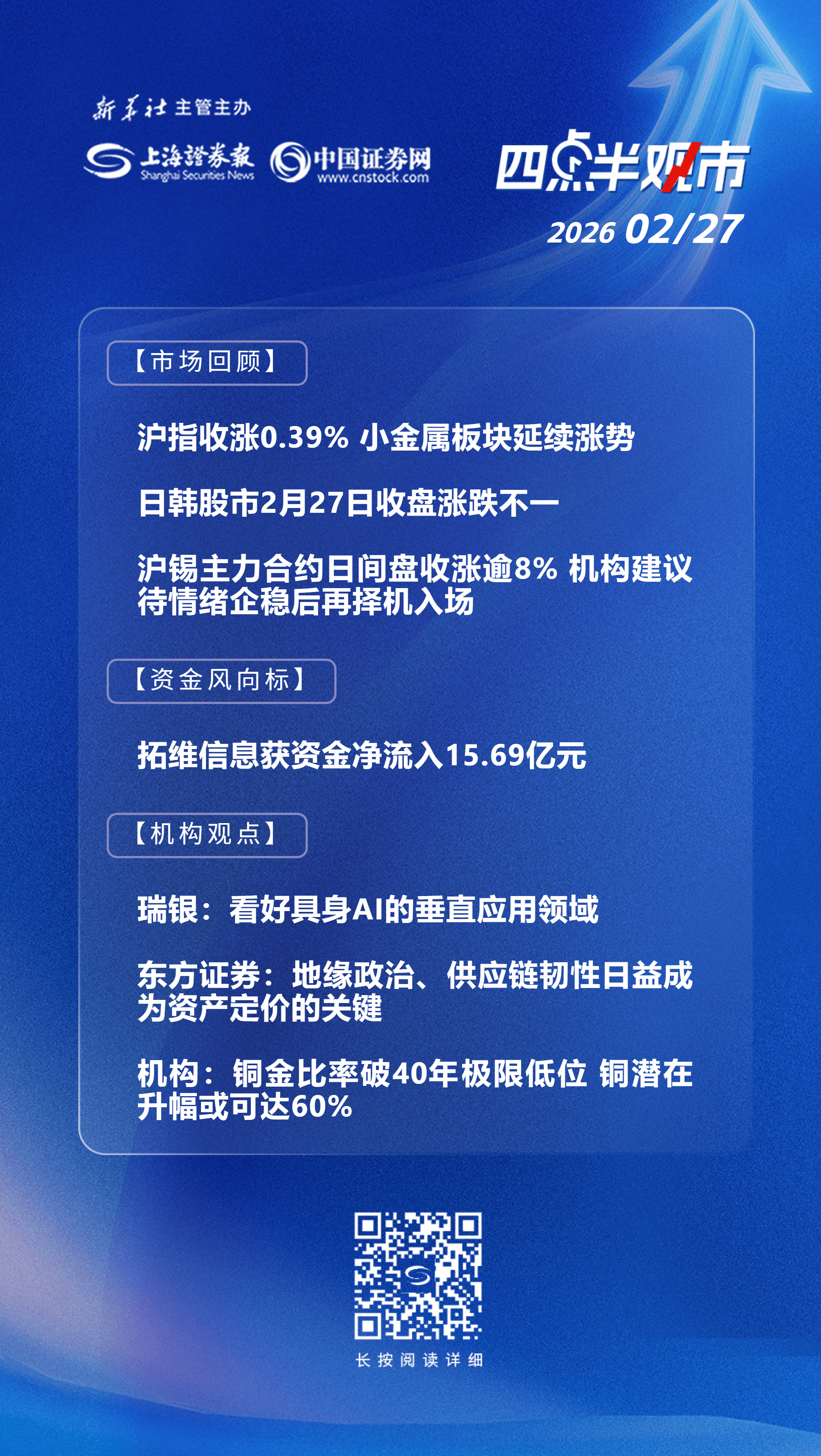
四点半观市 | 机构:看好具身AI的垂直应用领域
Sou Hu Cai Jing· 2026-02-27 08:32
Market Overview - The Shanghai Composite Index closed up 0.39% at 4162.88 points, while the Shenzhen Component fell 0.06% and the ChiNext Index dropped 1.04% [6] - The trading volume in the Shanghai and Shenzhen markets was 250.55 billion yuan, a decrease of 51.2 billion yuan from the previous day [6] - Over 3200 stocks in the market experienced gains [6] Sector Performance - The small metals sector continued its upward trend, with the main contract for tin rising over 8% during the day [6] - The copper-to-gold ratio has reached a 40-year low, suggesting a potential increase in copper prices of up to 60% if the ratio normalizes [9] Institutional Insights - UBS expressed optimism about the vertical applications of embodied AI, including humanoid robots, advanced driver-assistance systems, and industrial automation, highlighting the growth potential in these sectors [9] - According to Oriental Securities, geopolitical factors and supply chain resilience are becoming key in asset pricing, shifting investment logic from growth efficiency to building resilience [9] Fund Flows - Top net inflow stocks on February 27 included Tuowei Information, which saw a net inflow of 1.569 billion yuan [8]

春晚机器人炸翻全球!中国程序员悄悄拿下下一代硬件主场,老外彻底慌了
Sou Hu Cai Jing· 2026-02-26 15:32
Core Viewpoint - The emergence of humanoid robots during the Spring Festival Gala signifies China's leadership in the AI and hardware sector, showcasing significant advancements in control systems and algorithms developed by Chinese programmers [1][4][5]. Industry Perspective - The performance of humanoid robots at the Spring Festival Gala reflects the explosive growth of China's humanoid robot industry, with approximately 90% of the global humanoid robot shipments in 2025 expected to come from China [4]. - Morgan Stanley predicts that the sales of humanoid robots in China will double to 28,000 units by 2026, indicating China's dominant position in the "AI + hardware + manufacturing" composite sector [4]. Technological Advancements - The robots showcased at the 2026 Spring Festival Gala demonstrated remarkable capabilities, including complex movements and real-time adjustments, which were not possible in previous years [3]. - The transition from basic robotic functions to advanced performances highlights the significant improvements in software, AI integration, and control systems, which are crucial for the success of humanoid robots [5][8]. Career Opportunities - The rise of humanoid robots opens new career paths for programmers, shifting focus from traditional AI roles to areas such as robot control system development, motion algorithm optimization, and human-machine interaction [6][9]. - The demand for skilled professionals in the humanoid robotics field is expected to grow, as the industry requires expertise in software and AI to complement hardware advancements [8][9]. Market Dynamics - The competition in humanoid robotics is fundamentally a contest of software and AI capabilities, with hardware being easily replicable but the precision of control systems and algorithms being unique to skilled programmers [8]. - The industry is transitioning from a "traffic-driven" model to a "technology-driven" model, emphasizing the importance of hard technology and innovation in driving growth [6].

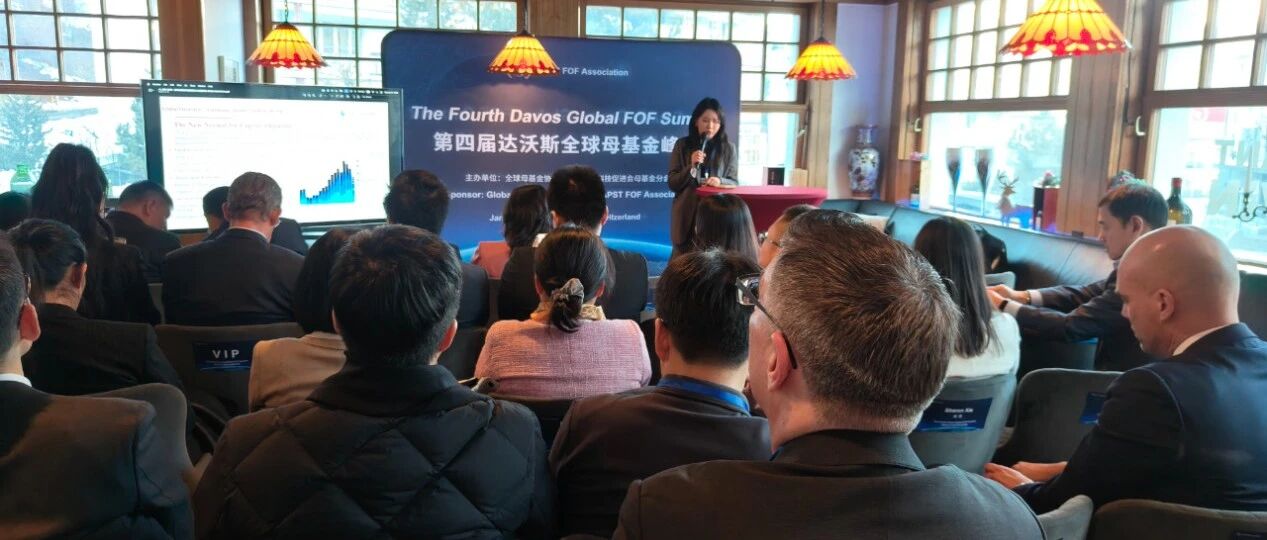
王爽:全球私募股权市场正在“重置”
母基金研究中心· 2026-02-08 08:35
Core Insights - The fourth Davos Global Fund of Funds Summit was held on January 21, 2026, focusing on the future development of the global fund of funds and venture capital industries [2][3] - The summit emphasized the importance of resilience in the face of a changing fundraising environment and highlighted strong intentions for capital allocation among limited partners (LPs) [4][5] Global Economic Trends - The years 2024 and 2025 are identified as "reset years" for global financial markets, with the U.S. economy entering a recovery phase by the third quarter of 2025 [10][11] - The Americas dominate global venture capital deal value, while Asian investors are shifting focus from consumer internet to hard technology and manufacturing [10][11] - Artificial intelligence is attracting significant capital, with a shift in investment focus towards practical applications in finance and healthcare [10][11] Liquidity and Exit Strategies - Liquidity is crucial, with investors prioritizing cash returns over paper profits; secondary transactions and mergers and acquisitions (M&A) are becoming key exit channels [12][13] - Continuation funds allow managers to hold high-quality assets longer, and M&A activities are increasing as funds acquire each other [12][13] Chinese Market Dynamics - The Chinese market is undergoing significant structural changes, with a divergence between macroeconomic recovery and microeconomic sentiment [14][15] - The dominance of state-owned capital is increasing, leading to a transformation of general partners (GPs) from professional investment institutions to comprehensive service providers [14][15] Patient Capital Policies - China is promoting patient capital policies, extending fund durations to 15-20 years to match the needs of industries with long R&D cycles [16][17] - Some regions allow up to 100% loss tolerance for early-stage investments to encourage innovation [16][17] Evolving Exit Channels - Exit channels in China are changing, with new models emerging for project incubation and delisting, alongside the rapid development of segmented industry funds [18][19] - Looking ahead to 2026, investment focus will be on supply chain advantage areas, such as humanoid robots, with a shift from mega funds to a model of "one mother fund + specialized sub-funds" [18][19]
美媒焦虑了:美国再不重视,中国机器人“新惊喜”又来了
Xin Lang Cai Jing· 2026-01-31 10:22
Core Insights - DeepSeek represents a significant advancement in China's AI capabilities, particularly in embodied AI, which integrates AI into hardware systems like robots and drones, allowing for environmental awareness and autonomous decision-making [1][3] - The article emphasizes that China's long-term, comprehensive policy efforts have positioned it as a leader in AI development, with a focus on embodied AI potentially yielding substantial economic and geopolitical advantages [1][4] Industry Focus - China is prioritizing the development of AI-driven robots, aiming to integrate embodied AI into core industries to enhance productivity and military capabilities [4] - The country is leveraging its existing manufacturing strengths to become a global leader in embodied AI systems, which could automate physical tasks across multiple industries [4] - Chinese companies such as AgiBot, UBTech, and Unitree are already leading the global market in humanoid robot shipments, with AgiBot accounting for approximately 5,100 units (39% market share) [5] Challenges and Strategic Insights - Despite facing challenges such as limited access to advanced AI chips and reliance on Western suppliers for high-end sensors, the article warns against underestimating China's ability to overcome these obstacles [7] - The U.S. is criticized for its strategic neglect of embodied AI, focusing resources on a few private companies and lacking a cohesive government policy, which could hinder its competitive edge [7] - The article calls for the U.S. to enhance its analytical capabilities regarding China's AI policies and progress, suggesting that Silicon Valley must mobilize talent and capital to transition embodied AI from research to large-scale market applications [7]
“美国一次次错过,再不长脑子,中国新惊喜又来了”
Guan Cha Zhe Wang· 2026-01-31 04:33
Group 1 - DeepSeek represents a significant advancement in China's AI capabilities, particularly in robotics and autonomous systems, prompting concerns in the West about China's technological leadership [1] - The U.S. is warned to take China's AI advancements seriously, as experts note that China's systematic efforts in AI research have been underestimated [1] - The article emphasizes that the same pattern of underestimation is repeating, indicating a potential for future surprises from China in the AI sector [1] Group 2 - China is focusing on "embodied AI," which integrates AI into hardware systems like robots and drones, allowing them to learn from physical interactions rather than just executing pre-programmed instructions [3] - The long-term benefits of embodied AI could provide China with significant economic and geopolitical advantages, particularly in enhancing military capabilities [3] - China aims to leverage its manufacturing strengths to become a global leader in embodied AI systems, which could automate physical tasks across multiple industries [3] Group 3 - Local Chinese governments are investing in embodied AI companies, while private sector firms like AgiBot, UBTech, and Unitree are emerging as global leaders in humanoid robotics [4] - By 2025, China is projected to dominate the global humanoid robot market, with AgiBot leading with approximately 5,100 units (39% market share), followed by Unitree with about 4,200 units (32%), and UBTech with around 1,000 units [4] Group 4 - Despite challenges such as limited access to advanced AI chips and reliance on Western suppliers for high-end sensors, China's ability to overcome early obstacles has been underestimated [6] - The U.S. is criticized for its strategic neglect of embodied AI, focusing resources on a few private companies and lacking a comprehensive government policy [6] - The article calls for the U.S. to enhance its analytical capabilities regarding China's AI policies and progress, emphasizing the need for urgent action to avoid missing future industrial waves [6]
玖物智能递表港交所 2024年智能具身产业机器人解决方案收入在中国排名第二
Zhi Tong Cai Jing· 2026-01-19 04:34
Company Overview - Jiu Wu Intelligent Technology Co., Ltd. is a leading company in China's intelligent embodied industrial robotics sector, holding a market share of 5.9% as of 2024 [4] - The company has developed the JOS robotic operating system, one of the first in China to integrate perception, motion control, and planning, enabling robots to adapt to various tasks [4] - Jiu Wu Intelligent is among the few suppliers capable of designing intelligent embodied industrial robots for sectors such as clean energy technology, electronics and semiconductors, and optical modules [4] Technological Capabilities - The company's solutions incorporate advanced AI capabilities for intelligent perception, decision-making, and control in complex industrial environments [5] - Jiu Wu Intelligent has a fully independent stack of robotic technology, covering core software, algorithms, and essential hardware components [5] - As of September 30, 2025, the R&D team consists of 168 professionals, accounting for 40.6% of the total workforce [5] Customer Base - The company has sold over 11,000 intelligent embodied industrial robots to 156 customers across 16 industrial sectors, including 48 listed companies [6] - The customer retention rate during the historical record period was 72.7%, surpassing the industry average for suppliers of intelligent embodied industrial robotics solutions in China [6] Financial Performance - Revenue for the fiscal years 2023 and 2024 is projected to be approximately RMB 207 million and RMB 366 million, respectively [7] - The profit for the fiscal year 2024 is estimated at RMB 9.13 million, with a projected profit of RMB 32.64 million for the following year [7] Industry Overview - The global market for embodied AI robotic solutions is expected to grow from RMB 37.8 billion in 2020 to RMB 82 billion by 2024, with a CAGR of 21.3% [9] - The Chinese market for embodied AI robotic solutions is projected to expand from RMB 12.5 billion in 2020 to RMB 28.7 billion by 2024, with a CAGR of 23.1% [9] - The intelligent embodied industrial robotics solutions market is anticipated to grow significantly, with a global market size expected to reach RMB 1,033 billion by 2029, reflecting a CAGR of 52.8% from 2024 to 2029 [12] Market Dynamics - The demand for intelligent embodied industrial robotics solutions is accelerating due to rapid expansion in lithium battery and photovoltaic manufacturing capacities [18] - The clean energy technology sector is expected to see its market size grow from RMB 400 million in 2020 to RMB 1.9 billion by 2024, with a CAGR of 48.0% [18] - The electronics and semiconductor sector is projected to grow from RMB 200 million in 2020 to RMB 1 billion by 2024, with a CAGR of 44.8% [21]