
想象力经济

Search documents
洗大澡 | 谈股论金
水皮More· 2026-02-03 09:11
Market Performance - The three major A-share indices collectively strengthened, with the Shanghai Composite Index rising by 1.29% to close at 4067.74 points, the Shenzhen Component Index increasing by 2.19% to 14127.11 points, and the ChiNext Index up by 1.86% to 3324.89 points [2] - The trading volume in the Shanghai and Shenzhen markets reached 256.58 billion, a slight decrease of 41.1 billion compared to the previous day [2] Market Sentiment and Influences - The Hong Kong Hang Seng Index experienced a significant drop, with a maximum decline of 3.37%, breaking through the adjustment low of the Hang Seng Technology Index since last year, which triggered market panic [3] - Major stocks like Tencent Holdings saw a notable decline of 6%, while Baidu and Alibaba also experienced significant drops due to circulating three versions of rumors regarding tax increases and changes in tax benefits for platform companies [3][4] - The spread of these rumors, despite being unfounded, had an immediate and substantial impact on the market [4] Sector Performance - A-share market showed a broad-based increase, with over 4800 stocks rising and only about 500 declining, indicating a rebound despite a relatively low trading volume of 2.5 trillion [5] - Sectors such as shipbuilding, photovoltaic, and commercial aerospace led the gains, aligning with the "imagination economy" logic following news of a merger between SpaceX and xAI [5] - Conversely, sectors like banking, insurance, and liquor faced declines, while the precious metals sector rebounded from an earlier drop, influenced by the recovery in gold and silver prices [5] Company-Specific Developments - The stock of Cambrian Technology faced a maximum drop of 14%, attributed to rumors about its 2026 revenue expectations being significantly lower than market forecasts, leading to a 9% decline by the close despite a clarification statement [6] - Cambrian's fourth-quarter revenue showed a sequential decline, raising concerns about its ability to recover in the upcoming quarters, with its high valuation being a critical issue [6] Technical Analysis - The market exhibited a V-shaped recovery after an initial high opening followed by a decline, indicating strong internal resilience despite not forming a bullish candlestick pattern [6] - The previous day's downturn was interpreted as a "digging pit" scenario, suggesting that the market is gradually stabilizing and moving towards a slow upward trend [6]


AI进入真实生产,创作将走向何处?这场论坛给出关键答案
Nan Fang Du Shi Bao· 2025-12-25 09:47
Core Insights - The content industry is facing a pivotal moment as generative AI transitions from a tool to a participant in the creative process, raising questions about the future of content creation [1] - The AI-driven production of quality content is approaching a critical threshold, with discussions at the AI Creation Global Ecosystem Forum highlighting the need for AI to integrate into the full content workflow for scalable production [5] Group 1: Technological Advancements - AI video generation capabilities have rapidly evolved over the past two years, with a focus on multimodal development to enhance interaction between AI and creators, facilitating easier and more complete content creation [2][4] - The launch of the O1 multimodal video and image creation model by Kuaishou's Keling AI aims to unify generation and editing tasks, allowing creators to convey complex ideas directly to AI while maintaining consistency in elements [4] Group 2: Impact on Creative Processes - The integration of AI into content production is reshaping creative paths and the role of creators, with discussions emphasizing that AI should not be seen as a replacement but as a tool that alters the creative workflow [6][8] - Experts argue that AI's role is to assist rather than replace human creativity, with the ultimate direction of a project still determined by the creator's vision and choices [9][11] Group 3: Economic and Structural Shifts - The content industry's value core is shifting from a knowledge economy to an imagination economy, emphasizing the transformation of imagination into tangible outputs [12] - As AI lowers the barriers to creation, the importance of platforms and ecosystems in supporting continuous creative output and ensuring quality content becomes crucial [12][14]
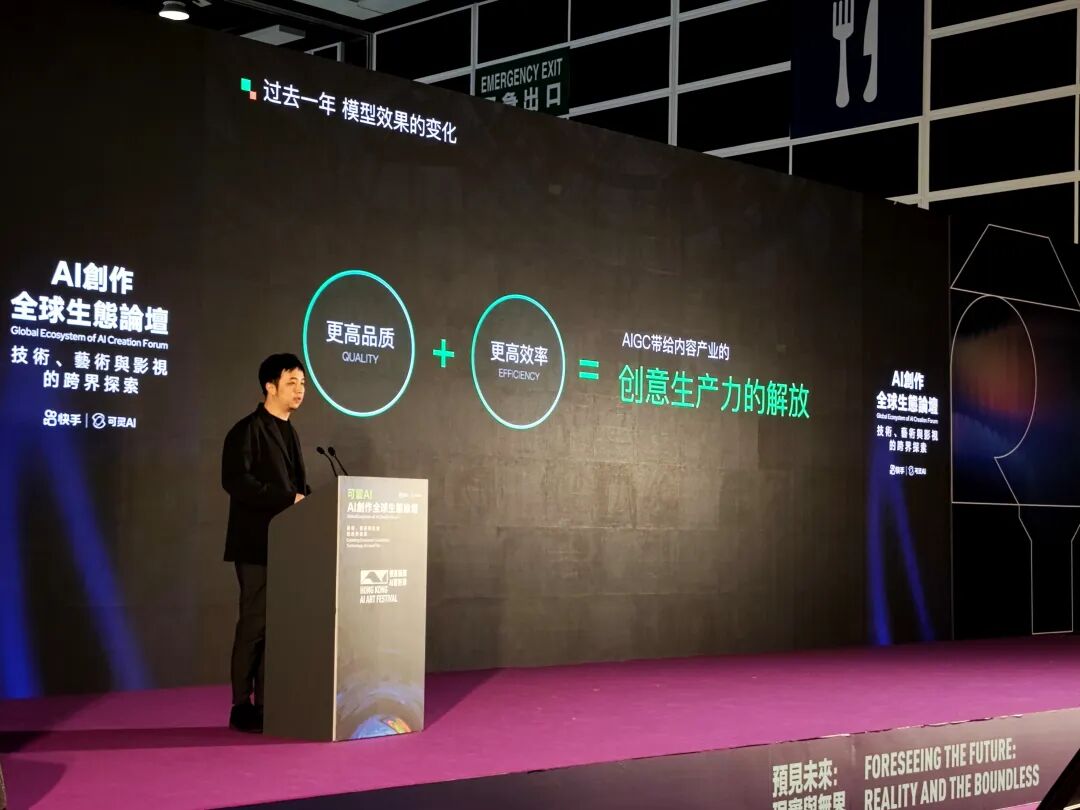
可灵AI亮相首届香港国际AI艺术节 携手全球顶尖学者、艺术家共话AI创作新趋势
Zheng Quan Ri Bao Wang· 2025-12-22 09:15
Core Insights - The forum "AI Creation Global Ecosystem Forum" held during the first Hong Kong International AI Art Festival focused on the intersection of technology, art, and film, gathering top experts and creators to discuss the future of the creative industry empowered by AI [1][2]. Group 1: AI Technology and Creative Industry - The emergence of AI technologies, represented by Kuaishou's Keling AI, is leading to a new era characterized by intelligence, efficiency, and low barriers, reshaping industry ecosystems and creative logic [2][4]. - Keling AI's new O1 model is the world's first unified multi-modal video and image creation tool, marking a significant advancement in AI generation technology from single-modal instructions to comprehensive understanding [4][5]. - The relationship between AI and artistic creation was deeply explored, emphasizing that while AI can enhance productivity, it cannot replace the unique interpretative abilities of human artists [2][3]. Group 2: Human-AI Collaboration - The concept of "mixed intelligence" was introduced, highlighting the need for human perception and emotional expression in the AI era, suggesting that artists should adopt creative methods that challenge conventional reasoning [3][7]. - The forum emphasized the importance of maintaining human qualities such as judgment, curiosity, and creativity in the face of advancing AI technologies, as these attributes remain irreplaceable in the creative process [7][9]. - Keling AI aims to lower the barriers for creative expression through technological iterations and support programs, aspiring to enable everyone to tell good stories using AI [8][9]. Group 3: Industry Applications and Future Perspectives - Industry experts shared practical applications of AI in film, noting that tasks that previously took days can now be completed in minutes, thus expanding creative possibilities [5][6]. - The discussion included the potential for AI to create new language patterns and viewing habits in film, urging the industry to remain open-minded about AI's role in creative processes [3][6]. - The forum concluded with a consensus that AI is evolving into a collaborative partner for creativity, while human emotional and ethical values will guide the creative journey [9].
可灵AI亮相首届香港国际AI艺术节,携手全球顶尖学者、艺术家共话AI创作新趋势
中国基金报· 2025-12-21 14:33
Core Viewpoint - The article discusses the emergence of AI in the creative industry, highlighting its potential to reshape artistic expression and production efficiency, as showcased during the first Hong Kong International AI Art Festival [2][4]. Group 1: AI and Creative Industry - The "AI Creation Global Ecosystem Forum" emphasized the collaboration between AI technology and various creative fields, aiming to explore the future of creativity empowered by AI [2][5]. - Ding Wei from the Zhijing Cultural Group noted that large models like Keling AI are moving towards a more intelligent, efficient, and accessible era, significantly enhancing creative potential in content production [5]. - The forum featured discussions on the relationship between AI and artistic creation, with representatives from academia, the arts, and the AI industry engaging in deep reflections [5][6]. Group 2: Perspectives from Experts - Professor Fei Jun from the Central Academy of Fine Arts introduced concepts of "sensation" and "hybrid intelligence," stressing the importance of human perception and emotional expression in the AI era [6]. - Wang Hongwei, Secretary-General of the China Film Directors Association, compared the birth of AI films to the early days of cinema, questioning whether AI should aim to completely replace human films [6][9]. - Assistant Professor Rao Anyi from Hong Kong University of Science and Technology highlighted the challenges in AI's ability to capture complex human creative intentions, advocating for controllable AI models to improve content generation [8]. Group 3: Practical Applications of AI - Renowned visual effects supervisor Ma Wenxian shared practical applications of AI in the film industry, noting that tasks that once took days can now be completed in minutes, thus expanding creative possibilities [8]. - He emphasized that AI should assist rather than replace human creators, allowing them to focus on more complex creative tasks [8]. - The forum also showcased collaborative short films created by top global artists and Keling AI creators, demonstrating the unique blend of AI and artistic expression [9]. Group 4: Future of AI in Creativity - Lin Fen, Vice President of City University of Hong Kong, proposed that the AI era is transitioning from a "knowledge economy" to an "imagination economy," urging the construction of ecosystems that support creative services [9][10]. - The discussions concluded with a consensus that AI is evolving into a collaborative partner for creativity, while human emotional intelligence and judgment remain crucial in guiding artistic endeavors [16].
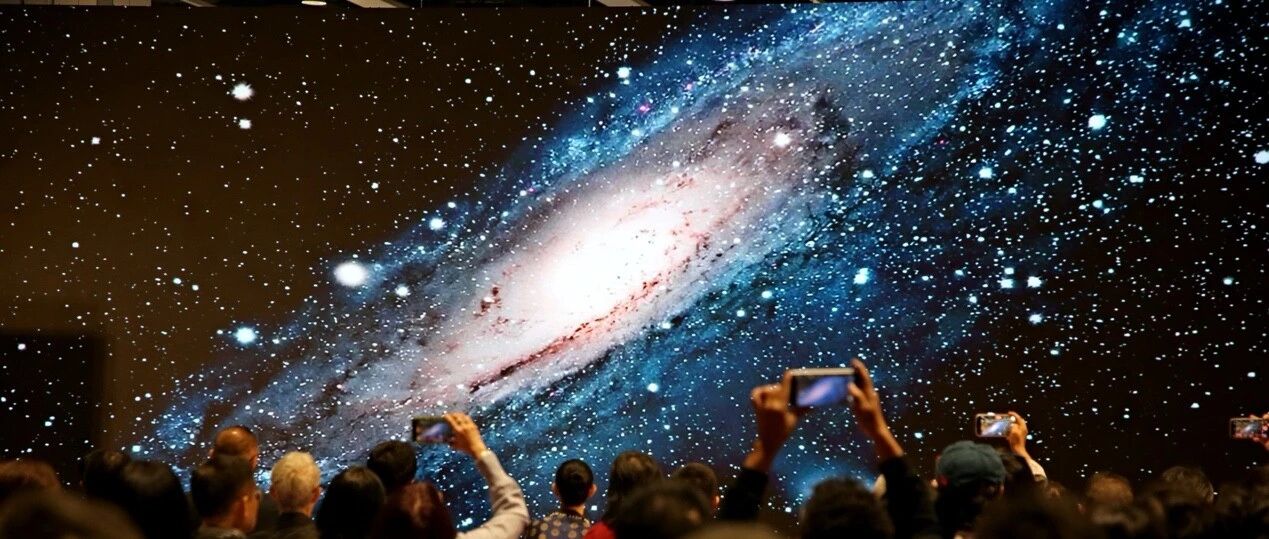
金准:科幻正打开旅游的时空尺度
Huan Qiu Wang· 2025-10-08 23:23
Core Insights - A new form of tourism is emerging, driven by science fiction, which expands the concept of travel beyond physical locations to include time and imaginative experiences [1][2] - The rise of sci-fi tourism is closely linked to the preferences of Generation Z and younger demographics, who seek immersive, interactive, and personalized experiences [2][3] - Sci-fi tourism is transforming urban landscapes and cultural identities, as seen in cities like Chengdu and Shanghai, where sci-fi attractions are becoming cultural landmarks and engines for urban development [3][4] Industry Trends - The integration of VR and AR technologies in tourism experiences is enhancing the appeal of industrial heritage sites, creating unique attractions that blend reality and virtual experiences [3] - Sci-fi tourism is evolving into a broader cultural phenomenon, moving beyond individual attractions to create an ecosystem that connects various creative industries, including film, gaming, and design [3][4] - The sustainability of the sci-fi tourism trend will depend on the ability to continuously innovate and tell compelling future-oriented stories that resonate with audiences [4][5] Market Dynamics - The sci-fi tourism sector is seen as a "infrastructure project" for future imagination, emphasizing the importance of content innovation and experience enhancement [5] - The potential for sci-fi tourism to revitalize industrial sites and contribute to new urban developments highlights its role in the broader cultural and economic landscape [3][5] - The value of imagination in the tourism industry is being recognized as a key driver for higher quality development in China's tourism sector [5]