慢时尚

Search documents
独家解析|2027春夏功能性面料色彩与材质趋势指南
Sou Hu Cai Jing· 2026-01-20 08:15
Core Insights - The Shanghai International Functional Textile Exhibition serves as a significant window for industry trends, providing insights for brand designers and material research teams [1] - The exhibition will take place on March 5-6, 2026, at the Shanghai World Expo Exhibition and Convention Center, featuring global innovative functional materials and the 2027 Spring/Summer functional fabric trend [1] Group 1: 2027 Spring/Summer Functional Fabric Trends - The 2027 Spring/Summer functional fabric trend report reveals core directions for the upcoming season, emphasizing a shift towards slow fashion and emotional connections in consumer behavior [5][11] - The trend highlights a focus on natural fibers, minimalist designs, and a balance between performance and refined texture in materials [9][15] - Applications for these fabrics include business commuting, yoga, and all-weather sports, reflecting a versatile approach to modern lifestyle needs [5][11] Group 2: Color and Material Characteristics - The color palette for the upcoming season features calming tones such as tranquil blues and earthy hues, designed to create a serene visual environment [8][15] - Materials are evolving to balance performance with aesthetic appeal, incorporating features like temperature control, moisture-wicking, and skin-friendly properties [9][18] - The trend also emphasizes the use of sustainable materials, such as recycled nylon and bio-based fibers, aligning with environmental commitments [21][26] Group 3: Design Philosophy and Consumer Behavior - The design philosophy is shifting towards a narrative-driven approach, where clothing serves as a cultural and emotional vessel, reflecting deeper connections to nature and personal stories [11][15] - Consumer behavior is moving from ownership to recognition and co-existence, seeking products that resonate with their values and lifestyles [11][15] - The integration of technology in fabrics, such as responsive fibers and smart textiles, is enhancing the functionality and appeal of sportswear [26][27]

Esprit回归Etam退出,外资女装品牌在中国市场为何作出两极选择?
Guan Cha Zhe Wang· 2025-12-07 11:03
Core Insights - The contrasting trajectories of Esprit's return and Etam's exit from the Chinese market highlight the challenges and transformations facing the fast fashion industry in China [1][8] Group 1: Esprit's Return - Esprit, after a five-year absence, has announced its return to the Chinese market, marking a significant strategic shift [1][2] - The brand plans to open flagship stores in major cities and establish a presence on major e-commerce platforms, indicating a comprehensive market re-entry strategy [2][3] - Esprit is shifting its brand positioning from "mass fast fashion" to "sustainable fashion" and "slow fashion," focusing on quality materials and design, with a higher price range targeting the mid-to-high-end market [3][4] Group 2: Etam's Exit - Etam has officially exited the Chinese market, closing its last e-commerce store, which signifies the end of its 11-year presence in the region [1][5] - The brand's decline can be attributed to stagnant design styles and increased competition from both local and international brands, leading to a significant reduction in store numbers over the years [6][7] - The shift in consumer preferences towards local brands that offer comfort and modern designs has further eroded Etam's market share [7][8] Group 3: Industry Trends - The traditional reliance on established channels and brand strategies is failing, as local consumer preferences evolve towards style expression and identity recognition [8][9] - Successful international brands in China are increasingly localizing decision-making and product development to regain growth opportunities [9]

如何改善全球纺织品行业的低循环率?六大战略场景提供可能性
Sou Hu Cai Jing· 2025-11-21 04:20
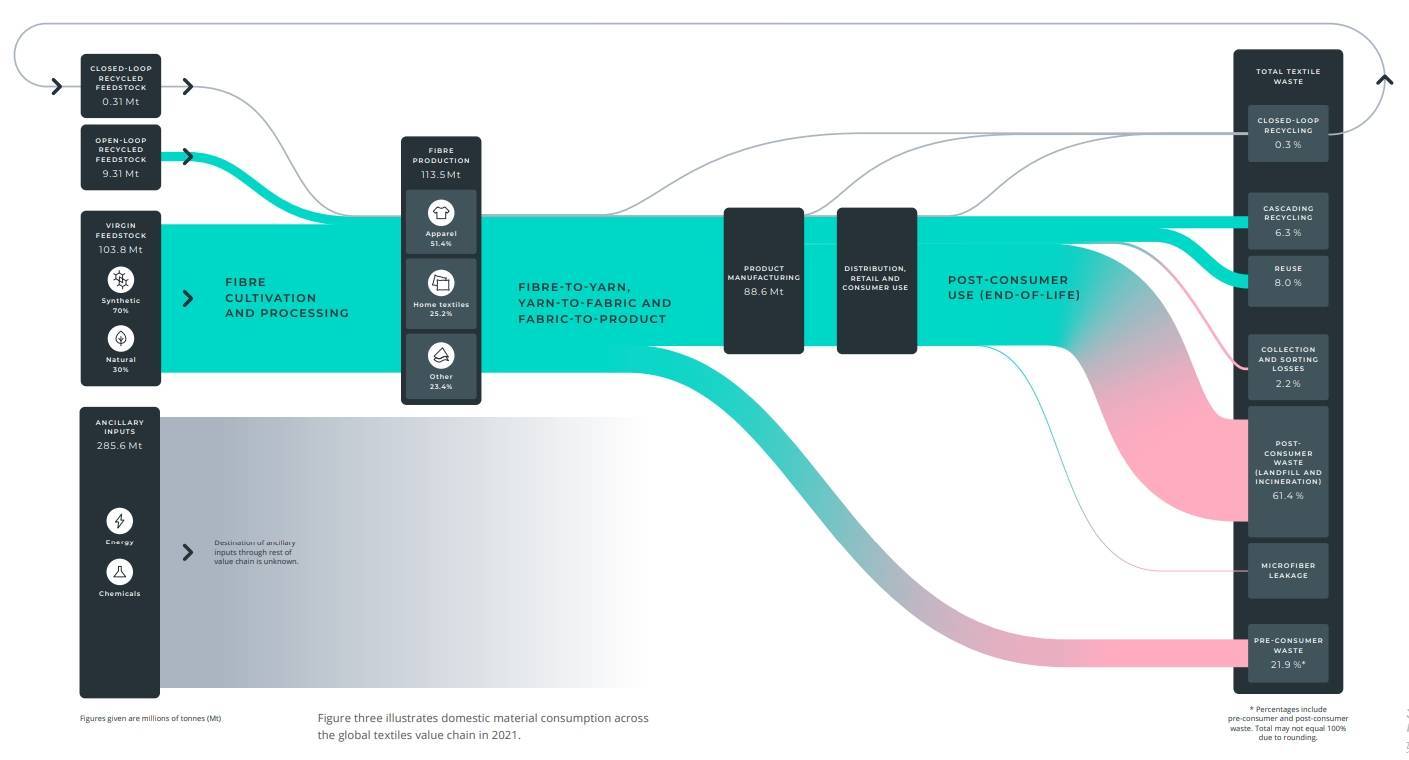
Core Insights - The Circularity Gap Report Textiles highlights the severe challenges facing the global textile industry in transitioning to a circular economy, with only 0.3% of materials used coming from recycled resources [1][4][30] - The report emphasizes the need for collaboration among manufacturers, brands, governments, and consumers to drive meaningful industry change towards circularity [1][30] Industry Overview - The textile industry, including apparel, leather, and footwear, is heavily reliant on virgin resources, with over 99% of the 3.25 billion tons of materials consumed annually sourced from non-renewable resources [4][11] - The industry predominantly follows a linear model of "take-make-dispose," leading to excessive extraction of non-renewable resources [4][30] Environmental Impact - The textile sector is a major contributor to pollution, accounting for 3.5% of global greenhouse gas emissions, with significant water consumption and pollution issues arising from various stages of the textile value chain [5][11] - Key environmental indicators analyzed in the report include water eutrophication and resource consumption, particularly in the dyeing and finishing stages, which consume approximately 93 billion cubic meters of water annually [5][11] Circular Economy Strategies - The report proposes six hypothetical scenarios for transitioning the textile industry towards a circular economy, aiming to halve its environmental impact [12][30] - Strategies include: 1. Shifting to natural, local, and recycled fibers [13] 2. Enhancing garment durability to reduce resource consumption [16] 3. Promoting sustainable production of natural fibers through regenerative agriculture [19] 4. Advocating for "slow fashion" to encourage mindful consumption [22] 5. Advancing circular manufacturing to minimize waste [25] 6. Restructuring regional supply chain dynamics to localize production [28] Collaboration and Transformation - Achieving a significant transition to circularity requires systemic change across the industry, including technological advancements, shifts in consumer behavior, and policy reforms [30][31] - The report calls for comprehensive collaboration among industry stakeholders, academia, government, and financial sectors to enhance transparency and sustainability practices [31]