成本护城河

Search documents
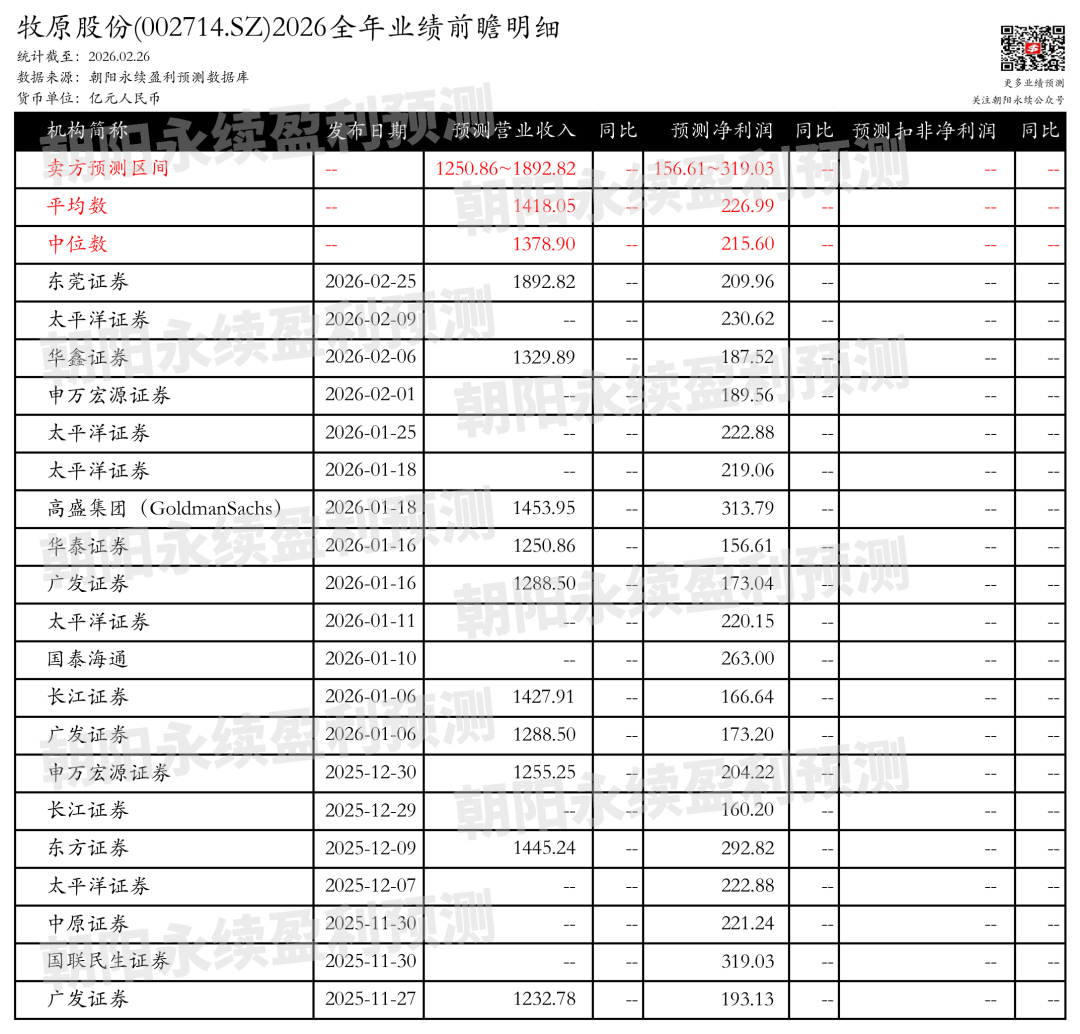
牧原股份:低成本优势与盈利增长,预测全年营业收入1250.86~1892.82亿元
Xin Lang Cai Jing· 2026-02-26 12:01
Core Viewpoint - The forecast for the operating revenue of the company is between 125.09 billion to 189.28 billion yuan, and the net profit is projected to be between 15.66 billion to 31.90 billion yuan by February 26, 2026, indicating potential for exceeding expectations in future financial disclosures [1][7]. Revenue and Profit Forecast - The predicted operating revenue range is 1250.86 to 1892.82 billion yuan, with an average forecast of 1418.05 billion yuan [2][8]. - The projected net profit range is 156.61 to 319.03 billion yuan, with an average of 226.99 billion yuan [2][8]. - The median revenue forecast is 1378.90 billion yuan, and the median net profit forecast is 215.60 billion yuan [2][8]. Company Insights - The company has established a strong cost moat through three pillars: breeding source, feed, and management, achieving 100% self-supply of breeding pigs [3][9]. - Feed costs are stabilized at 55%-60% of total costs, and the total breeding cost has been reduced to an industry-leading level of approximately 11.3 yuan per kilogram [4][9]. - Employee stock ownership and equity incentives are used to align interests and ensure strategic financing matches operational goals [4][9]. Business Expansion and Performance - The company is focusing on expanding its pig production capacity, with significant investments directed towards breeding projects across 24 provinces, establishing a slaughter capacity of approximately 30 million heads [4][9]. - The overseas market expansion strategy includes entering Vietnam through a light-asset cooperation model, enhancing management and technical capabilities [5][10]. - The slaughter business has seen a substantial increase in capacity utilization, reaching 88.1%, contributing positively to profit stability [5][11].


恒力石化第三季度盈利19.72亿元,同比增长逾8成
Zheng Quan Shi Bao Wang· 2025-10-27 11:48
Core Viewpoint - Hengli Petrochemical reported strong financial performance in Q3 2025, with a significant year-on-year profit increase despite challenging macroeconomic conditions [1][2]. Financial Performance - For the first three quarters of the year, Hengli Petrochemical achieved operating revenue of 157.384 billion yuan and a net profit attributable to shareholders of 5.023 billion yuan, with operating cash flow of 20.134 billion yuan [1]. - In Q3 alone, the company recorded a profit of 1.972 billion yuan, representing an 81.47% year-on-year increase and a substantial improvement compared to Q2 [1]. Operational Strategy - The company has maintained a leading position in the industry by flexibly adjusting its product structure and enhancing cost control in response to market changes and cost fluctuations [1][2]. - Hengli Petrochemical employs a strategy of "oil when suitable, ethylene when suitable, aromatic when suitable, and chemical when suitable," allowing it to prioritize high-margin products [2]. Industry Position and Capabilities - As one of the earliest private large-scale refining enterprises in China, Hengli Petrochemical has established a modern industrial system with integrated capacities, including a 20 million tons/year refining project and various chemical production facilities [1]. - The company has a comprehensive product layout in downstream chemical new materials, including differentiated fibers, functional films, engineering plastics, and biodegradable materials [1]. Competitive Advantages - Hengli Petrochemical possesses strategic advantages in full industry chain development, comprehensive operational capabilities, high-end R&D-driven market competitiveness, and efficient management through smart and lean practices [2]. - The company has implemented continuous cost improvements and accelerated the construction of high-value-added projects, reinforcing its cost advantage [2]. Shareholder Returns - Hengli Petrochemical is noted for its commitment to high cash dividends, having distributed a total of 26.1 billion yuan in cash dividends since its listing, which is 40.43% of the cumulative net profit during the same period [3]. - The company plans to enhance its shareholder value return mechanism, ensuring long-term, stable, and sustainable returns as profitability and cash dividend capacity improve [3].

解码巴菲特万亿财富密码:5大护城河重构投资底层逻辑
Sou Hu Cai Jing· 2025-06-25 13:40
Core Concept - Warren Buffett's wealth, exceeding $100 billion, exemplifies the ultimate practice of recognizing competitive advantages in businesses, with the "moat" theory serving as a core framework for value investing [2] Group 1: Economic Essence of Moat Theory - The moat represents a "monopolistic competition barrier" that allows companies to achieve long-term excess profits, contrasting with the traditional economic assumption of perfect competition [3] - Companies with a moat act as "micro-monopolists," leveraging differentiated competition strategies to break the diminishing marginal returns [3] - Tiffany's blue box exemplifies brand premium, where brand value and price discrimination theory combine to create a significant competitive barrier, with brand premium contribution in the luxury sector exceeding 60% [3] Group 2: Five Types of Moats - **Brand Moat**: Strong brands create cognitive monopolies, with brand loyalty increasing profits by 25%-85% for every 5% increase in loyalty [4] - **Switching Cost Moat**: High switching costs, such as those in the banking sector, create natural barriers to customer turnover, with retention rates in high switching cost industries being 3-5 times higher than in others [5] - **Network Effect Moat**: The success of platforms like Microsoft Windows illustrates the network effect, where value increases with user numbers, creating a self-reinforcing cycle [6] - **Economies of Scale Moat**: Walmart's "Everyday Low Price" strategy is based on scale economies, with logistics costs controlled at one-third of the industry average [7] - **Scale Moat**: Companies like Apple and Walmart leverage scale advantages and network effects to create high user migration costs and comprehensive cost control systems [8] Group 3: Dynamic Evolution of Moat Theory - In the digital economy, the forms of moats are evolving, with data monopolies and algorithmic advantages reshaping competitive landscapes, yet the essence remains in building sustainable competitive advantages for long-term excess profits [8] Group 4: Investment Insights - Investors should identify moats by analyzing financial statements and understanding the economic substance of competitive advantages, focusing on dimensions like brand value and cost structures [9] - Buffett's investment philosophy embodies the practice of moat theory, emphasizing the importance of finding companies with enduring moats for value growth [9]