
房屋保险

Search documents
What happened after one man’s home burned down: Insurance, loss and the emotional road to recovery
Yahoo Finance· 2026-01-22 19:36
Core Insights - The article emphasizes the importance of understanding home insurance, particularly additional living expense (ALE) coverage, which assists homeowners in temporary housing and other costs when their home becomes uninhabitable due to a covered claim [1][3][4] Group 1: Additional Living Expense (ALE) Coverage - ALE is automatically included in homeowner policies, typically covering 20% of dwelling coverage, which can significantly aid in temporary housing costs [1] - Many homeowners are unaware of how ALE works, leading to confusion and potential financial strain during recovery [8][9] - Claim payouts for ALE can vary in timing, with complex claims potentially taking longer, leaving homeowners vulnerable if they lack emergency savings [7][9] Group 2: Emotional and Financial Impact of Home Loss - The emotional toll of losing a home to fire is profound, with individuals experiencing trauma and stress that insurance cannot fully address [19][20] - Homeowners often face unexpected financial realities during recovery, including the need to replace personal belongings, which may not be fully covered by standard insurance policies [12][13] - The article highlights the importance of having financial buffers and understanding insurance coverage to navigate the aftermath of a home loss effectively [4][15] Group 3: Recommendations for Homeowners - Homeowners are advised to seek safety first and stabilize their emotional and financial situations before focusing on replacing lost items [21] - It is suggested that homeowners consider increasing their ALE coverage to better prepare for potential living expenses during recovery [10] - Understanding the nuances of personal property coverage and the claims process is crucial for homeowners to avoid financial pitfalls [12][14]
老房子“体检”很有必要
Jing Ji Ri Bao· 2026-01-04 22:11
Core Viewpoint - The implementation of mandatory housing inspections is a necessary response to the aging of urban residential buildings, with a significant increase in the proportion of buildings over 30 years old expected in the coming decades [1][2]. Group 1: Current Status and Implementation - At least 22 cities in China have initiated pilot programs for housing inspections, with a collaborative approach involving housing inspections, housing pensions, and housing insurance [1]. - By 2024, it is projected that 35% of buildings in China will be over 30 years old, potentially rising to nearly 80% by 2040, highlighting the urgency of addressing safety risks associated with aging structures [1]. Group 2: Challenges and Recommendations - The housing inspection initiative is still in the pilot phase, facing challenges such as unclear pricing mechanisms, quality standards, and a lack of professional talent and technical resources [2]. - To enhance the effectiveness of housing inspections, there is a need for unified technical standards, professional training, and encouragement of technological innovation to improve service quality [2]. Group 3: Funding and Sustainability - Sustainable funding is crucial for the success of housing inspections, with various cities exploring different funding models, including government funding, responsibility from property owners, and market mechanisms [2]. - Future efforts should focus on legalizing funding sources and standardizing usage procedures to ensure a stable and sustainable financial supply for housing inspections [2].
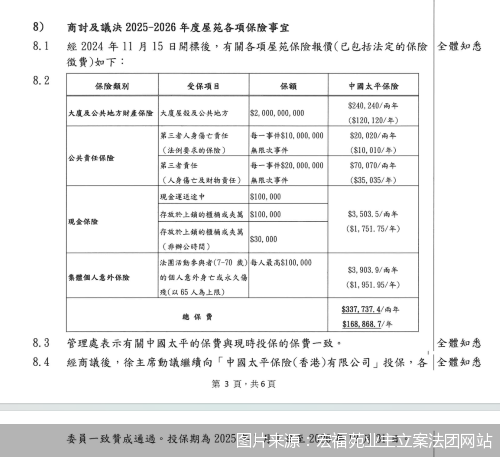
独家!大厦保额20亿港元,香港大埔火灾涉事小区曾投保房屋保险,含大厦财产险、公众责任险、现金保险和个人意外险
Bei Jing Shang Bao· 2025-11-27 05:38
Group 1 - A fire incident occurred in multiple residential buildings at Hong Kong's Hong Fu Court, resulting in significant casualties [1] - The owners' corporation discussed and approved the continuation of insurance coverage with China Taiping Insurance (Hong Kong) Co., Ltd. for the period from January 1, 2025, to December 31, 2026 [1][2] - The insurance plan includes property insurance for buildings and common areas, public liability insurance, cash insurance, and collective personal accident insurance [2] Group 2 - The property insurance for buildings and common areas has a coverage amount of HKD 2 billion, with a premium of HKD 240,240 for two years [2][4] - Public liability insurance covers third-party personal injury with a limit of HKD 10 million per event, costing HKD 20,020 for two years, and third-party liability with a limit of HKD 200 million per event, costing HKD 70,000 for two years [2][4] - The total premium for all four types of insurance amounts to HKD 337,737.4 for two years [3][4]


What is the monthly mortgage payment on a $400,000 house?
Yahoo Finance· 2024-07-09 20:31
Core Insights - Home prices have significantly increased in recent years, necessitating financial preparation for potential homebuyers [1] - Understanding monthly mortgage payments is crucial for budgeting when considering a home priced around $400,000 [2] Mortgage Payment Details - Monthly payments on a $400,000 mortgage vary based on loan term and interest rate; a 30-year mortgage at 6.25% results in approximately $2,463 monthly, while a 15-year term increases payments to about $3,430 [3][4] - Interest rates directly impact monthly payments; a 30-year mortgage at 6% results in a payment of $2,398, while a 7% rate raises it to $2,661 [5] Factors Influencing Mortgage Rates - Mortgage rates are influenced by credit scores, down payment amounts, loan types, and regional market conditions; obtaining quotes from multiple lenders is advisable [6] Additional Costs - Homeowners insurance averages $2,036 annually, or about $170 monthly, for homes valued between $400,000 and $499,999 [13] - The average property tax paid per household in the U.S. was $1,889 in 2023, with significant variations by state [14] - Private mortgage insurance (PMI) costs range from $30 to $70 per month for every $100,000 borrowed if the down payment is less than 20% [15] Financial Guidelines - The 28/36 rule suggests that no more than 28% of gross monthly income should be allocated to mortgage payments, while total debt payments should not exceed 36% [18] - A household income of approximately $87,100 may be sufficient for a $400,000 home at a 6.25% interest rate, but this figure increases to around $105,000 when accounting for insurance and taxes [19]