
扩大中等收入群体

Search documents
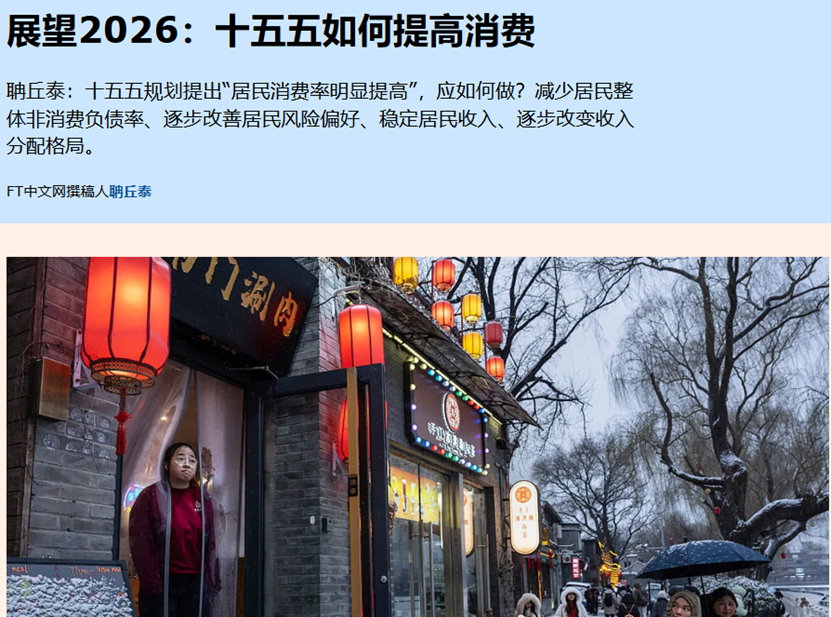
2026年国补下达首批625亿元,外媒分析该如何提高消费
Huan Qiu Wang· 2025-12-31 00:52
Group 1 - The National Development and Reform Commission and the Ministry of Finance have issued a notice regarding the implementation of a large-scale equipment update and consumer goods replacement policy in 2026, with an initial funding of 62.5 billion yuan to support the replacement of consumer goods [1] - The scope of national subsidies for home appliances has been narrowed to six categories: refrigerators, washing machines, televisions, air conditioners, computers, and water heaters, with the subsidy rate for first-level energy-efficient appliances reduced from 20% to 15%, and the maximum subsidy per appliance decreased from 2,000 yuan to 1,500 yuan [1] - New smart products such as smart glasses and smart home devices will be included in the subsidy program, while categories like home decoration and electric bicycles have been excluded [1] Group 2 - The article emphasizes the need to encourage wealthy individuals to spend more and save less, while also increasing consumer loan availability to support lower-income groups in making significant purchases based on life and career cycles [4] - It suggests that improving consumption hinges on optimizing income distribution, expanding the middle-income group, and enhancing social security, alongside implementing credit policies to reduce debt constraints [4] - Recommendations include reducing non-consumption debt, increasing credit accessibility, stabilizing income, and adjusting income distribution structures to achieve a steady increase in the consumption rate [4]

投资于人的教育向度
Xin Lang Cai Jing· 2025-12-29 20:21
Group 1 - The core viewpoint emphasizes the importance of investing in both material and human resources during the "15th Five-Year Plan" period, highlighting the need for comprehensive educational reforms to support innovation and development [1] - The "15th Five-Year Plan" aims to strengthen the foundation of education by focusing on the future, ensuring that current students are prepared to contribute to national rejuvenation [2] - Education is positioned as a key driver for social mobility, with a focus on improving the quality of employment for college graduates to expand the middle-income group [7] Group 2 - The article outlines the necessity of reinforcing the internal and external functions of education, emphasizing its role in supporting national development and technological advancement [2] - It discusses the importance of viewing Chinese education within a global context, advocating for high-level openness while promoting domestic innovation and talent cultivation [3] - The need for educational reforms to leverage technology is highlighted, with a focus on enhancing the understanding of technology among educators and students [4][6] Group 3 - The article stresses the significance of cultural confidence in education, arguing against a Western-centric view and promoting a diverse understanding of educational civilizations [4][5] - It points out that China's basic education has achieved levels comparable to high-income countries, suggesting a need to share these experiences globally [6] - The "15th Five-Year Plan" is seen as a critical period for vocational education to expand its influence and integration with industry [6][7]