
提高消费率

Search documents
陆挺建议逐渐将农民养老金上调至每月千元
经济观察报· 2026-01-23 13:58
Group 1 - The article emphasizes the importance of increasing rural pension levels to improve the income expectations of rural workers and flexible employment personnel, which can significantly stimulate consumption due to their higher marginal propensity to consume [1][2][8] - It suggests that raising the rural pension by 50 to 100 yuan per month could gradually increase the average pension level from less than 300 yuan to 1000 yuan over several years, which aligns with the goal of boosting consumption in China's macro economy [2][8] - The article highlights that the current rural pension system covers approximately 1.8 billion elderly individuals, with a significant number of rural workers and flexible employment personnel benefiting from potential increases in pension levels [8][9] Group 2 - The article discusses the government's cautious approach to stock market management, aiming to prevent it from becoming a "mad bull" while avoiding sharp declines, which has been effective in maintaining market stability [2][4] - It notes that the government has not introduced a stimulus policy comparable to the "924" moment in 2025, primarily due to a favorable stock market performance, which serves as a lesson from past experiences [4][5] - The article anticipates that the real estate sector may experience a "924 moment" in the near future, indicating a potential policy shift to stimulate the market [4][5] Group 3 - The article mentions that the central government's financial support for rural pensions is projected to exceed that for enterprise employee pensions and civil servant pensions within two years if the monthly increase is set at 100 yuan [8][9] - It points out the disparity in local financial support for rural pensions, with some regions providing significantly higher subsidies than others, suggesting that central government intervention is necessary to ensure equitable pension increases [9] - The article argues that enhancing the rural pension system is crucial for transitioning from a middle-income to a middle-developed country, marking the next two to three years as a critical period for social security reform in China [9]


2026年国补下达首批625亿元,外媒分析该如何提高消费
Huan Qiu Wang· 2025-12-31 00:52
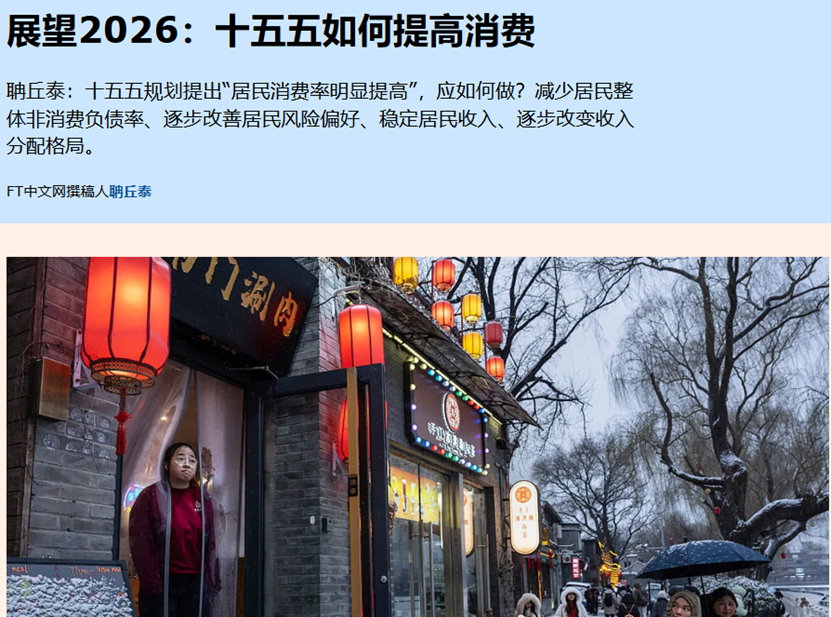
Group 1 - The National Development and Reform Commission and the Ministry of Finance have issued a notice regarding the implementation of a large-scale equipment update and consumer goods replacement policy in 2026, with an initial funding of 62.5 billion yuan to support the replacement of consumer goods [1] - The scope of national subsidies for home appliances has been narrowed to six categories: refrigerators, washing machines, televisions, air conditioners, computers, and water heaters, with the subsidy rate for first-level energy-efficient appliances reduced from 20% to 15%, and the maximum subsidy per appliance decreased from 2,000 yuan to 1,500 yuan [1] - New smart products such as smart glasses and smart home devices will be included in the subsidy program, while categories like home decoration and electric bicycles have been excluded [1] Group 2 - The article emphasizes the need to encourage wealthy individuals to spend more and save less, while also increasing consumer loan availability to support lower-income groups in making significant purchases based on life and career cycles [4] - It suggests that improving consumption hinges on optimizing income distribution, expanding the middle-income group, and enhancing social security, alongside implementing credit policies to reduce debt constraints [4] - Recommendations include reducing non-consumption debt, increasing credit accessibility, stabilizing income, and adjusting income distribution structures to achieve a steady increase in the consumption rate [4]
“十五五”规划系列报告(八):提高消费率:“口径”的意义
Minsheng Securities· 2025-11-08 08:20
Group 1: Importance of Improving Consumption Statistics - Improving consumption statistics is crucial for accurately observing the resident consumption rate and guiding policy direction[1] - Recent efforts have been made to enhance consumption statistics, including the release of service retail data in August 2023[1] - The government has initiated actions to improve comprehensive consumption statistics, aiming for a more targeted approach in stimulating consumption[1] Group 2: Comparison with Other Economies - Comparing consumption statistics between China and the U.S. reveals significant differences, with U.S. residents' per capita consumption approximately ten times that of China[1] - The U.S. enjoys a price advantage in consumer price index (CPI) compared to China's overall price levels, affecting consumption rates[2] - Service consumption in China is a major bottleneck, with only 46.1% of consumption expenditure allocated to services compared to 68.5% in the U.S.[20] Group 3: Statistical Methodology Challenges - China's statistical methods for financial services and insurance are inadequate, leading to underreported service consumption[22] - The narrow scope of service consumption statistics in China fails to capture the full value of public service subsidies, affecting data comparability[25] - The transition from depreciation cost method to market-based virtual rent method for housing services in 2023 aims to better reflect actual consumption value[26] Group 4: Risks and Considerations - There are risks associated with discrepancies between service consumption data and actual figures, potentially affecting policy effectiveness[31] - The progress of improving consumption statistics may not align with expectations, complicating efforts to enhance consumption rates[31] - Achieving higher consumption rates requires not only improved statistics but also policies that enhance consumer willingness and capacity[31]