
扫码检查

Search documents
新疆乌苏市市场监管局开展“四大安全”冬季百日整治 筑牢冬季安全防线
Zhong Guo Shi Pin Wang· 2025-12-26 09:35
Core Viewpoint - The Xinjiang Uygur Autonomous Region's Wusu City Market Supervision Administration is implementing a comprehensive winter safety campaign to address safety risks during the cold season and the upcoming New Year and Spring Festival consumption peaks [1] Group 1: Safety Campaign Overview - The campaign is named "Four Major Safety" winter hundred-day concentrated rectification action, focusing on ensuring public safety during the winter season [1] - The administration employs a collaborative approach involving various departments and utilizes QR code inspections as a primary method for risk assessment and data entry [1] Group 2: Focus Areas of Rectification - The campaign emphasizes four key safety areas: food safety, drug and cosmetic safety, industrial product quality safety, and special equipment safety [2] - Food safety inspections target critical production stages of key food items such as edible oils, meat products, and dairy products, with a focus on raw material control and storage conditions [2] - Drug and cosmetic safety measures include strict checks on special drugs, Chinese herbal medicines, and medical device storage and usage, ensuring compliance with temperature and humidity controls [2] - Industrial product quality safety focuses on hazardous chemicals, electric bicycles, fire safety products, and fireworks, with a crackdown on illegal production and counterfeit goods [2] - Special equipment safety inspections prioritize elevators, heating boilers, pressure vessels, and other machinery, ensuring that operators fulfill their responsibilities and enhance emergency preparedness [2]
北京55万户信用好、低风险企业纳入“无事不扰”清单
Xin Jing Bao· 2025-12-18 10:41
Group 1 - The Beijing Municipal Market Supervision Administration aims to create a safe, convenient, and international consumption environment through reforms and innovative regulatory methods [1][2] - A total of 550,000 low-risk and creditworthy enterprises have been included in the "no disturbance" list to minimize on-site inspections [1][2] - The administration has simplified licensing requirements for food service in cultural and tourism venues, providing fast-track processing for 304 such establishments [1] Group 2 - A bilingual version of the "Foreign Investment Company Registration Guide" has been launched, enhancing transparency and convenience for cross-border investments [1] - The food safety regulatory standard system has been improved, with local standards released for various sectors including school canteens and food production [2] - The implementation of a "one code per elevator" smart supervision system for 322,000 elevators has been completed, with plans for real-time updates and risk prevention for other key special equipment by the end of the year [2]
5000余户失信企业被移出“无事不扰”清单
Bei Jing Shang Bao· 2025-12-11 08:37
Core Viewpoint - Beijing has focused on optimizing the business environment over the past five years, implementing various reforms to create a stable, transparent, and predictable legal business environment [1] Group 1: Reform Measures - The city has introduced innovative measures such as non-site supervision, "scan check," and a "no disturbance" enterprise list to enhance the business environment [1] - A total of 550,000 low-risk and creditworthy enterprises have been included in the "no disturbance" list, significantly reducing on-site inspections except for specific circumstances like complaints [1] Group 2: Regulatory Framework - The regulatory approach is centered on graded and classified supervision, strengthening the role of credit incentives and constraints [1] - Over 5,000 enterprises that violated trust commitments or engaged in illegal activities have been removed from the list and subjected to enhanced supervision [1]
新疆乌苏市市场监管局构建“党建+监管”融合模式 以数字化手段破局传统监管难题
Zhong Guo Shi Pin Wang· 2025-06-20 13:44
Core Insights - The Xinjiang Uygur Autonomous Region's Urumqi City Market Supervision Bureau is integrating "red gene" into smart regulatory practices, creating a "Party Building + Regulation" model to address traditional regulatory challenges through digital means [1][2] - The implementation of a "QR code inspection" model has significantly reduced the time and resources required for businesses to prepare for inspections, allowing for a more efficient regulatory process [1] - The use of the "Tatongban Smart Regulation Platform" has transformed traditional regulatory methods by enabling real-time data uploads and automatic aggregation, enhancing the accuracy and speed of regulatory responses [1] Group 1 - The shift from "being overwhelmed" to "lightly equipped" has been achieved by generating unique QR codes for 3,281 businesses, integrating essential information such as business licenses and permits [1] - The transition from "manpower tactics" to "intelligent empowerment" has led to a reduction of over 50% in inspection duration, with real-time data entry and analysis improving regulatory precision [1] - The system utilizes big data for intelligent analysis of illegal activities, allowing for precise identification of high-risk enterprises and facilitating joint punishment across multiple departments [1] Group 2 - The move from "information barriers" to "shared governance" allows citizens to easily access merchant qualifications, credit ratings, inspection results, and enforcement personnel information through QR codes [2] - The "QR code inspection" not only represents a technological innovation but also signifies a conceptual shift in regulation, enhancing service quality and optimizing the business environment [2] - This digital approach aims to ensure efficient market regulation under "sunshine" conditions, reinforcing safety measures for high-quality development [2]
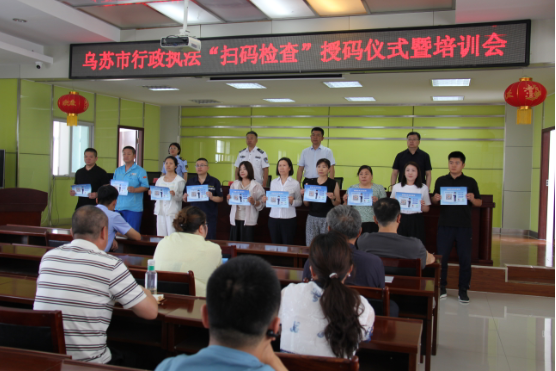
新疆乌苏市召开行政执法“扫码检查”授码仪式暨培训会
Zhong Guo Shi Pin Wang· 2025-06-05 01:40
Core Points - The implementation of "QR code inspection" in Urumqi City aims to enhance regulatory efficiency and transparency in administrative enforcement [1][3][5] - The initiative is part of broader reforms to optimize the business environment and improve the commercial regulatory system [3][5][6] Group 1: Implementation Details - The "QR code inspection" requires administrative enforcement departments to scan a unique QR code for each enterprise before conducting inspections, ensuring information verification and documentation throughout the process [5][6] - The program is designed to promote a new regulatory mechanism through information technology, enabling quick risk identification and ensuring fair competition [5][6] Group 2: Training and Awareness - A training session was held to educate participants on the scope, operational norms, and exceptions of the "QR code inspection" [3][6] - The initiative will initially focus on sectors such as pharmaceuticals, special equipment, and standard measurement, with plans to expand to over 3,000 enterprises in the city [6]

额敏县积极推动“扫码检查”授码工作 开启智慧监管新征程
Zhong Guo Shi Pin Wang· 2025-05-30 10:50
Core Points - The core initiative of E'min County is the implementation of a "QR Code Inspection" system aimed at enhancing market supervision efficiency and reducing the burden on enterprises [1][2] Group 1: Implementation of QR Code Inspection - E'min County's market supervision bureau held a ceremony to launch the "QR Code Inspection" system, with over 300 business leaders and individual entrepreneurs in attendance [1] - The "QR Code Inspection" mechanism utilizes modern technologies such as big data and cloud computing, allowing for quick access to electronic licenses and credit records through a smartphone and a QR code [1][2] - This initiative is expected to benefit 1,200 enterprises in the county, marking a significant step towards digital and intelligent market regulation [1] Group 2: Benefits and Innovations - The "QR Code Inspection" system aims to improve the standardization, normalization, and digitization of market supervision, addressing the inefficiencies of traditional inspection methods [1] - Representatives from local businesses highlighted the advantages of the system, including transparency in inspection standards and reduced costs associated with compliance [2] - The initiative represents not only a technological innovation but also a shift in regulatory philosophy, promoting collaboration between government and businesses for mutual benefits [2]