
投机性资产

Search documents
“大空头”Burry:已经暴跌40%,若比特币再跌10%,将引发“灾难后果”
Hua Er Jie Jian Wen· 2026-02-04 01:01
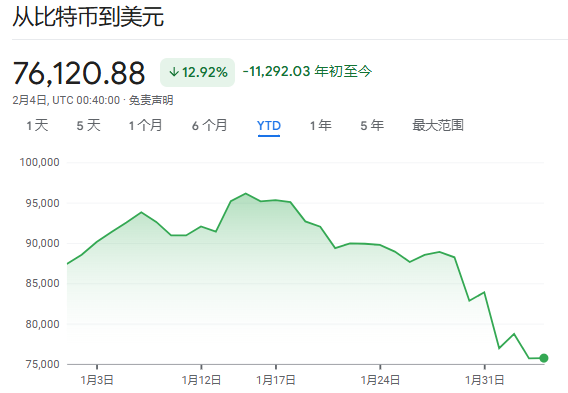
Core Viewpoint - Michael Burry warns that Bitcoin has fallen 40% and further declines could cause lasting damage to companies that heavily invested in it, indicating that Bitcoin has proven to be a speculative asset rather than a hedge like precious metals [1][5][9] Group 1: Bitcoin's Market Performance - Bitcoin has dropped over 40% since reaching an all-time high in early October, recently falling below $73,000, erasing all gains since Trump's re-election in November 2024 [1][5] - The market capitalization of Bitcoin is less than $1.5 trillion, with limited household ownership and narrow corporate adoption, suggesting any wealth effect may remain contained [4] Group 2: Corporate Exposure and Risks - Nearly 200 publicly traded companies hold Bitcoin, and Burry warns that if Bitcoin drops another 10%, one of the most aggressive holders, Strategy Inc., could face billions in losses and find itself effectively shut out of capital markets [6][7] - Burry emphasizes that inventory assets must be marked to market and included in financial reports, leading risk managers to potentially recommend selling if prices continue to decline [7] Group 3: Speculative Nature and Market Correlation - The emergence of spot ETFs has intensified Bitcoin's speculative nature and increased its correlation with the stock market, with recent correlations with the S&P 500 nearing 0.50 [8] - Since late November, Bitcoin ETFs have recorded significant daily outflows, indicating a decline in institutional investor confidence [8] Group 4: Broader Market Implications - Burry warns that the decline in Bitcoin could have broader market implications, contributing to recent downturns in gold and silver as financial executives and speculators may need to sell tokenized metal futures to mitigate risks [9] - He highlights the risk of a "collateral death spiral" in tokenized metal futures, which are not backed by physical metals, potentially overwhelming physical metal trading [9]

黄金走势处于负值区间 金价跌势仍在延续
Jin Tou Wang· 2026-02-02 06:04
Group 1 - The core viewpoint of the articles indicates that gold prices are experiencing significant volatility, with a notable drop following the nomination of a new Federal Reserve Chair, which has strengthened the US dollar and led to a record single-day decline in gold prices since 1983 [1][2] - Analysts suggest that the recent surge in gold prices, which increased by 24% in January, was followed by a substantial correction, indicating that the market remains volatile and investors should exercise caution [2][3] - The long-term outlook for gold remains positive, with key support levels identified above the 100-day EMA, suggesting potential upward movement despite short-term fluctuations [3] Group 2 - The nomination of Walsh as the next Fed Chair may have limited immediate impact on interest rate cuts but could lead to adjustments in dollar liquidity expectations, affecting speculative assets [1] - The market is currently observing a significant resistance level at $4,885, with potential upward targets towards $5,000, while the first downside target is set at $4,620 [3] - The articles emphasize the importance of monitoring key trend lines and resistance levels, as they will influence future price movements in the gold market [2][3]
国际清算银行警告:散户正将黄金和美股推向“泡沫区域”
Hua Er Jie Jian Wen· 2025-12-08 14:22
Group 1 - The International Bank for Settlements (BIS) warns that retail investors are shifting gold from a traditional safe-haven asset to a speculative asset, marking a simultaneous entry into an "explosive zone" for both gold and stock markets for the first time in at least 50 years [1][2] - Gold prices have increased by approximately 20% since early September, moving in tandem with high-risk assets, which deviates from its historical role as a safe-haven asset [1][2] - BIS emphasizes that the current market dynamics, where both gold and stock markets are in an "explosive zone," pose higher systemic risks, as a correction in one market could trigger a chain reaction affecting overall market stability [2][3] Group 2 - The surge in gold prices is partly attributed to "trend-chasing investors" capitalizing on media hype surrounding gold, fundamentally altering its trading patterns [2] - The recent rise in risk appetite, driven by expectations of interest rate cuts, has alleviated concerns about economic slowdown, facilitating retail capital inflow into the gold market [2] - BIS notes that the oversupply of government bonds, resulting from significant debt issuance by developed economies, has led to a reversal of typical yield spreads, indicating structural pressures even in the safest government bond markets [3]