投资者情绪指标

Search documents
读研报 | “连阳”之下的关切
中泰证券资管· 2026-01-13 11:33
Core Viewpoint - The recent surge in A-shares is attributed to a combination of market sentiment and capital inflow, with expectations for continued upward movement in 2026 [1][2][4] Group 1: Market Dynamics - The phenomenon of a strong start in 2026 is not unique to A-shares, as global markets have also experienced robust beginnings due to factors like liquidity expectations and geopolitical changes [2] - Reports indicate that the influx of capital at the beginning of the year was driven by investors fearing to miss out on potential gains, leading to a rapid increase in market participation [1][2] Group 2: Economic Indicators - Economic indicators show improvement, with the PMI rising above the threshold in December 2025, signaling better production and demand conditions [2] - December 2025 inflation data revealed a CPI increase of 0.8% year-on-year, while PPI showed a narrowing decline, indicating a potential recovery in prices [2] Group 3: Investor Sentiment - Investor sentiment has surged, with an emotional index reaching a new high of 98.1 on January 9, 2026, indicating a state of euphoria in the market [4] - The trading volume of small-cap stocks has reached historically high levels, suggesting heightened speculative activity among investors [4] Group 4: Investment Strategy - Individual investors are encouraged to adopt a more measured approach, as they do not face the same pressures as institutional investors to outperform quickly [4] - The focus should be on long-term investment strategies rather than short-term gains, aligning with the goal of achieving steady returns [4]


市场情绪“接近狂热” 美股小盘股涨势亮红灯
Zhi Tong Cai Jing· 2025-07-07 11:19
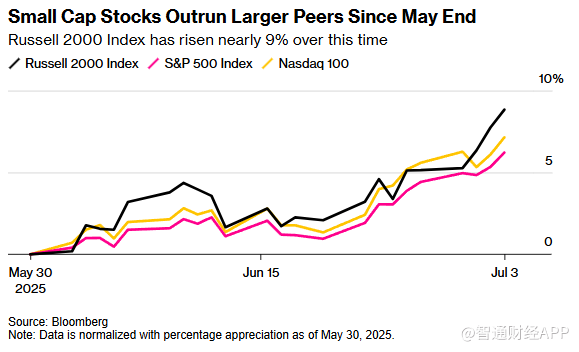
Core Viewpoint - The U.S. stock market shows signs of overheating, indicating that the recent rally in high-risk small-cap stocks may soon lose momentum as investor sentiment shifts from panic to near-euphoria [1] Group 1: Market Performance - The S&P 500 index has surged to a historical high over the past month, with small-cap stocks outperforming large-cap stocks [1][2] - Bloomberg Intelligence's investor sentiment indicator shifted from panic in April to near-euphoria in June, suggesting that when this indicator reaches euphoric levels, small-cap stocks tend to underperform large-cap stocks [1] - Historical data from 2012 to 2023 shows that when the sentiment indicator reaches euphoric levels, the S&P 500 outperformed the Russell 2000 index by 178 basis points over the following three months [1] Group 2: Small-Cap Stocks Dynamics - Small-cap stocks are generally viewed as cyclical stocks that perform well in the early stages of market uptrends but are sold off during downturns [4] - The recent example of small-cap performance occurred after President Trump's second term began, where the sentiment indicator reached extreme levels, leading to a 7.8% decline in the S&P 500 and a 14% drop in the Russell 2000 over the next three months [4] - Despite the recent resilience in both large-cap and small-cap stocks, there are concerns about the sustainability of small-cap strength [5] Group 3: Economic Indicators and Strategy - Small-cap stocks are considered important leading indicators, typically declining first during economic turmoil and recovering first after a downturn [5] - The Russell 2000 index recently broke through its long-term trading range, suggesting potential for further gains [5] - Analysts recommend maintaining long positions in small-cap stocks due to stable economic growth forecasts and a favorable financial environment [5] Group 4: Large-Cap Stocks Outlook - As key deadlines for tariff negotiations approach, some strategists advise focusing on larger companies with stronger balance sheets and profitability [6] - Barclays strategist Venu Krishna believes that despite potential double-digit earnings growth for small-cap stocks due to tax reforms, the fundamentals do not support a shift from large-cap to small-cap stocks [6] - Large-cap companies are expected to benefit more from macro growth drivers like artificial intelligence, with improving earnings expectations and stronger profit margins [6]