抗跌

Search documents
基底回撤末期的两种关键信号
猛兽派选股· 2026-03-27 03:44
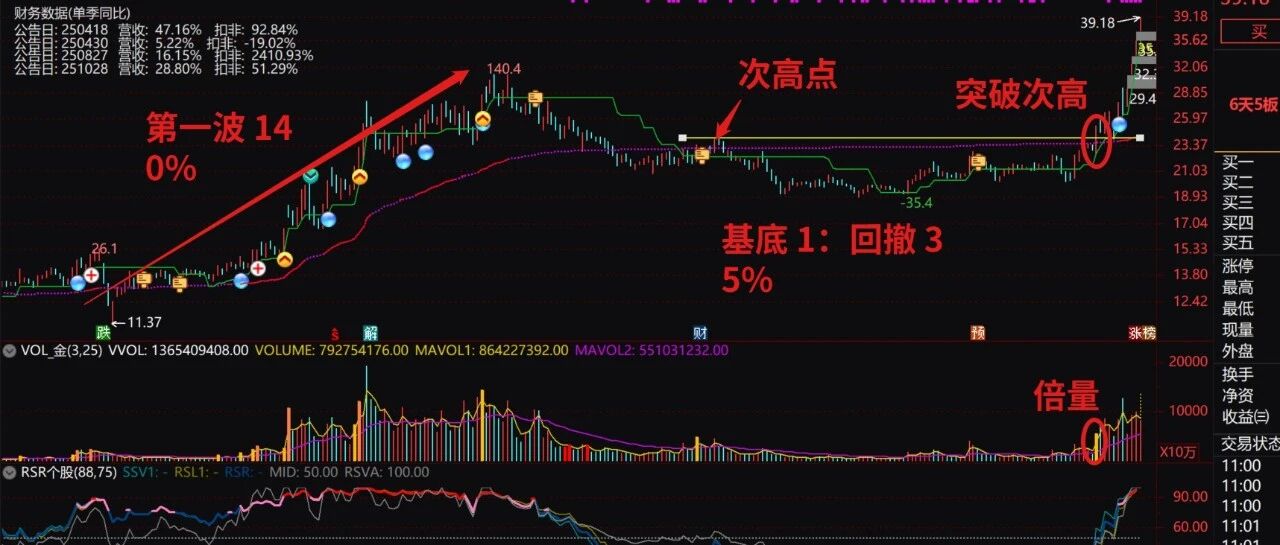
Group 1 - The end of a bear market and the end of a base pullback are good times to identify new leading industries and stocks [1] - New leading industries and stocks showing unusual movements also serve as important indicators of the end of a bear market and base [1] - The current bull market's significant stocks, which have increased over 10 times, started to gain momentum after April last year [1] Group 2 - Meinohua is a quality company in the second tier of the CDMO industry, with progress on oral weight loss drug projects and volume growth from centralized procurement [3] - The market's choice of Meinohua as a second wave target may also consider factors like market capitalization [3] - The main targets in the innovative drug sector are tracked separately, with pivotal signals identifiable through stock screening tools [3] Group 3 - The base construction has lasted for six months, with a maximum pullback of 23%, and the volume-price relationship has normalized in the latter half of the base [5] - The company's price-to-earnings and price-to-book ratios remain low, while profit growth is still high [5] - The overall logic of innovative drugs has not changed, and after a period of dormancy, a resurgence is possible [5]

金融破段子 | 红利的“人设”与本质
中泰证券资管· 2026-01-26 11:32
Core Viewpoint - The article discusses the shift in perception of dividend assets from a stable investment to a less appealing option in the context of a rising market driven by technology and AI, leading to feelings of dissatisfaction among investors holding these assets [2][4]. Group 1: Investment Motivation - Investors initially turned to dividend assets for their relative stability and income generation during market volatility, particularly around 2022 [4]. - The perception of dividend assets as a safe haven was reinforced by their performance during turbulent market conditions, contrasting with the fluctuations of other sectors [4]. Group 2: Performance Comparison - A comparison of the performance of the CSI Dividend All-Return Index against major indices over the past decade reveals periods of underperformance, including years where it declined significantly, such as a drop of over 15% in 2017 [5][6]. - The annual performance data shows that the CSI Dividend All-Return Index had a total return of 96.47% over ten years, while other indices like the CSI 300 All-Return Index and the ChiNext Index had returns of 56.49% and 26.92%, respectively [5]. Group 3: Investment Strategy - The essence of dividend investing lies in acquiring high-dividend stocks at reasonable prices and reinvesting dividends to enhance long-term returns, rather than expecting consistent outperformance [6][7]. - Understanding and accepting the underlying logic of dividend investment is crucial for investors to remain committed during market fluctuations, rather than being swayed by short-term comparisons [7].

房地产集体卷豪宅“回血”,但富人也不够用了
Sou Hu Cai Jing· 2025-12-16 10:11
Core Insights - The luxury real estate market in Shanghai has shown significant resilience and growth, with transactions of luxury properties priced over 10 million yuan increasing by 21% year-on-year in the first half of 2025, compared to a mere 5% increase in ordinary new homes [2][17] - The majority of this growth is concentrated in Shanghai, where 80% of luxury homes sold for over 50 million yuan are located, and 15 out of 19 properties sold for over 100 million yuan nationwide are also in Shanghai [2][17] - The luxury market is evolving, with some buyers viewing luxury homes as consumables rather than investments, while others are opting to rent instead of purchase, indicating a shift in buyer sentiment [2][19] Market Dynamics - The luxury market has seen a surge in demand, with high-profile projects like the "Cuihu Huating" selling out quickly, indicating a strong appetite among wealthy buyers [4][10] - New luxury developments are emerging in previously limited supply areas, with a notable increase in new luxury homes being marketed as "pre-sale" properties [6][8] - The introduction of a points-based lottery system for new home purchases has created a competitive environment, further driving demand for luxury properties [9][10] Buyer Behavior - Wealthy buyers are increasingly viewing luxury homes as a means of asset allocation, with many opting for larger units to accommodate family needs, reflecting changing lifestyle preferences [10][11] - The perception of luxury homes is shifting, with some buyers now considering them as depreciating assets rather than purely investment vehicles, leading to a more cautious approach in purchasing [22][48] - The market is witnessing a diversification of buyers, with a significant proportion of non-local buyers, particularly from Zhejiang and Jiangsu provinces, becoming key players in the luxury segment [33] Supply and Pricing Trends - The supply of luxury homes is increasing, with a notable rise in projects priced above 10 million yuan, leading to a more competitive market environment [54] - The average price for high-end residential properties in Shanghai has reached record levels, with some areas seeing prices as high as 24.32 million yuan per square meter [17][39] - The traditional price premium of second-hand luxury homes over new builds is diminishing, as new luxury properties are now being offered at competitive prices [50][52] Developer Strategies - Developers are adapting to market changes by offering more flexible financing options and reducing entry barriers for buyers, indicating a shift in strategy to stimulate sales [52] - The competitive landscape among developers is intensifying, with major players like Greenland and China Overseas actively acquiring prime land parcels to bolster their luxury offerings [39][40] - The luxury market is becoming increasingly segmented, with a clear hierarchy emerging based on location and property features, influencing buyer preferences and pricing strategies [27][30]