振兴东北老工业基地

Search documents
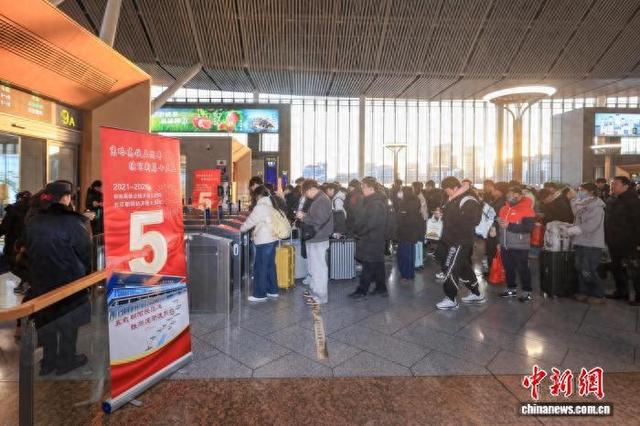
数说京哈高铁五周年
Xin Lang Cai Jing· 2026-01-22 15:07
Core Insights - The Beijing-Harbin High-Speed Railway (京哈高铁) has celebrated its fifth anniversary since full operation, with a total of 210 million passengers expected to be transported from January 22, 2021, to January 22, 2026 [1][3] Group 1: Operational Growth - The railway's capacity has expanded from an initial 12 pairs of trains to 88.5 pairs by the end of 2025 [3] - Passenger numbers have consistently increased, surpassing 5 million in its first operational year within the Beijing-Tianjin-Hebei region [3] - Daily average passenger numbers grew from 12,400 to 30,700 over five years, with a peak of over 100,000 passengers on October 1, 2025 [5] Group 2: Network Expansion - The railway has continuously expanded its service, adding cities such as Qiqihar, Hunchun, and Dalian to its network [7] - The introduction of direct high-speed train services has improved connectivity between major cities, including the first direct service from Shijiazhuang to Chengde [7] - The network now covers the entire Northeast region and connects with the Beijing-Tianjin-Hebei area, enhancing regional transportation [7] Group 3: Service Enhancements - The railway has upgraded both its hardware and service quality, focusing on passenger needs, including specialized services for mothers, the elderly, and other key travelers [7] - The CR400BF-GS model trains used can withstand temperatures as low as -40°C, ensuring safe winter operations [7] - The service philosophy emphasizes a balance of speed and warmth, enhancing the overall travel experience [7]

紫金矿业创始人陈景河,发表退休感言!
券商中国· 2026-01-01 15:41
Core Viewpoint - The retirement of Chen Jinghe, founder and honorary chairman of Zijin Mining, marks the end of a 44-year career in the mining industry, reflecting on the company's growth and achievements during his tenure [1][3][4]. Company Overview - Zijin Mining was founded in 1993 and has transformed from a small county enterprise into a global leader in metal mining, with a market value exceeding 900 billion RMB and ranking among the top three metal mining companies worldwide [4][5]. - The company has expanded its operations globally, with significant resources and profits from overseas projects, surpassing domestic performance [4]. Leadership Transition - On December 31, 2025, the company elected Zou Laichang as the new chairman and Lin Hongfu as vice chairman, both of whom have been with the company for many years and are seen as capable successors [1][5]. Financial Performance - Zijin Mining announced a significant increase in its 2025 net profit, projected to be between 51 billion and 52 billion RMB, representing a year-on-year increase of 59% to 62%. The non-GAAP net profit is expected to be around 47.5 billion to 48.5 billion RMB, up 50% to 53% year-on-year [1]. - The increase in profits is attributed to higher production volumes and rising sales prices of key minerals such as gold, copper, and silver [1]. Production Plans - For 2026, Zijin Mining has set ambitious production targets, including 105 tons of gold, 120,000 tons of copper, 12,000 tons of lithium carbonate equivalent, and 520 tons of silver [1].


不出意外,中国未来一半人口将流入这几个城市,房价将报复性反弹
Sou Hu Cai Jing· 2025-04-23 01:13
Core Viewpoint - The article discusses the potential for a rebound in housing prices in major Chinese city clusters due to population inflows, especially in the context of a declining overall population trend in China [1][3]. Group 1: Major City Clusters - The Beijing-Tianjin-Hebei city cluster is expected to see strong housing price support due to its status as China's political and cultural center, along with its rich technological resources and top-tier educational institutions [3]. - The Yangtze River Delta city cluster, contributing to a quarter of China's economic output, is anticipated to experience increased population concentration and sustained housing demand as regional integration progresses [4]. - The Pearl River Delta, now part of the Guangdong-Hong Kong-Macau Greater Bay Area, is projected to attract more population and capital, bolstered by its economic strength and government planning [5]. - The Chengdu-Chongqing city cluster aims to transition into a world-class city cluster by 2030, enhancing its population aggregation and economic significance [6]. - The Central Plains city cluster, with Zhengzhou as a pivotal city, is positioned to facilitate industrial transfers and regional development, potentially leading to significant growth [7]. - The Liaoning Central South city cluster is recovering economically and is expected to become a key area for population and resource aggregation in Northeast China [8]. Group 2: Global Context and Implications - The article draws parallels with global urban agglomerations, highlighting that similar population concentration trends have led to housing market pressures and rising prices in developed countries [10]. - It suggests that over half of China's population may converge in these major city clusters, indicating a significant opportunity for investment in real estate within these areas [10]. - The article encourages proactive investment in these core cities, emphasizing the potential for substantial returns as these urban clusters continue to develop [10].