
政府股权投资

Search documents
特朗普政府股权投资风暴:10家企业被“收编”
Jin Shi Shu Ju· 2026-02-09 03:14
Core Viewpoint - The Trump administration has made unprecedented equity investments in at least 10 companies, primarily in critical minerals, with a strategy to support domestic supply chains and potentially expand investments in sectors like chip manufacturing and nuclear reactors [1]. Group 1: U.S. Steel - The Trump administration acquired a "golden share" in U.S. Steel, granting veto power over key business decisions without direct economic equity [1][2]. - This golden share allows the government to block decisions such as closing or relocating plants and changing the company's name [2]. Group 2: MP Materials - MP Materials operates the only commercial rare earth mine in the U.S. and has a market capitalization exceeding $10 billion [3]. - The U.S. Department of Defense agreed to a landmark deal involving a $400 million preferred stock purchase, potentially making it the largest single shareholder with a 15% stake [3]. Group 3: Intel - The U.S. Department of Commerce purchased 433.3 million shares of Intel at $20.47 per share, acquiring a 10% stake funded by government grants [4]. - The shares acquired do not carry voting rights or governance rights [4]. Group 4: Lithium Americas - Lithium Americas is a startup planning to develop a lithium mine in Nevada and has received a debt repayment deferral from the Department of Energy in exchange for equity [5]. - The government aims to mitigate taxpayer risk by acquiring a small equity stake [5]. Group 5: Trilogy Metals - Trilogy Metals is another startup focused on mining in Alaska, with the government investing $35.6 million for a 10% equity stake and additional warrants for more shares [6]. Group 6: USA Rare Earth - USA Rare Earth is developing a magnet manufacturing facility and has received a $1.3 billion loan offer from the Department of Commerce in exchange for equity [7]. - The government could hold between 8% to 16% of the company depending on warrant exercise [7]. Group 7: Westinghouse - Westinghouse, a private nuclear reactor developer, received funding for an $80 billion nuclear power plant project, with the government acquiring participation rights [8]. - The government may become an 8% shareholder if the company's value exceeds $30 billion [8]. Group 8: Vulcan Elements - Vulcan Elements is establishing a domestic rare earth magnet supply chain and has secured $6.2 billion in loans and incentives from the government [9]. - The Department of Commerce will receive a $50 million equity investment and the Department of Defense will obtain warrants [9]. Group 9: XLight - XLight is developing free-electron lasers for semiconductor manufacturing and has been offered up to $150 million in federal incentives in exchange for equity [10]. Group 10: L3 Harris Technologies - L3 Harris Technologies, valued over $65 billion, announced a partnership with the government for a $1 billion investment in its missile systems [12]. - The investment will convert into common stock during an anticipated IPO in late 2026 [12].
特朗普政府要入股开发格陵兰稀土矿公司?白宫官员否认
Hua Er Jie Jian Wen· 2025-10-06 17:23
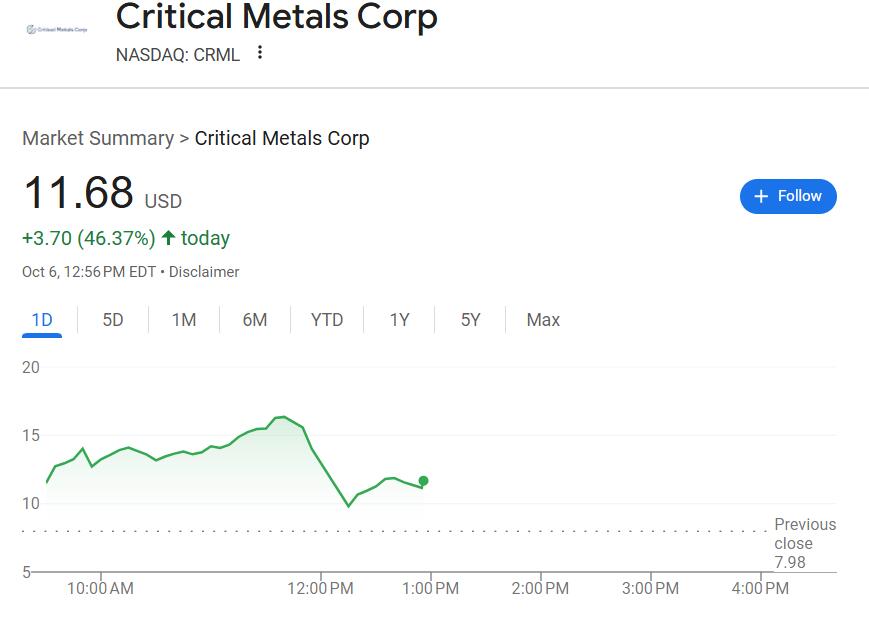
Core Insights - The Trump administration was reportedly considering acquiring a stake in Critical Metals Corp., which is involved in Greenland's largest rare earth project, but this was denied by White House officials [1][3] - Following the denial, Critical Metals' stock experienced significant volatility, initially surging by 109% before stabilizing to a 40% increase [1] - Other rare earth companies showed mixed stock performance, with Ucore Rare Metals and NioCorp Development seeing gains, while USA Rare Earth experienced a brief decline before recovering [2] Company Developments - Critical Metals is in discussions to convert a $50 million defense production fund allocation into equity, potentially giving the U.S. government an 8% stake in the company [3] - The company had previously agreed to acquire the Tanbreez deposit in Greenland for $5 million in cash and $211 million in stock [3] - Critical Metals did not respond to requests for comments regarding the situation [4] Government Investment Strategy - The Trump administration has been actively pursuing equity investments in private companies, including a recent $400 million investment in MP Materials Corp., making it the largest shareholder with a 15% stake [5] - The government also secured a 10% stake in Intel through a $11 billion investment as part of the CHIPS Act [5] - The U.S. government plans to acquire a 5% stake in Lithium Americas Corp. related to its Thacker Pass lithium project [5]


“一分钱没花”!特朗普称政府已获得英特尔10%股份,美国产业政策或开启大转向
华尔街见闻· 2025-08-23 11:48
Core Viewpoint - The U.S. government has made a significant investment in Intel, acquiring shares worth approximately $11 billion, which is seen as a beneficial deal for both the U.S. and Intel [1][3]. Group 1: Investment Details - The U.S. government will invest $8.9 billion in Intel, purchasing 433.3 million shares at $20.47 per share, with $5.7 billion coming from the CHIPS Act [3][8]. - This investment supplements the $2.2 billion Intel has already received from the CHIPS Act, bringing the total to $11.1 billion (approximately 795 million RMB) [3]. - Following the announcement, Intel's stock price initially rose by about 5.5% but later fell over 1% in after-hours trading [4]. Group 2: Government's Role and Strategy - The investment is part of a broader strategy to convert government subsidies from the CHIPS Act into equity stakes in companies [7][11]. - The government will hold non-voting shares, meaning it will not interfere directly in Intel's daily operations [13]. - This move reflects a trend of increased government intervention in corporate affairs, raising concerns about new political risks for businesses [15]. Group 3: Industry Context and Challenges - Despite the influx of capital from both the government and external investors, analysts highlight that Intel faces fundamental challenges that cash injections alone cannot resolve [6]. - Intel needs to catch up technologically with TSMC to attract customers, as TSMC currently leads in technology and serves major clients like Apple and Nvidia [6].

知情人士:美国政府将不会进入英特尔董事会
Di Yi Cai Jing· 2025-08-22 18:27
Core Viewpoint - The U.S. government, led by President Trump, is considering acquiring a 10% stake in Intel (INTC.O), which is viewed as a beneficial transaction. Intel has agreed to sell this stake, and the government plans to pursue similar deals in the future [1] Group 1 - The U.S. government will not take a seat on Intel's board or play a significant role in the company's governance as part of this investment [1]