数字人类模拟

Search documents
马斯克重组xAI团队:多名高管离职,并入SpaceX后架构大调整
Xin Lang Cai Jing· 2026-02-12 09:51
Core Insights - The merger between xAI and SpaceX has led to a comprehensive restructuring of xAI's leadership, with Elon Musk pressuring the AI company to accelerate the development of the Grok model [1][6] - A significant number of executives have left xAI, with only half of the original 12 founding members remaining full-time [1][6] - The restructuring has promoted several technical leaders who now report directly to Musk, including Guodong Zhang and Manuel Cross [1][6] Financial Overview - SpaceX reported approximately $16 billion in revenue last year, with an EBITDA of about $8 billion, while xAI is projected to burn around $1 billion per month for most of 2025 due to high cash requirements [2][7] - xAI is in the process of building expensive data centers, with a recent acquisition in Memphis, Tennessee, for a third large data center as part of a plan to deploy a million NVIDIA GPUs [4][9] Leadership Changes - Recent departures from xAI include co-founders Tony Wu and Jimmy Ba, amidst ongoing leadership adjustments since the company's inception in 2023 [2][7] - Musk expressed dissatisfaction with xAI's internal progress, prompting the leadership changes aimed at improving execution efficiency [2][7] Project Focus - xAI aims to compete with products like Anthropic's Claude Code through its Grok code tool, targeting large enterprise clients [3][8] - The company is also developing a "non-woke" alternative to Wikipedia, referred to as Grok Encyclopedia, which will provide specialized training data for the Grok model [3][8]
xAI全员会:马斯克重组四大战队,推出“巨硬”项目挑战微软,到月球建卫星工厂与数据中心
Hua Er Jie Jian Wen· 2026-02-12 01:00
Core Insights - The article discusses Elon Musk's ambitious plans for xAI, including the "Macrohard" project aimed at achieving full automation in office tasks to compete with Microsoft, and the establishment of a lunar manufacturing base to address AI energy consumption challenges [1][2]. Group 1: Organizational Structure and Projects - xAI has been restructured into four main teams, each led by different technical leaders reporting directly to Musk, reflecting dissatisfaction with current AI model development progress and a need for accelerated product deployment [2][5]. - The "Macrohard" project, led by Toby Pohlen, aims to enable AI to perform any task that humans can do with computers, indicating a shift from simple chatbots to enterprise-level automation [2][5]. - Other teams include Grok, focusing on chatbots and voice functions; Coding, responsible for application coding systems; and Imagine, which specializes in video and image generation models [5]. Group 2: Vision and Infrastructure - Musk presented a vision for extending AI infrastructure beyond Earth, proposing the establishment of space-based data centers and a lunar AI satellite factory, utilizing a lunar mass driver for satellite launches [4]. - This ambitious plan supports the rationale for the merger between xAI and SpaceX, as xAI continues to build data centers on Earth, including a facility in Memphis to deploy a large Nvidia GPU cluster [4]. Group 3: Financial Performance and Challenges - Recent operational data revealed that xAI's integration with the X platform has led to significant commercialization progress, with a monthly cash burn of approximately $1 billion prior to the merger [6][7]. - The new CFO, Bret Johnsen, is tasked with leveraging SpaceX's $16 billion revenue and $8 billion EBITDA to support xAI's extensive computational infrastructure needs [7]. Group 4: Internal Dynamics and Leadership Changes - The company is experiencing significant internal upheaval, with several executives, including co-founders Tony Wu and Jimmy Ba, leaving the company, resulting in a reduced founding team [8]. - Musk indicated that such changes are a natural outcome of rapid company growth, emphasizing the need for structural evolution and the promotion of technical talent to enhance execution [8]. Group 5: User Engagement and Revenue Growth - The X platform's subscription service has surpassed $1 billion in annual recurring revenue (ARR), driven by holiday marketing efforts [10]. - The Imagine tool is generating 50 million videos daily, with over 6 billion images created in the past 30 days, indicating high user engagement despite potential controversies surrounding content [10].
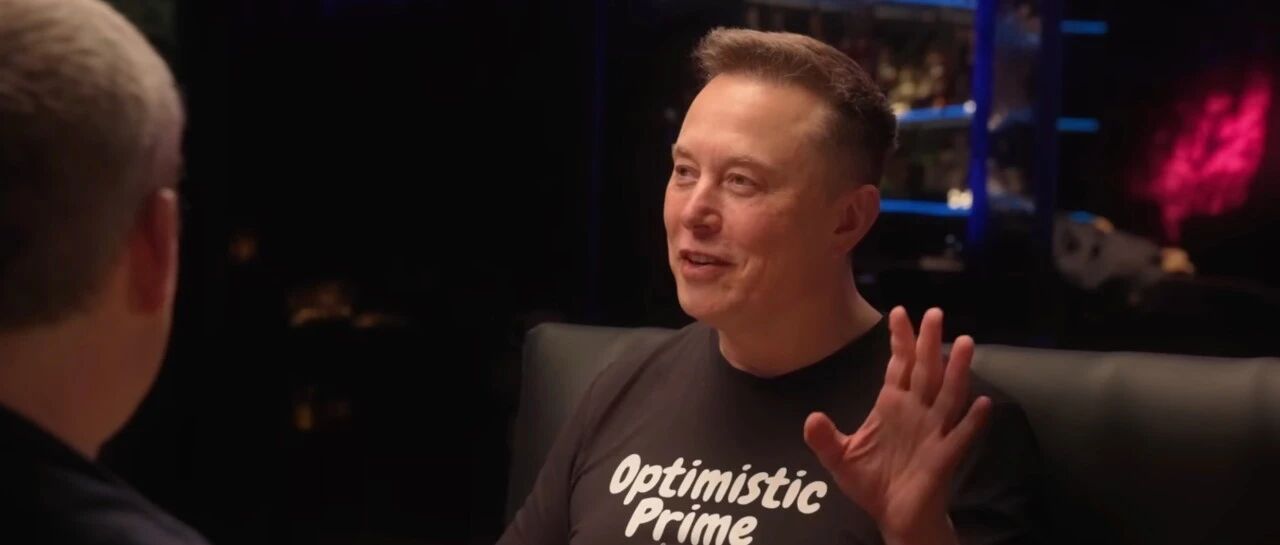
“公司终局是纯 AI、纯机器人!”马斯克酒后激进预言:让机器人造机器人,未来要靠AI留着人类智能
AI前线· 2026-02-07 05:33
Core Insights - The core argument presented is that relocating computational power to space is not primarily about cost savings on electricity, but rather about addressing the limitations of terrestrial energy production, which cannot keep pace with the exponential growth of chip computing power [2][5][6]. Group 1: Space Data Centers and Energy Challenges - Musk emphasizes that the main issue is energy supply, as global electricity generation outside of China is stagnating, while chip computing power is growing exponentially [6][10]. - He argues that building solar power plants on Earth faces significant regulatory hurdles, making space a more viable option for energy generation [8][10]. - In space, solar energy efficiency is projected to be five times greater than on Earth, eliminating the need for battery storage, thus making it a more cost-effective solution for AI deployment [8][9][16]. Group 2: AI Deployment and Future Predictions - Musk predicts that within five years, the amount of AI deployed and operational in space will exceed the cumulative total on Earth, with annual AI capacity in space potentially reaching hundreds of gigawatts [24][26]. - He asserts that the future of the strongest companies will be a closed loop of pure AI and robotics, minimizing human involvement in processes to enhance efficiency [3][24]. Group 3: Manufacturing and Supply Chain Bottlenecks - The discussion highlights that manufacturing capabilities, particularly for critical components like turbine blades, are significant bottlenecks in scaling energy production [12][13][20]. - Musk indicates that SpaceX and Tesla are working towards achieving a solar power capacity of 100 gigawatts, emphasizing the need for a complete supply chain from silicon to solar panels [14][15][16]. Group 4: SpaceX's Business Model and IPO Considerations - Musk discusses the potential for SpaceX to become a major supplier of computational power in space, likening it to a cloud service provider [25][29]. - He notes that the public market offers significantly more capital than private markets, which may necessitate an IPO to fund future expansions [31][32][36]. Group 5: AI and Human Interaction - Musk expresses concerns about the future relationship between humans and AI, suggesting that as AI intelligence surpasses human intelligence, the focus should be on ensuring AI values support the continuation of human civilization [54][55][61]. - He argues that the ultimate goal should be to maximize the range and longevity of consciousness and intelligence, which includes the preservation of human civilization [55][60].