
Macrohard项目

Search documents
人才持续流失,马斯克旗下xAI关键项目陷入停滞
财富FORTUNE· 2026-03-18 13:06
Core Viewpoint - Elon Musk is undertaking a complete reconstruction of his AI startup xAI, following its acquisition by SpaceX, which is one of the largest mergers in history [1][2]. Group 1: Company Restructuring - xAI is experiencing significant talent loss, with nine out of the original eleven co-founders leaving since 2024, raising concerns about the company's future [3][5]. - Musk describes the current restructuring of xAI as similar to the early stages of Tesla, indicating a foundational overhaul due to issues with the initial architecture [2][3]. - The acquisition by SpaceX aims to create a "orbital data center," which Musk claims is the most cost-effective way to generate AI computing power [3]. Group 2: Talent Challenges - The departure of key personnel has led to the suspension of major AI projects, such as the "Macrohard" initiative, which was intended to develop a versatile AI capable of performing all white-collar jobs [5]. - Despite the talent exodus, Musk downplays the situation as a planned restructuring, suggesting that some employees are better suited for early-stage startups rather than later development phases [5][6]. - xAI is actively recruiting to address the talent shortage, having recently hired two employees from AI programming company Cursor, which has a significant growth potential in the programming tools market [6]. Group 3: Market Potential - The programming tools market is projected to grow from $7.65 billion in 2025 to $22.2 billion by 2030, indicating substantial opportunities for companies like xAI [6].


马斯克公布 xAI 新组织架构,提出月球人工智能卫星工厂构想
Huan Qiu Wang Zi Xun· 2026-02-12 03:31
Core Insights - xAI, under Elon Musk, held a rare 45-minute all-hands meeting, revealing its new organizational structure, product development data, and ambitious projects including a lunar AI satellite factory [1][3] Organizational Changes - xAI is undergoing an organizational restructuring, resulting in some employee departures, including members of the founding team. Musk emphasized the need for an adaptable structure in a rapidly growing company, and recruitment efforts are ongoing, particularly for the lunar autonomous vehicle project [3] - The new structure divides xAI into four core teams, each with a specific focus: Team One on Grok chatbot development, Team Two on application coding systems, Team Three on optimizing the Imagine video generation tool, and Team Four on the Macrohard project, which aims to handle a wide range of tasks from simple computer operations to enterprise modeling [3] Product Performance - The latest operational data from xAI and the X platform shows strong market performance, with X's subscription business achieving an annual recurring revenue exceeding $1 billion, attributed to holiday marketing efforts [4] - xAI's Imagine tool generates an average of 50 million videos daily, with over 6 billion images produced in the past 30 days, showcasing its robust content generation capabilities [4] Future Plans - Musk reiterated the importance of a space-based data center, despite existing technical challenges. He proposed the construction of an AI satellite factory on the moon, equipped with a lunar mass driver for satellite launches. This infrastructure could enable the deployment of powerful AI clusters capable of harnessing a significant portion of solar energy and potentially expanding operations to other star systems [4]
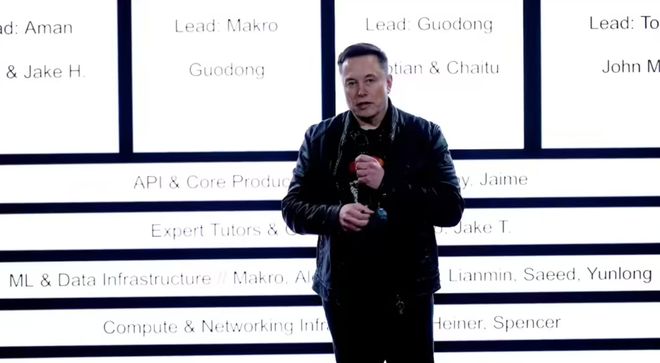
xAI全员会:马斯克重组四大战队,推出“巨硬”项目挑战微软,到月球建卫星工厂与数据中心
Hua Er Jie Jian Wen· 2026-02-12 01:00
Core Insights - The article discusses Elon Musk's ambitious plans for xAI, including the "Macrohard" project aimed at achieving full automation in office tasks to compete with Microsoft, and the establishment of a lunar manufacturing base to address AI energy consumption challenges [1][2]. Group 1: Organizational Structure and Projects - xAI has been restructured into four main teams, each led by different technical leaders reporting directly to Musk, reflecting dissatisfaction with current AI model development progress and a need for accelerated product deployment [2][5]. - The "Macrohard" project, led by Toby Pohlen, aims to enable AI to perform any task that humans can do with computers, indicating a shift from simple chatbots to enterprise-level automation [2][5]. - Other teams include Grok, focusing on chatbots and voice functions; Coding, responsible for application coding systems; and Imagine, which specializes in video and image generation models [5]. Group 2: Vision and Infrastructure - Musk presented a vision for extending AI infrastructure beyond Earth, proposing the establishment of space-based data centers and a lunar AI satellite factory, utilizing a lunar mass driver for satellite launches [4]. - This ambitious plan supports the rationale for the merger between xAI and SpaceX, as xAI continues to build data centers on Earth, including a facility in Memphis to deploy a large Nvidia GPU cluster [4]. Group 3: Financial Performance and Challenges - Recent operational data revealed that xAI's integration with the X platform has led to significant commercialization progress, with a monthly cash burn of approximately $1 billion prior to the merger [6][7]. - The new CFO, Bret Johnsen, is tasked with leveraging SpaceX's $16 billion revenue and $8 billion EBITDA to support xAI's extensive computational infrastructure needs [7]. Group 4: Internal Dynamics and Leadership Changes - The company is experiencing significant internal upheaval, with several executives, including co-founders Tony Wu and Jimmy Ba, leaving the company, resulting in a reduced founding team [8]. - Musk indicated that such changes are a natural outcome of rapid company growth, emphasizing the need for structural evolution and the promotion of technical talent to enhance execution [8]. Group 5: User Engagement and Revenue Growth - The X platform's subscription service has surpassed $1 billion in annual recurring revenue (ARR), driven by holiday marketing efforts [10]. - The Imagine tool is generating 50 million videos daily, with over 6 billion images created in the past 30 days, indicating high user engagement despite potential controversies surrounding content [10].