
数字长三角

Search documents
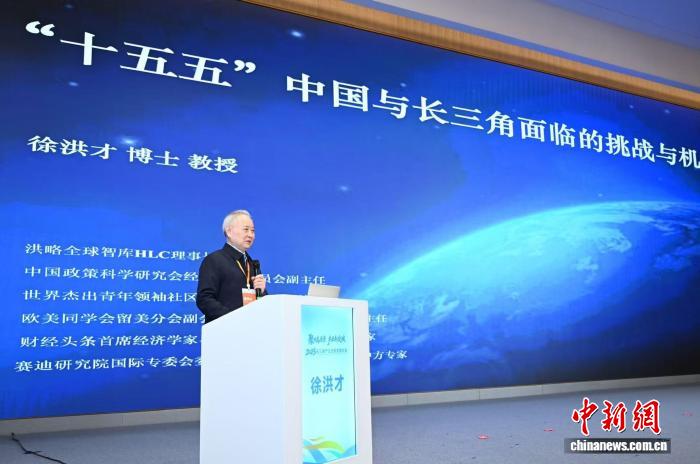
专家解读:长三角发展的“四重机遇”与一体化密码
Zhong Guo Xin Wen Wang· 2025-12-23 09:25
Core Insights - The Yangtze River Delta (YRD) is entering a period of "fourfold opportunities" as it approaches the 14th Five-Year Plan, emphasizing the need for collaborative innovation ecosystems, institutional openness, infrastructure improvement, and innovative regional cooperation mechanisms [1][3]. Group 1: Fourfold Opportunities - The YRD is experiencing a convergence of national strategic initiatives, industrial cluster development, rich scientific and technological resources, and accelerated open economy growth [3]. - The region's strategic position is increasingly prominent as it leads China's economic development while balancing regional growth [1]. Group 2: Collaborative Innovation - There is a strong emphasis on leveraging the YRD's technological innovation resources to establish cross-regional collaborative innovation mechanisms [3]. - Initiatives include the joint development of major scientific infrastructure and a collaborative plan focusing on key sectors such as integrated circuits, artificial intelligence, and biomedicine [3][4]. Group 3: Institutional Openness - The YRD provinces and cities are encouraged to pioneer institutional openness in areas such as rules, regulations, management, and standards, aligning with international high-standard trade rules [4][5]. - Efforts to eliminate hidden barriers to the free flow of resources are essential, particularly in technology transactions and talent evaluation [5]. Group 4: Infrastructure Development - Infrastructure connectivity is identified as a foundational element for YRD integration, with a call to accelerate the construction of a world-class port and airport network [5]. - The development of digital infrastructure and collaborative platforms for computing power is also highlighted as a priority [5]. Group 5: Shared Benefits and Cost Mechanisms - The establishment of various forms of benefit-sharing and cost-sharing mechanisms is recommended to promote collaborative advantages in the YRD [5]. - The success of collaborative industrial funds should be leveraged to create a metropolitan area industrial innovation fund [5].

数字长三角何以领跑?《报告》揭示算力成为“新增长极”
Zhong Guo Xin Wen Wang· 2025-11-08 14:24
Core Insights - The "Digital Yangtze River Delta Development Report (2025)" was released at the 2025 Digital Yangtze River Delta Development Conference, highlighting the region's leadership in various digital sectors [1][2] - The Yangtze River Delta is recognized as one of China's most dynamic economic regions, excelling in generative artificial intelligence, integrated circuits, and biological computing [1] - The region's industrial internet platform scale is expanding, with computing power accounting for nearly 30% of the national total, indicating a new growth driver for integrated development [1] Economic Indicators - In 2024, the Yangtze River Delta is expected to lead China in 20 key indicators, including internet broadband access user rate and newly registered digital economy enterprises [1] - The region ranks second in 10 indicators, such as the number of new online education platform enterprises and the prevalence of digital job-seeking [1] Local Development - Jiaxing, the host city of the conference, has established Zhejiang Province's first "ten thousand card" computing power cluster, leading in intelligent computing scale and operational computing power [1] - The "Wuzhen Light" supercomputing center has become Zhejiang's first national supercomputing center, while the Pinghu Runze center is the largest single high-performance computing center in the Yangtze River Delta [1]
我市深入推进长三角一体化发展2025年工作要点发布
Nan Jing Ri Bao· 2025-06-09 01:42
Core Points - The 2025 Yangtze River Delta Leaders' Conference was held in Nanjing, summarizing the achievements and experiences since the integration of the region into a national strategy, and outlining major tasks for high-quality development [1][2][3] Group 1: Innovation and Industry Development - The focus on deepening regional innovation collaboration includes supporting the Zijinshan Laboratory with major scientific tasks and promoting the establishment of a national laboratory base for biological breeding [1] - The plan emphasizes the construction of a modern industrial system through collaboration with cities like Shanghai, Hangzhou, and Hefei, exploring cross-regional development mechanisms, and enhancing the "Digital Yangtze River Delta" initiative [1][2] Group 2: Infrastructure and Connectivity - Key infrastructure projects include the continuation of the North Jiangsu High-speed Railway, Nanjing-Huai'an Intercity Railway, and the capacity expansion of the Nanjing-Wuhu Railway, along with the construction of the Nanjing North Station comprehensive hub [1][2] Group 3: Regional Coordination and Cooperation - The initiative promotes high-quality development of the Nanjing metropolitan area, including the preparation of land space planning and multi-level rail transit planning [2] - Support for cross-border cooperation in regions like Qixia, Lishui, Gaochun, and Liuhe is also highlighted [2] Group 4: Reform and Open Economy - Strengthening cooperation with the Shanghai Stock Exchange and utilizing digital platforms to cultivate quality sci-tech enterprises is a key focus [2] - The plan includes deepening the comprehensive pilot for expanding service industry openness and exploring open application scenarios [2] Group 5: Public Services and Environmental Protection - Development of an integrated human resources recruitment platform for the Yangtze River Delta and expansion of e-government services are part of the public service initiatives [2] - Collaborative efforts for ecological protection, including the Yangtze River dolphin conservation and the development of the Ning-Hang ecological economic belt, are emphasized [2]