数据清洗

Search documents
主数据管理≠数据清洗!你的企业数据还在各说各话吗?
Sou Hu Cai Jing· 2026-01-20 05:39
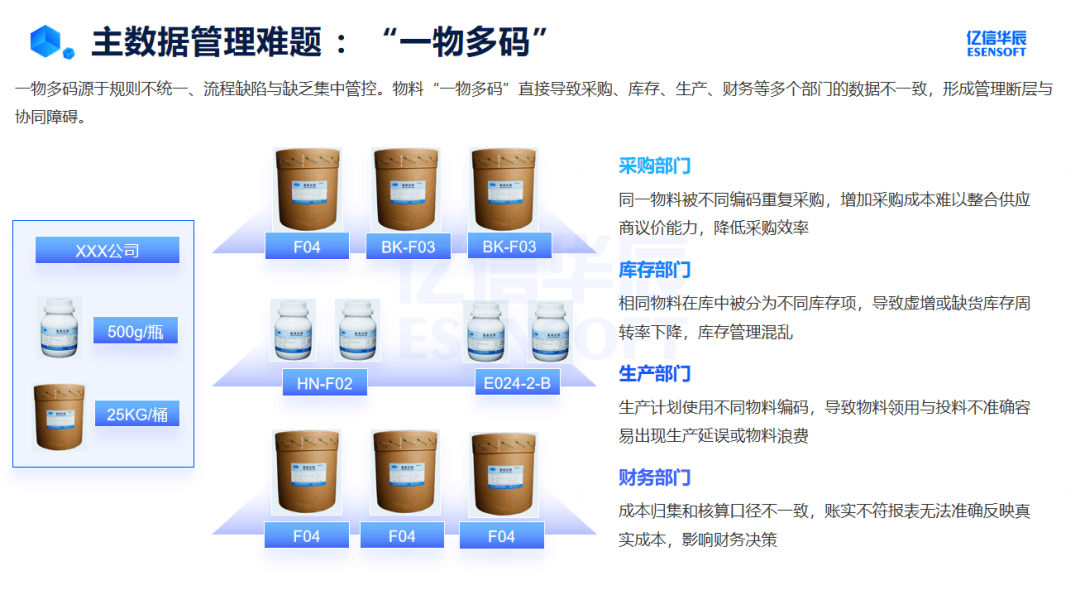
Core Insights - The article highlights the inefficiencies and hidden costs that arise from data inconsistencies within enterprises, particularly during digital transformation efforts [1][2][3] Group 1: Data Challenges - System silos are undermining enterprise efficiency, with different systems (ERP, CRM, SCM) failing to communicate effectively, leading to discrepancies in customer identities and material codes [3] - A large retail company reported annual losses exceeding tens of millions due to inventory errors caused by inconsistent product coding, which also negatively impacts supply chain responsiveness and customer satisfaction [3] - The lack of standardized data management practices results in management losing control, as different departments use varying coding systems based on their own criteria [3] Group 2: Misconceptions and Solutions - There is a common misconception that data cleansing and master data management are the same; data cleansing corrects existing errors, while master data management establishes rules to prevent data chaos [7] - Master data management focuses on managing key business entities such as customers, products, and suppliers, which are crucial for maintaining data quality and consistency across business processes [7][8] Group 3: Importance of Master Data Management - Master data management is essential for ensuring data credibility, enabling effective decision-making, process optimization, and business innovation [10] - The strategic value of master data management is evident at operational, managerial, and strategic levels, enhancing efficiency, reducing costs, and driving growth [10] Group 4: Implementation and Results - The Yixin Huachen Ruima platform offers a comprehensive solution for master data management, addressing challenges like "one item, multiple codes" through intelligent coding engines and real-time synchronization [15][16] - A multinational manufacturing company using the Ruima platform achieved unified coding management for thousands of materials, reducing maintenance time from 4 hours to 30 minutes and streamlining new material application processes [16] - In the retail sector, a nationwide chain utilized the Ruima platform to unify customer data across channels, resulting in a 40% increase in promotional response rates [17] Group 5: Long-term Benefits - Effective data management fosters communication across systems, reduces the need for data reconciliation meetings, and allows employees to trust the data, ultimately freeing up time for strategic activities [19] - The true competitive advantage in digital transformation comes from mastering data management as a foundational skill rather than relying solely on technological breakthroughs [19]

电商运营:2025年身体清洁护理精洗报告
Sou Hu Cai Jing· 2025-09-01 14:02
Market Overview - The online market size for body cleansing and care reached 15.3 billion yuan in the first half of 2025, representing a year-on-year growth of 14%, and is expected to exceed 17 billion yuan in the first half of 2026 [6][7][8] - Body cleansing sales grew by 7% year-on-year, while body care sales increased by 19% in terms of revenue, with a 21% rise in volume [8][9] - The sales focus is shifting towards content e-commerce, with body cleansing sales on a specific content platform increasing from 32% to 41%, a year-on-year growth of 36% [10][11] Category Analysis - In the body cleansing category, shower gel accounts for nearly 70% of the market, with shower oil showing significant growth at 67% year-on-year [18][21] - The demand for nourishing and soothing products peaks in the autumn and winter seasons, indicating seasonal sales trends [14] - In body care, body lotion/cream exceeded 4 billion yuan in sales, growing by 22%, while hair removal cream and neck care saw growth rates of 36% and 34%, respectively [21][22] Brand and Pricing Dynamics - The brand landscape is characterized by a dominance of mass-market brands, with domestic brands in body cleansing increasing their market share from 49% to 76% and in body care from 52% to 65% [12][13] - There is a noticeable price differentiation, with high-price segments gaining traction in shelf e-commerce, while low-price segments are rapidly growing in content e-commerce [25][27] E-commerce Platform Trends - The report highlights a significant shift in sales channels, with content e-commerce gaining a larger share of the market, particularly in the body cleansing segment [10][11] - The average price of shower oil has decreased, indicating a competitive pricing strategy in the market [27][28] Data Quality Challenges - The industry faces challenges related to data cleaning due to inconsistent platform categories and SKU mixing, necessitating the establishment of a dedicated data cleaning library to enhance data quality for product innovation and strategy formulation [21]

DeepSeek “极你太美” bug,官方回应了
猿大侠· 2025-08-29 04:12
Core Viewpoint - The article discusses a significant bug in the DeepSeek V3.1 model, which has caused widespread concern among developers due to the unexpected appearance of the character "极" in output results during API calls [1][2][12]. Group 1: Bug Discovery and Impact - The bug was initially discovered on platforms like Volcano Engine and Chutes, but it has since affected more platforms, including Tencent's CodeBuddy and even the DeepSeek official platform [5]. - The issue has sparked discussions on platforms like Reddit, particularly focusing on the terms "extreme," "极," and "極" [7]. - The presence of the "极" character can lead to compilation failures in code, posing a serious risk for scenarios requiring high precision and structured output [11]. Group 2: Solutions and Workarounds - While a complete fix is pending from DeepSeek, users have started sharing potential workarounds, such as using specific prompt patterns to mitigate the issue [14][19]. - One suggested workaround involves prohibiting certain symbol sequences in API calls, which is particularly relevant for third-party platforms [19]. Group 3: Analysis of the Bug's Origin - A user on Zhihu, Huang Zhewai, provided insights suggesting that this bug is not an isolated incident and may relate to a "malicious pattern" in large model programming [20]. - Huang observed similar issues in earlier models, indicating that the bug might stem from inadequate data cleaning during the supervised fine-tuning (SFT) and pre-training phases [23]. - He hypothesized that the "极" character could have been learned as a termination symbol due to its presence in "dirty data" that was not properly cleaned [23]. Group 4: Future Outlook - The resolution of the "极" bug, humorously referred to as "极你太美" or "'极'速版," is contingent upon the release of a new version from DeepSeek [25].
DeepSeek “极你太美” bug,官方回应了
程序员的那些事· 2025-08-28 04:17
Core Viewpoint - The article discusses a significant bug in the DeepSeek V3.1 model, which has caused widespread issues among developers using its API, particularly the unexpected appearance of the character "极" in output results, leading to potential compilation failures in code [1][2][11]. Group 1: Bug Discovery and Impact - The bug was initially discovered on platforms like Volcano Engine and Chutes, but it has since affected more platforms, including Tencent's CodeBuddy and even the DeepSeek official platform [5]. - The issue has sparked discussions on international platforms like Reddit, with the character "极" being a focal point of concern [7]. - The presence of the "极" character in outputs can lead to critical failures in high-precision and structured output scenarios, which are essential for developers [11]. Group 2: Proposed Solutions and Workarounds - While a complete fix is pending from DeepSeek, users have started sharing workarounds, such as using specific prompt patterns to mitigate the bug [14][19]. - One suggested workaround involves prohibiting certain symbol sequences in API calls, which is particularly relevant for third-party platforms [19]. Group 3: Analysis of the Bug's Origin - A user on Zhihu, Huang Zhewai, provided insights suggesting that this bug is not an isolated incident and may relate to a "malicious pattern" in large model programming [20]. - Huang noted that similar issues were observed in earlier models, where unexpected outputs like "极长" appeared during tasks, indicating a potential flaw in data cleaning processes [22]. - He hypothesized that the bug could stem from uncleaned "dirty data" during the supervised fine-tuning (SFT) phase, which may have led to the model misinterpreting the "极" character as a termination symbol [23]. Group 4: Future Outlook - The resolution of the "极" bug is contingent upon the release of a new version from DeepSeek, which is expected to address these issues [25].