新股定价机制改革

Search documents
4只新股全部破发!港股IPO高破发现象抬头 什么情况?
Zheng Quan Shi Bao· 2025-12-22 14:14
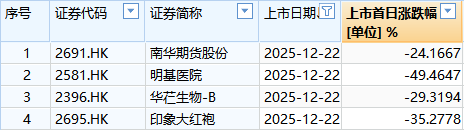
Core Viewpoint - The phenomenon of high IPO failures in the Hong Kong stock market has resurfaced, with four newly listed companies all experiencing significant declines on their debut, indicating a shift in investor sentiment and market dynamics [1][12]. Group 1: IPO Performance - On December 22, four companies—Nanhua Futures, Mingji Hospital, Huachang Biotechnology, and Impression Dahongpao—were listed on the Hong Kong stock market, all of which faced declines on their first trading day, with drops of over 24%, 49%, 29%, and 35% respectively [1][2]. - The overall trend shows that since November, the rate of IPO failures in Hong Kong has approached 50%, contrasting with earlier periods where the failure rate was significantly lower [12][13]. Group 2: Company Profiles - Nanhua Futures, established in 1996, ranks eighth among all futures companies in China by total revenue for 2024, and first among non-financial related futures companies [3]. - Mingji Hospital is a private hospital group in East China, holding a 1.0% market share in the region, and is the largest private profit-making hospital group in East China by total revenue for 2024 [3]. - Huachang Biotechnology, founded in 2012, focuses on developing protein drugs for various medical needs, with two core products in clinical trials [4]. - Impression Dahongpao is a state-owned cultural tourism service enterprise, ranked eighth in China's cultural tourism performance market by sales revenue for 2024 [4]. Group 3: Market Dynamics - The recent IPOs have shown a trend of low subscription rates, with Nanhua Futures and Mingji Hospital having subscription multiples of only 1.91 times and 6.28 times, respectively, indicating a lack of investor enthusiasm [8][9]. - The pricing strategy for these IPOs has also shifted, with three companies pricing at the lower end of their offering range, reflecting a need to attract investors amid changing market conditions [10][11]. Group 4: Investor Sentiment - The recent surge in IPO failures suggests a cooling of the "easy money" environment for new listings, leading to more selective investment behavior among investors [12][13]. - Analysts indicate that the disconnect between primary market pricing and secondary market risk preferences is contributing to the increased failure rates, as investor appetite has not kept pace with aggressive pricing strategies [13][14].

4只新股全部破发!港股IPO高破发现象抬头,什么情况?
证券时报· 2025-12-22 14:08
Core Viewpoint - The recent trend of IPOs in the Hong Kong market has seen a significant number of companies experiencing a decline in share prices on their debut, indicating a shift away from the previous "blindly investing" mentality in new listings [1][10]. Group 1: IPO Performance - On December 22, four companies—Nanhua Futures, Mingji Hospital, Huachang Biotech, and Impression Dahongpao—were listed on the Hong Kong stock market, all of which faced declines on their first trading day, with drops of over 24%, 49%, 29%, and 35% respectively [1][2]. - The phenomenon of high IPO failures has resurfaced since November, with the overall IPO failure rate in Hong Kong approaching 50% for newly listed companies [15][18]. Group 2: Company Profiles - Nanhua Futures, established in 1996, ranks eighth among all futures companies in China by total revenue for 2024, and first among non-financial related futures companies [4]. - Mingji Hospital is a private hospital group in mainland China, recognized as the largest private profit-making hospital group in East China, holding a market share of 1.0% [4]. - Huachang Biotech, founded in 2012, focuses on developing protein drugs for wound healing therapies, with two core products currently in clinical trials [5]. - Impression Dahongpao is a state-owned cultural tourism service enterprise, ranked eighth in the Chinese cultural tourism performance market by sales revenue for 2024 [6]. Group 3: Market Trends and Investor Sentiment - The recent IPOs have shown a stark contrast to the previous performance of biotech companies, which had been stable and successful in the latter half of the year, with many achieving over 100% gains on their debut [8]. - Subscription data for the four companies revealed that while Huachang Biotech and Impression Dahongpao had relatively good performance, Nanhua Futures and Mingji Hospital had low subscription multiples of 1.91 times and 6.28 times, respectively [10][11]. - The pricing strategy for these IPOs has shifted, with three companies pricing at the lower end of their offering range, indicating a need to attract investors [13][19]. Group 4: Future Outlook - The Hong Kong IPO market is expected to see a resurgence in 2026, potentially reclaiming its position as the leading global IPO market, despite the recent downturn in investor sentiment [16].

港交所IPO新规生效,散户打新时代终结?|中环观察
2 1 Shi Ji Jing Ji Bao Dao· 2025-08-15 09:25
Core Viewpoint - The recent IPO reform by the Hong Kong Stock Exchange aims to rebalance the interests of institutional and retail investors, with a focus on enhancing pricing efficiency and reducing speculative behavior in the market [2][4][10]. Group 1: IPO Reform Details - The new IPO distribution mechanism allows issuers to choose between a traditional allocation method or a pre-locked allocation ratio, with a minimum public offering ratio set at 10% [1][2]. - Mechanism A retains a similar structure to previous rules but lowers the minimum allocation for public offerings from 10% to 5%, while adjusting the reallocation percentages based on oversubscription levels [2][4]. - Mechanism B introduces a fixed allocation for public offerings, ensuring that institutional investors receive a larger share, with no reallocation mechanism in place [2][3]. Group 2: Market Reactions and Implications - The first company to utilize the new rules, Guangzhou Yino Pharmaceutical Group, saw its stock price surge over 280% on its debut, raising questions about the effectiveness of the new pricing mechanism [1][5]. - The reform is expected to enhance the participation of institutional investors, as it addresses previous concerns about the unpredictability of allocations under the old system [7][10]. - Despite the potential benefits for institutional investors, retail investors express concerns about reduced chances of allocation, leading to dissatisfaction and fears of market liquidity being compromised [9][11]. Group 3: Market Performance and Trends - The Hong Kong IPO market has shown robust growth, with 53 new listings in the first seven months of the year, raising approximately HKD 127 billion, a year-on-year increase of over 600% [6]. - International interest in Hong Kong IPOs has surged, with about two-thirds of recent investors being foreign, indicating a shift in market dynamics [6][7]. - The new rules are designed to mitigate the risks of pricing bubbles and post-listing volatility, potentially leading to more stable stock performances [4][10].

港交所与时俱进IPO新规今日落地 香港新股市场国际竞争力将获提升
Zheng Quan Ri Bao· 2025-08-03 16:08
Core Viewpoint - The Hong Kong Stock Exchange (HKEX) is implementing significant reforms to its IPO pricing mechanism, aimed at enhancing market competitiveness and adapting to international investor needs [1][2]. Group 1: Changes in IPO Mechanism - The new regulations require at least 40% of shares to be allocated to the book-building portion for institutional investors, down from the previously suggested 50% [2][3]. - The maximum percentage for public subscription can now be adjusted up to 35% under Mechanism A, increasing from the original 20% [3]. - Mechanism B introduces a fixed allocation for public subscription between 10% and 60%, with no reallocation mechanism, allowing issuers to control the public offering portion more effectively [4]. Group 2: Public Holding Requirements - HKEX is consulting on adjusting the public holding requirement, proposing a tiered system based on market capitalization, which would provide clearer guidelines for companies seeking to list [6][7]. - The initial public holding requirement may be set at 10% for companies with a market value of HKD 1 billion, or 5% for "A+H" issuers, enhancing flexibility compared to the previous 25% requirement [6][7]. - The new rules aim to ensure sufficient shares are available for trading post-IPO, aligning with international practices and improving the attractiveness of the Hong Kong listing mechanism [7].
事关IPO!港交所,重磅新规
Zheng Quan Shi Bao· 2025-08-01 10:48
Core Viewpoint - The Hong Kong Stock Exchange (HKEX) is implementing reforms to optimize the pricing and allocation mechanisms for initial public offerings (IPOs) to enhance its competitiveness and attract a new generation of quality companies to list in Hong Kong [1][5]. Group 1: Changes in IPO Pricing and Allocation Mechanisms - The minimum allocation to the book-building portion of IPOs has been reduced from 50% to 40% [2]. - New applicants can choose between two allocation mechanisms: Mechanism A allows a maximum reallocation percentage of 35% to the public subscription portion, while Mechanism B sets a fixed allocation between 10% and 60% without a reallocation mechanism [2][6]. - The existing six-month lock-up period for cornerstone investors will remain in place to maintain investor commitment [2]. Group 2: Initial Public Holding and Free Float Requirements - New regulations will require issuers to meet minimum public holding and free float requirements at the time of listing, with HKEX retaining discretion to exempt certain applicants [3]. - The new rules will take effect on August 4, 2025, and will apply to all new applicants filing listing documents on or after that date [3]. Group 3: Rationale for Modifying the Pricing Mechanism - The current IPO pricing mechanism has not changed in 27 years, despite significant changes in the backgrounds of issuers and investors [5]. - The market has shifted from being dominated by retail investors to a landscape where institutional investors account for nearly 90% of trading [5][6]. - The reforms aim to create a more flexible, clear, and transparent framework for pricing and allocation, balancing the interests of institutional and retail investors [5][7]. Group 4: Future Consultation on Continuous Public Holding Requirements - HKEX is seeking further consultation on the continuous public holding requirements, recognizing the need for flexibility given the increasing number of large companies listing in Hong Kong [8]. - A tiered initial public holding requirement based on market capitalization will be introduced to provide clearer guidance for companies looking to list [8][9].
事关IPO!港交所重磅新规!为什么要修改新股定价机制?
Zheng Quan Shi Bao Wang· 2025-08-01 10:23
Core Viewpoint - Hong Kong Exchanges and Clearing Limited (HKEX) aims to enhance the pricing and allocation mechanisms for initial public offerings (IPOs) to maintain its competitiveness and attract a new generation of quality companies to list in Hong Kong [1][7]. Summary by Sections IPO Pricing and Allocation Mechanism - The minimum allocation to the bookbuilding portion of an IPO has been reduced from 50% to 40% [2]. - Two allocation mechanisms are introduced for new listing applicants: - Mechanism A allows for a designated allocation percentage based on the oversubscription ratio, with maximum allocation to the public offering portion increased from 20% to 35% [2][10]. - Mechanism B requires issuers to pre-select a fixed allocation percentage for the public offering, ranging from 10% to 60%, without a replenishment mechanism [3][10]. Initial Public Holding and Free Float Requirements - New minimum public holding and free float requirements have been established for issuers at the time of listing, with specific thresholds based on market capitalization [4][12]. - The new regulations will take effect on August 4, 2025, and will apply to all new listing applicants [5][12]. Rationale for Changes - The existing IPO pricing mechanism has not been updated for 27 years, despite significant changes in the market and investor demographics [7][8]. - The reforms aim to create a more flexible, clear, and transparent framework for issuers and investors, reflecting the increased participation of institutional investors [9][10]. Continuous Public Holding Requirements - Further consultations will be conducted regarding the continuous public holding requirements, with a proposal to introduce a tiered system based on market capitalization to provide clearer guidance for companies [11][12]. - The current requirement of 25% for continuous public holding is deemed inflexible, especially for larger companies [11]. Overall Market Context - The Hong Kong IPO market is currently very active, with a record number of applications in process, indicating a strong demand for the proposed reforms [10].
事关IPO!港交所,重磅新规!
证券时报· 2025-08-01 10:11
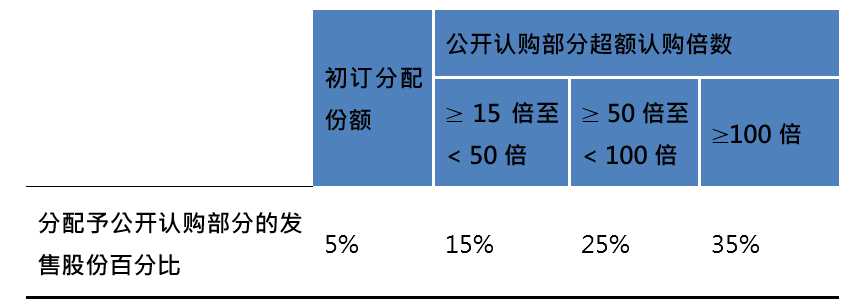
Core Viewpoint - The Hong Kong Stock Exchange (HKEX) is implementing reforms to optimize the pricing and allocation mechanisms for initial public offerings (IPOs) to enhance its competitiveness and attract a diverse range of international investors [1][9]. Summary by Sections Changes in IPO Pricing and Allocation Mechanisms - The minimum allocation to the book-building portion is set at 40%, down from the previously suggested 50% [3]. - Two allocation mechanisms are introduced for new listings: - Mechanism A allows for a specified allocation percentage based on the oversubscription ratio, with maximum allocation percentages of 5%, 15%, 25%, and 35% for different oversubscription levels [2][4]. - Mechanism B allows issuers to pre-select an allocation percentage between 10% and 60%, with no backfilling mechanism [4]. - The maximum backfilling percentage under Mechanism A has been increased from 20% to 35% [4][11]. Initial Public Holding and Free Float Requirements - New minimum public holding and free float requirements are established for issuers at the time of listing, with thresholds varying based on the type of issuer and market capitalization [5][6]. - For single-class issuers not registered in mainland China, the initial public holding must be between 10% and 25%, with a free float of at least 10% and a market value of HKD 50 million [6]. - The new regulations will take effect on August 4, 2025, and will apply to all new listing applicants [7]. Rationale for Changes - The existing IPO pricing mechanism has not been updated in 27 years, despite significant changes in the market and investor landscape, necessitating a more flexible and transparent framework [9][10]. - The shift from a retail-dominated market to one where institutional investors account for nearly 90% of trading volume requires adjustments to ensure balanced allocation among different types of investors [9][10]. Ongoing Consultation on Public Holding Requirements - The HKEX is seeking further consultation on the continuous public holding requirements, aiming to introduce a tiered system based on market capitalization to provide clearer guidance for companies [13][14]. - The current requirement of 25% for continuous public holding is deemed inflexible, especially for larger companies, prompting the need for a more adaptable approach [13][14].