港股IPO破发

Search documents
4只新股全部破发!港股IPO高破发现象抬头,什么情况?
Xin Lang Cai Jing· 2025-12-22 14:17
Group 1 - The core phenomenon observed is the resurgence of high IPO failures in the Hong Kong market, with four companies listed on December 22, 2025, all experiencing significant declines on their first trading day, with drops of over 24%, 49%, 29%, and 35% respectively [1][2][17] - The four companies that went public are Nanhua Futures, Mingji Hospital, Huachang Biopharmaceutical, and Impression Dahongpao, each with distinct characteristics and market positions [3][4][18] - Nanhua Futures ranks eighth among all futures companies in China by total revenue for 2024, while Mingji Hospital is the largest private hospital group in East China, holding a 1.0% market share [3][4][18] Group 2 - Huachang Biopharmaceutical, a biotech company, faced unexpected failure despite the sector's strong performance in the second half of the year, where many biotech firms achieved over 100% first-day gains [6][21] - The subscription data for the four companies showed mixed results, with Impression Dahongpao achieving an impressive oversubscription of over 3,397 times, while Nanhua Futures and Mingji Hospital had much lower oversubscription rates of 1.91 times and 6.28 times respectively [8][23] - The recent trend indicates that the IPO pricing mechanism reform in August 2025 has led to a significant increase in IPO failures, with a failure rate of nearly 50% for new listings since November 2025 [12][27] Group 3 - The pricing strategy for the recent IPOs involved setting prices at the lower end of the range to attract investors, which is a shift from the previous trend of pricing at the upper end for popular stocks [10][25] - The overall market sentiment has shifted, with a notable increase in the proportion of IPOs failing to maintain their initial pricing, reflecting a disconnect between primary market valuations and secondary market risk appetites [13][28][29] - Analysts have identified three main issues with current IPO pricing: reliance on A-share valuations, high proportions of cornerstone and long-term placements leading to smaller float sizes, and limited flexibility in the pricing range [29]

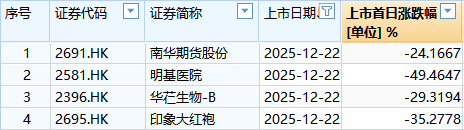
4只新股全部破发!港股IPO高破发现象抬头 什么情况?
Zheng Quan Shi Bao· 2025-12-22 14:14
Core Viewpoint - The phenomenon of high IPO failures in the Hong Kong stock market has resurfaced, with four newly listed companies all experiencing significant declines on their debut, indicating a shift in investor sentiment and market dynamics [1][12]. Group 1: IPO Performance - On December 22, four companies—Nanhua Futures, Mingji Hospital, Huachang Biotechnology, and Impression Dahongpao—were listed on the Hong Kong stock market, all of which faced declines on their first trading day, with drops of over 24%, 49%, 29%, and 35% respectively [1][2]. - The overall trend shows that since November, the rate of IPO failures in Hong Kong has approached 50%, contrasting with earlier periods where the failure rate was significantly lower [12][13]. Group 2: Company Profiles - Nanhua Futures, established in 1996, ranks eighth among all futures companies in China by total revenue for 2024, and first among non-financial related futures companies [3]. - Mingji Hospital is a private hospital group in East China, holding a 1.0% market share in the region, and is the largest private profit-making hospital group in East China by total revenue for 2024 [3]. - Huachang Biotechnology, founded in 2012, focuses on developing protein drugs for various medical needs, with two core products in clinical trials [4]. - Impression Dahongpao is a state-owned cultural tourism service enterprise, ranked eighth in China's cultural tourism performance market by sales revenue for 2024 [4]. Group 3: Market Dynamics - The recent IPOs have shown a trend of low subscription rates, with Nanhua Futures and Mingji Hospital having subscription multiples of only 1.91 times and 6.28 times, respectively, indicating a lack of investor enthusiasm [8][9]. - The pricing strategy for these IPOs has also shifted, with three companies pricing at the lower end of their offering range, reflecting a need to attract investors amid changing market conditions [10][11]. Group 4: Investor Sentiment - The recent surge in IPO failures suggests a cooling of the "easy money" environment for new listings, leading to more selective investment behavior among investors [12][13]. - Analysts indicate that the disconnect between primary market pricing and secondary market risk preferences is contributing to the increased failure rates, as investor appetite has not kept pace with aggressive pricing strategies [13][14].
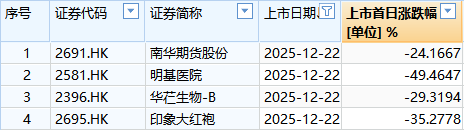
4只新股全部破发!港股IPO高破发现象抬头,什么情况?
证券时报· 2025-12-22 14:08
Core Viewpoint - The recent trend of IPOs in the Hong Kong market has seen a significant number of companies experiencing a decline in share prices on their debut, indicating a shift away from the previous "blindly investing" mentality in new listings [1][10]. Group 1: IPO Performance - On December 22, four companies—Nanhua Futures, Mingji Hospital, Huachang Biotech, and Impression Dahongpao—were listed on the Hong Kong stock market, all of which faced declines on their first trading day, with drops of over 24%, 49%, 29%, and 35% respectively [1][2]. - The phenomenon of high IPO failures has resurfaced since November, with the overall IPO failure rate in Hong Kong approaching 50% for newly listed companies [15][18]. Group 2: Company Profiles - Nanhua Futures, established in 1996, ranks eighth among all futures companies in China by total revenue for 2024, and first among non-financial related futures companies [4]. - Mingji Hospital is a private hospital group in mainland China, recognized as the largest private profit-making hospital group in East China, holding a market share of 1.0% [4]. - Huachang Biotech, founded in 2012, focuses on developing protein drugs for wound healing therapies, with two core products currently in clinical trials [5]. - Impression Dahongpao is a state-owned cultural tourism service enterprise, ranked eighth in the Chinese cultural tourism performance market by sales revenue for 2024 [6]. Group 3: Market Trends and Investor Sentiment - The recent IPOs have shown a stark contrast to the previous performance of biotech companies, which had been stable and successful in the latter half of the year, with many achieving over 100% gains on their debut [8]. - Subscription data for the four companies revealed that while Huachang Biotech and Impression Dahongpao had relatively good performance, Nanhua Futures and Mingji Hospital had low subscription multiples of 1.91 times and 6.28 times, respectively [10][11]. - The pricing strategy for these IPOs has shifted, with three companies pricing at the lower end of their offering range, indicating a need to attract investors [13][19]. Group 4: Future Outlook - The Hong Kong IPO market is expected to see a resurgence in 2026, potentially reclaiming its position as the leading global IPO market, despite the recent downturn in investor sentiment [16].

最新变化:港股IPO破发悄然抬头,什么原因?
Zheng Quan Shi Bao· 2025-12-11 02:08
Core Viewpoint - The Hong Kong IPO market is expected to be robust in 2025, with a total IPO scale reaching HKD 267.1 billion, potentially reclaiming the top position globally in IPOs. However, the phenomenon of IPOs trading below their offering price has resurfaced since November, raising concerns about investor enthusiasm for new listings [1][2]. Group 1: IPO Performance - In 2024, out of 70 newly listed stocks, 25 experienced a decline in share price post-IPO, resulting in a 35.71% failure rate. In the first half of 2025, 13 out of 43 new listings also broke below their offering price, with a failure rate of 30.23% [1]. - Following the reform of the IPO pricing mechanism in August, the initial months saw a significant reduction in the IPO failure rate, with only 2 out of 28 new stocks breaking below their offering price, translating to a failure rate of 7.14% [2]. Group 2: Pricing Mechanism and Market Dynamics - The new IPO pricing mechanism allows issuers to choose between two distribution methods, with many opting for Method B, which allocates only 10% of shares to retail investors, significantly increasing the pricing power of institutional investors [2]. - Since November, the IPO failure rate has surged to 42.10% among 19 new listings, indicating a disconnect between primary pricing and secondary market risk appetite [2]. Group 3: Future Outlook - The Hong Kong IPO market is anticipated to remain active in 2026 due to several factors, including stricter regulations in the U.S. market, ongoing policy benefits, improved liquidity conditions, and continued interest from mainland companies in listing in Hong Kong [3].
港股IPO破发悄然抬头 定价三难题待解
Xin Lang Cai Jing· 2025-12-10 18:44
Group 1 - The Hong Kong IPO market is expected to be robust in 2025, with a total IPO scale reaching 267.1 billion HKD, potentially reclaiming the top position globally for IPOs [1] - After the reform of the Hong Kong IPO pricing mechanism in August, the occurrence of IPOs breaking below their issue price has become rare, but this trend has reversed since November [1][2] - In 2024, 25 out of 70 newly listed stocks broke below their issue price, resulting in a break rate of 35.71%, while in the first half of 2025, 13 out of 43 new stocks broke below their issue price, with a break rate of 30.23% [1][2] Group 2 - Most new listings since the reform have opted for Mechanism B, allocating only 10% of new shares to retail investors, significantly increasing the pricing power of institutional investors [2] - From August 4 to the end of October, only 2 out of 28 new stocks broke below their issue price, leading to a break rate of 7.14% [2] - However, from November onwards, 8 out of 19 new stocks have broken below their issue price, resulting in a break rate of 42.10%, which is significantly higher than previous rates [2] Group 3 - Current issues in Hong Kong IPO pricing include reliance on A-share valuations, high proportions of cornerstone and long-term placements leading to smaller tradable shares, and limited flexibility in offering price ranges [3] - The Hong Kong IPO market is expected to remain active in 2026 due to stricter regulations in the U.S. market, ongoing policy benefits, improved liquidity conditions, and continued interest from mainland companies in listing in Hong Kong [3]

赛力斯港股一度重挫10%,什么情况?
第一财经· 2025-11-05 10:41
Core Viewpoint - The article discusses the phenomenon of high subscription rates for IPOs in the Hong Kong market, exemplified by the case of Saisir, which experienced a significant drop in share price on its first trading day despite a 133 times oversubscription, indicating a disconnect between market enthusiasm and actual stock performance [3][4][8]. Group 1: IPO Performance - Saisir's stock opened down 1.98% on its first day and hit a low of 118 HKD, ultimately closing at 131.5 HKD, equal to its issue price [3][7]. - In the first three quarters of the year, 98% of new Hong Kong IPOs were oversubscribed, but over 20% of these stocks experienced a drop on their first trading day [3][10]. - The overall IPO market in Hong Kong raised 182.45 billion HKD in the first three quarters, with 68 new stocks listed [10]. Group 2: Market Sentiment and Investor Behavior - High subscription rates reflect ample market liquidity and speculative sentiment, but do not necessarily correlate with the intrinsic value of the companies [4][8]. - Investors are increasingly facing uncertainty, as many are experiencing losses despite the high demand for new shares [11][12]. - The phenomenon of "leveraged IPO investing" is contributing to investor losses, as individuals incur costs regardless of whether they receive shares [13]. Group 3: Company-Specific Concerns - Saisir's revenue structure is heavily reliant on a single brand, with the "Wen Jie" series accounting for over 90% of total revenue, raising concerns about its business model [8]. - The company's financial performance showed a revenue of 110.53 billion CNY in the first three quarters, with a net profit increase of 31.56% to 5.31 billion CNY [7]. Group 4: Historical Context - The current IPO failure rate is at a historical low, with only 24% of new stocks experiencing a drop on their first day, the lowest since 2017 [13]. - Despite the high subscription rates, the market has seen a significant number of stocks drop below their issue price within 20 trading days [12][13].