
新能源产业链重构

Search documents
碳酸锂期货涨疯了,突破17万元大关!电池行业要变天了
Nan Fang Du Shi Bao· 2026-01-13 05:38
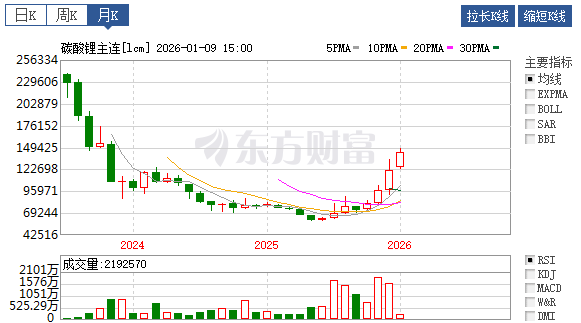
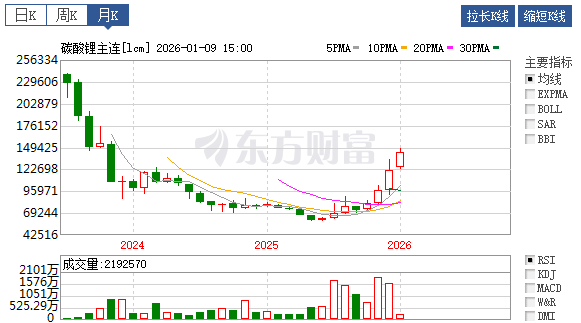
Core Insights - The price of lithium carbonate futures has surged, closing at 143,420 yuan per ton, marking an increase of over 120% from the low of 59,900 yuan per ton in June 2025, reaching a new high since November 2023 [2] - Demand for lithium is robust, with electric vehicle sales increasing by over 30% year-on-year and battery installation volumes rising by over 40%, while the energy storage market has seen a doubling in domestic project tenders [4] - Supply constraints are exacerbated by government policies limiting new mining projects and ongoing production ramp-ups at key lithium extraction projects [4][6] Supply and Demand Dynamics - The mismatch between supply and demand has intensified short-term supply tightness, with key expansion projects facing delays and maintenance in lithium iron phosphate enterprises leading to reduced output [4] - The Chinese government has implemented policies to control irrational competition in the lithium battery industry, further pushing lithium prices upward [6] Long-term Agreements and Market Structure - Leading battery companies are restructuring supply chains by signing long-term agreements to lock in costs, moving away from rigid pricing models to dynamic pricing mechanisms that allow for price fluctuations [8] - Major contracts, such as those between Longpan Technology and Chuangneng New Energy, involve significant sales commitments and are often tied to technology and price linkage clauses [9] Industry Consolidation - The industry is witnessing a shift towards consolidation, with smaller battery manufacturers being pushed out of the core supply chain as larger firms secure resources through binding agreements [11] - The market share of the top ten battery companies is expected to increase from 65% to 75% by 2025, with significant losses reported among smaller firms in the lithium iron phosphate sector [13] Alternative Technologies - High lithium prices are catalyzing the development of alternative battery technologies, such as sodium batteries, which are gaining traction in low-end energy storage and light-duty applications due to their cost advantages [15] - Investment in sodium battery projects has surged, with a total investment of approximately 61.5 billion yuan across 28 announced projects, indicating a shift in focus within the battery industry [17] Solid-State Battery Development - Solid-state battery technology is expected to see large-scale production around 2030, although it currently shows increased reliance on lithium compared to other battery types [18][22] - The high demand for lithium resources driven by solid-state battery development is prompting a reevaluation of the industry's cost structures and competitive dynamics [22]

半年翻倍涨,逼近15万元/吨!锂价疯涨背后,电池行业变了
Nan Fang Du Shi Bao· 2026-01-09 17:07
Core Viewpoint - Lithium carbonate futures prices have surged, closing at 143,420 yuan per ton on January 9, 2026, marking a 120% increase from the low of 59,900 yuan per ton in June 2025, and reaching a new high since November 2023, becoming a significant price anchor in the new energy industry chain [2] Supply and Demand Dynamics - Demand for lithium has skyrocketed, with new energy vehicle sales increasing over 30% year-on-year and battery installation volumes rising over 40%. The energy storage market has also seen a doubling in domestic project bidding and a surge in overseas orders, leading to a supply-demand mismatch and short-term supply tightness [4] - The Chinese government has restricted the approval of new mining projects without self-built mines and tailings disposal facilities, impacting key expansion projects like Ganfeng Lithium's Cauchari-Olaroz and Tianqi Lithium's Sichuan expansion, which are currently ramping up production [4][6] Cost Pressures and Market Reactions - The solid waste management action plan released by the State Council has added to industry cost pressures, potentially increasing operational costs for companies. A recent meeting by the Ministry of Industry and Information Technology aimed to curb irrational competition in the lithium battery industry, further altering market expectations regarding overcapacity and driving lithium prices up [6] - Major battery companies are responding to rising raw material prices by increasing product prices, with some companies like Suzhou Dejia Energy announcing a 15% price hike. A shift towards long-term agreements in the supply chain is evident, with leading firms locking in costs through dynamic pricing mechanisms linked to market indices [7] Industry Restructuring - The deep binding agreements between leading battery companies and suppliers are excluding smaller players from the core supply chain, indicating a new round of industry consolidation. The market share of the top ten battery companies is expected to rise from 65% to 75% by 2025, with smaller firms facing accelerated exit from the market [8][10] - Recent acquisitions in the lithium resource sector, such as Salt Lake Co.'s acquisition of a controlling stake in China Salt Lake and Shengxin Lithium Energy's purchase of a stake in Qicheng Mining, highlight the increasing value of lithium resources [10] Technological Shifts - High lithium prices are catalyzing a shift towards alternative battery technologies, such as sodium batteries, which are gaining traction in mid-to-low-end energy storage and light-duty applications due to their cost advantages and stable material supply [11][13] - Investment in sodium battery projects has surged, with a total investment of approximately 61.5 billion yuan across 28 announced projects, indicating a significant shift in focus within the battery industry [13] - Solid-state battery technology, while initially seen as a potential solution to reduce lithium dependency, is showing increased lithium usage compared to lithium iron phosphate batteries, with projections for large-scale production expected around 2030 [14][16] Conclusion - The lithium carbonate price surge is not merely a short-term speculative trend but reflects a systemic revaluation based on real supply-demand dynamics, cost structures, and industry power shifts. Companies with resource advantages, technological depth, and cost discipline are transitioning from price takers to rule makers in this evolving landscape [10][16]
半年翻倍涨 逼近15万元/吨!锂价疯涨背后 电池行业变了
Nan Fang Du Shi Bao· 2026-01-09 15:58
Core Insights - Lithium carbonate futures prices have surged, closing at 143,420 yuan per ton on January 9, 2026, marking an increase of over 120% from the low of 59,900 yuan per ton on June 5, 2025, and reaching a new high since November 2023 [1][3] Supply and Demand Dynamics - Demand for lithium has significantly increased, with new energy vehicle sales growing over 30% year-on-year and battery installation volumes rising over 40% [3] - The supply side is facing constraints due to government policies limiting new mining projects and key expansion projects being in the ramp-up phase, leading to a short-term supply tightness [3] - Recent government initiatives have added cost pressures on the industry, further driving up operational costs for companies [3] Raw Material Price Trends - Major battery companies are responding to rising raw material costs by increasing product prices, with some companies raising prices by 15% [4] - A shift towards long-term agreements in the supply chain is occurring, with leading companies locking in costs through dynamic pricing mechanisms that allow for price fluctuations [4] Market Consolidation - The competitive landscape is shifting, with smaller battery companies being pushed out of the core supply chain as leading firms secure resources through binding agreements [5] - The market share of the top ten battery companies is expected to increase from 65% to 75% by 2025, indicating a trend towards consolidation [7] Technological Developments - The high lithium prices are catalyzing the development of alternative battery technologies, such as sodium batteries, which are becoming viable substitutes in certain applications [8] - Solid-state battery technology is advancing, but it remains heavily reliant on lithium, with significant lithium consumption per GWh compared to other battery types [9][13] Investment Trends - Investment in sodium battery projects has surged, with a total of approximately 61.5 billion yuan allocated across 28 projects, indicating a shift in focus within the battery industry [8] - The capital market is increasingly favoring mature technologies with established production capabilities, leading to a pronounced "Matthew Effect" in the industry [13]
深耕北美市场,铭利达铸就本地化交付标杆
Xin Lang Cai Jing· 2025-05-09 02:15
Group 1 - Minglida has invested nearly $200 million in Mexico and Hungary, completing its "dual hub" strategic layout for North America and Europe [1] - In 2024, Minglida's automotive segment achieved revenue of 1.434 billion yuan, a year-on-year increase of 20.67%, becoming the new growth pillar by surpassing solar and energy storage businesses [1] - In Q1 2025, Minglida reported revenue of 655 million yuan, reflecting a year-on-year growth of 17.99%, indicating steady operational progress [1] Group 2 - Minglida is strategically positioning itself in Mexico to address the restructuring of the global new energy supply chain and local customer demands, with cumulative investments exceeding 710 million yuan since 2023 [1] - The company is developing an integrated production capacity for aluminum alloy extrusion, die-casting, injection molding, and deep processing, with a planned area of 200 acres and a building area of 100,000 square meters [1] - The Mexican base will import mature manufacturing technologies and management systems from China while enhancing local innovation capabilities, becoming a core hub for the North American market [2]