
新能源供给消纳体系

Search documents
中国特高压:绿电闪送 千里直达
Zhong Yang Ji Wei Guo Jia Jian Wei Wang Zhan· 2026-03-09 00:28
Core Viewpoint - The construction of ultra-high voltage (UHV) power transmission projects is crucial for enhancing energy security, optimizing clean energy distribution, and supporting the green transformation of the economy in China [7][21]. Group 1: Project Developments - The Shaanxi-Fujian ±800 kV UHV DC transmission project is set to be operational by June 2024, spanning 1,070 kilometers to deliver clean energy to the Jianghuai region [6]. - The Inner Mongolia-Beijing-Tianjin-Hebei ±800 kV UHV DC project is progressing steadily, aimed at supporting the energy output from the Kubuqi Desert renewable energy base [6]. - The Jinshang-Hubei ±800 kV UHV DC project is designed to transmit clean energy from Tibet across nearly 1,900 kilometers, marking a significant engineering achievement [10]. Group 2: Energy Consumption and Capacity - By 2025, China's total electricity consumption is expected to exceed 10 trillion kilowatt-hours, solidifying its position as the world's largest electricity consumer [7]. - The UHV projects consist of 46 completed projects with a total length exceeding 62,000 kilometers, forming the largest and most advanced long-distance power transmission network globally [12]. Group 3: Technological Innovations - UHV technology has evolved rapidly in China, achieving world-leading standards in design, construction, and management, with over 500 various standard documents developed [16]. - The projects utilize innovative technologies to address challenges such as high-altitude construction and extreme weather conditions, ensuring safety and efficiency [14][16]. Group 4: Environmental Impact - The Ningxia-Hunan project has a total installed capacity of 17.64 million kilowatts, with over 70% from renewable sources, significantly reducing carbon emissions by 16 million tons annually [18]. - The Hami-Chongqing project can support over 10 million kilowatts of renewable energy, also contributing to a reduction of 16 million tons of carbon emissions each year [19]. Group 5: Future Prospects - The upcoming Tibet to Guangdong-Hong Kong-Macau Greater Bay Area ±800 kV UHV DC project will span 2,681 kilometers, expected to deliver over 43 billion kilowatt-hours of clean energy annually by 2029 [20]. - The Longdong-Shandong ±800 kV UHV DC project will facilitate the development of a significant renewable energy base in Gansu, providing 36 billion kilowatt-hours of electricity to Shandong each year, also reducing carbon emissions by 16 million tons [20].

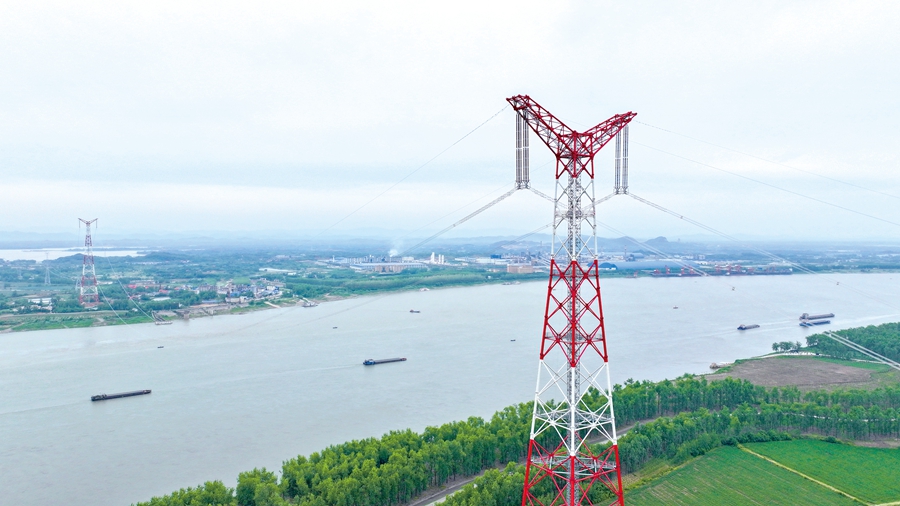
护航“宁电入湘” 国产“超级装备”提供关键技术支撑
Ren Min Wang· 2025-08-20 09:55
Core Insights - The "Ningdian into Xiang" project, China's first "Shagehuang" wind and solar power base, has been completed, with a full-load transmission capacity of 8 million kilowatts, capable of delivering over 36 billion kilowatt-hours of clean electricity to Hunan annually [1][2] Group 1: Project Overview - The "Ningdian into Xiang" project starts from Zhongning Converter Station in Ningxia and passes through Gansu, Shaanxi, Chongqing, and Hubei, reaching Hengyang Converter Station in Hunan, covering a total length of 1,616 kilometers with a total investment of 28.1 billion yuan [1] - The project serves as a model for the renewable energy supply and consumption system, addressing the challenges of large geographical spans and complex environments during construction [1] Group 2: Equipment and Technology - The high-end converter transformer, a key component in UHVDC projects, plays a crucial role in converting high-voltage direct current to alternating current, ensuring seamless integration with local power grids [2] - Each ±800 kV high-end converter transformer measures 14.8 meters in height, weighs 570 tons, and has dimensions of 26.5 meters in length and 8.4 meters in width, showcasing complete independent intellectual property rights [2] - The completion of the project is expected to meet Hunan's electricity demand, optimize the energy structure, and facilitate large-scale clean energy delivery from Ningxia, promoting cross-regional energy optimization [2]

特变电工助力“宁电入湘”送电投运
Zheng Quan Ri Bao Wang· 2025-08-20 05:48
Core Viewpoint - The completion of the "Ning Electric into Hunan" project marks a significant milestone in China's renewable energy infrastructure, enabling the transmission of over 36 billion kilowatt-hours of clean electricity annually to Hunan province [1][2]. Group 1: Project Overview - The "Ning Electric into Hunan" project is China's first "Shagohuang" wind and solar power base external high-voltage transmission channel, with a total investment of 28.1 billion yuan [1]. - The project spans 1,616 kilometers, starting from the Zhongning converter station in Ningxia and passing through Gansu, Shaanxi, Chongqing, and Hubei before reaching Hengyang in Hunan [1]. - The project is designed to have a full-load transmission capacity of 8 million kilowatts [1]. Group 2: Technological Innovations - The company has implemented digital quality management throughout the entire process of high-end converter transformer production, achieving a 100% qualification rate for batch production [2]. - The company has developed or optimized various products tailored to the project's specific geographical and climatic conditions, including steel-core aluminum stranded wire and epoxy resin-impregnated paper capacitive DC bushings [2]. Group 3: Economic and Social Impact - The project not only meets its economic and social objectives but also enhances the capabilities of the team involved, leading to technological advancements and the development of new products [2]. - The successful execution of such large-scale power engineering projects serves as a reference for the high-quality development of the power equipment industry in China [2].
国家电网:宁夏-湖南±800千伏特高压直流输电工程投产送电
Jing Ji Guan Cha Bao· 2025-08-20 05:00
Core Viewpoint - The Ningxia-Hunan ±800 kV UHVDC project has been put into operation, serving as a crucial channel connecting the abundant renewable energy resources in the western region with the load centers in central China, significantly enhancing energy supply security and promoting the optimization of clean energy distribution [2][4]. Group 1: Project Overview - The Ningxia-Hunan project has a rated voltage of ±800 kV and a capacity of 8 million kW, spanning 1,616 kilometers with a total investment of 28.1 billion yuan [4]. - It is the first UHVDC project approved to primarily transmit renewable energy from the "Shagao" wind and solar base and is the third UHVDC project to be put into operation this year [4]. - The project is expected to deliver over 36 billion kWh of electricity annually to Hunan, with more than 50% coming from renewable sources [5]. Group 2: Economic and Social Impact - The project will significantly enhance Hunan's electricity supply, increasing its external electricity capacity to 16 million kW and providing about one-sixth of the province's power needs [5]. - It is anticipated to drive investment exceeding 70 billion yuan in Ningxia, positively impacting local infrastructure and related industries, thereby stabilizing supply chains and employment [6]. - The project supports the development of high-energy industries in Hunan, such as advanced manufacturing and data centers, optimizing the business environment [6]. Group 3: Technological Innovation - The project has achieved a series of standardized results, including over 5,500 typical drawings and the establishment of various national and industry standards [7]. - It has successfully implemented domestic manufacturing of all equipment, marking a significant advancement in the quality of domestic components used in UHVDC technology [7]. - The project exemplifies the integration of advanced technology in the construction of UHVDC lines, addressing challenges related to safety and reliability in complex environments [7].
2025年电力、电气设备制造行业分析
Lian He Zi Xin· 2025-04-27 14:23
Investment Rating - The report maintains a stable outlook for the power and electrical equipment manufacturing industry, projecting continued growth and investment in the sector through 2025 [2][18][23]. Core Insights - The power and electrical equipment manufacturing industry is experiencing steady growth, driven by increased electricity consumption and significant investments in power generation and grid infrastructure [4][18]. - The industry is closely linked to national economic performance and electricity investment demand, with a projected 6.8% year-on-year increase in total electricity consumption in 2024 [4][18]. - The construction of new energy systems and the development of high-voltage transmission lines are expected to create substantial opportunities for the industry [2][18][19]. Industry Overview - The power and electrical equipment manufacturing industry is a crucial part of the national economy, with a favorable external environment and significant investment growth in 2024 [4][8]. - In 2024, total electricity investment is expected to reach 1.78 trillion yuan, a 13.2% increase year-on-year, with major investments in power generation and grid projects [8][10]. - The industry is characterized by a competitive landscape with many small and medium-sized enterprises, and the competition is intensifying due to centralized bidding practices by major state-owned enterprises [11][12]. Policy Support - Recent policies aim to eliminate local protectionism and optimize resource allocation for the renewable energy industry, fostering a more competitive market environment [15][17]. - The government has outlined a series of initiatives to enhance energy infrastructure and promote the development of a new power system, emphasizing the importance of renewable energy integration [16][17]. Future Outlook - The implementation of the "dual carbon" strategy and the anticipated growth in energy demand will support the development of the power equipment manufacturing industry [18][19]. - The construction of ultra-high voltage transmission lines and smart grids is expected to drive significant investment and innovation in the sector [19][21]. - The industry is poised for stability and growth, with substantial investments planned by major grid companies during the 14th Five-Year Plan period [18][23].