
新能源车购置税优惠

Search documents
4000亿补贴难撬动增长,明年车市会跌多少?
3 6 Ke· 2025-12-09 02:17
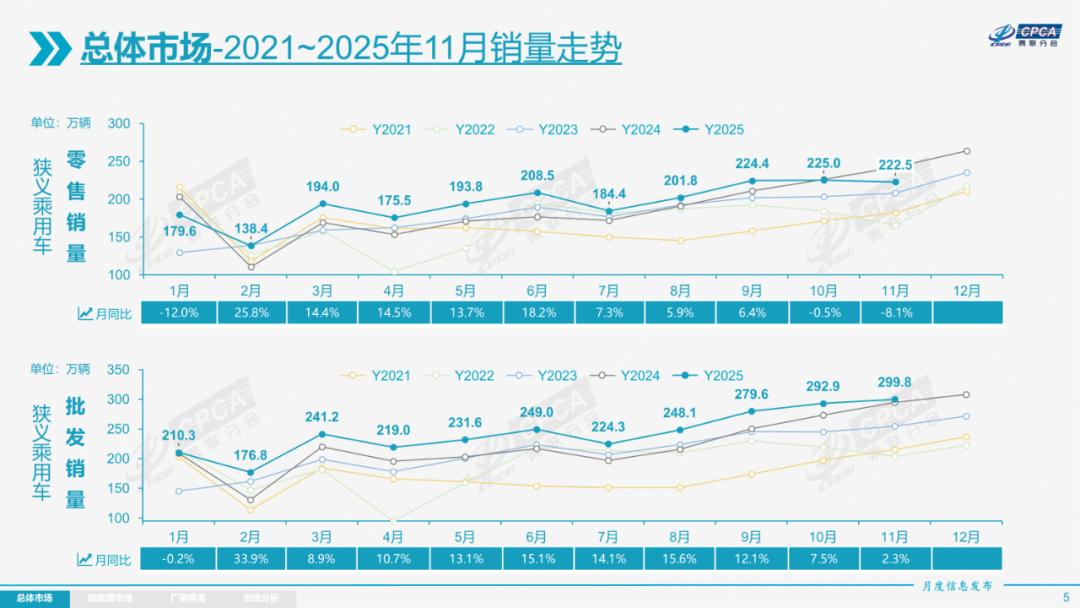
Core Viewpoint - The current downturn in the Chinese automotive market is characterized by a lack of consumer confidence and a significant decline in sales, leading to predictions of a challenging future for the industry [1][2][4]. Market Performance - In November, the domestic passenger car retail market experienced an 8% year-on-year decline, marking the second consecutive month of decline in the fourth quarter [1][2]. - The overall retail market growth for the first eleven months of the year was approximately 6%, indicating a stark contrast to previous years' trends [2][4]. Industry Trends - The end-of-year sales surge, typically seen in November and December, is absent this year, with industry experts noting a rare "loss of warmth" in the market [4][7]. - Major automakers, including BYD, have reported declining sales figures, with year-on-year drops of 5.5%, 12%, and 5% over the past three months, despite a significant increase in overseas sales [4][6]. Inventory and Dealer Sentiment - The inventory warning index for automotive dealers surged to 55.6%, indicating a high level of unsold stock, with over 330,000 vehicles in total inventory [6]. - Many dealers are experiencing significant price losses, with 43.6% reporting over 15% price cuts, leading to a challenging environment for smaller dealerships [6]. Policy Impact - The government's substantial subsidies, totaling around 400 billion, have stimulated some consumer activity but have also led to a depletion of future demand, as many consumers have brought forward their purchasing decisions [7][9]. - The anticipated decline in the market is attributed to the exhaustion of policy incentives and the resulting impact on consumer behavior [11][12]. Future Projections - Predictions for 2026 suggest a potential decline in the passenger car market, with estimates ranging from a 2% to an 8% drop in sales [11][12]. - The automotive industry is expected to face significant challenges due to overcapacity, with a utilization rate of only 64% against a production capacity of 48.7 million vehicles [15]. Opportunities Amidst Challenges - Despite the downturn, there are structural opportunities, particularly in the export market, which is projected to grow significantly, with expectations of reaching nearly 7 million units by 2026 [16]. - Technological advancements, such as the development of Robotaxi and AI integration, are seen as potential growth areas for the industry [18][20]. Industry Restructuring - The current market conditions are likely to lead to a reshaping of the industry, where companies focusing on innovation and differentiation will thrive, while those relying on subsidies and price competition may struggle to survive [20][21].

新能源车购置税将减半征收 多家车企宣布税费“兜底”政策
Mei Ri Jing Ji Xin Wen· 2025-11-04 12:46
Core Insights - The upcoming reduction of the new energy vehicle (NEV) purchase tax is expected to stimulate a surge in vehicle purchases before the end of the year, with consumers aiming to take advantage of the tax benefits [1][4][5] Group 1: Tax Policy and Consumer Behavior - Several automakers have introduced "tax guarantee" policies to encourage consumers to place orders before the end of November, ensuring that any tax differences due to delays will be covered by the manufacturers [2][3] - Consumers are motivated to finalize their purchases quickly, as the current tax exemption will be replaced by a 5% tax next year, making timely orders crucial for savings [4][5] Group 2: Market Dynamics and Sales Strategies - The automotive market is currently experiencing a sales push as companies leverage the tax adjustment period to boost sales figures [4][5] - Data from the China Automobile Dealers Association indicates that from October 1 to 26, retail sales of new energy passenger vehicles reached 901,000 units, with a year-to-date total of approximately 9.77 million units, reflecting a 22% year-on-year increase [4]




