
日元套息交易平仓风险

Search documents
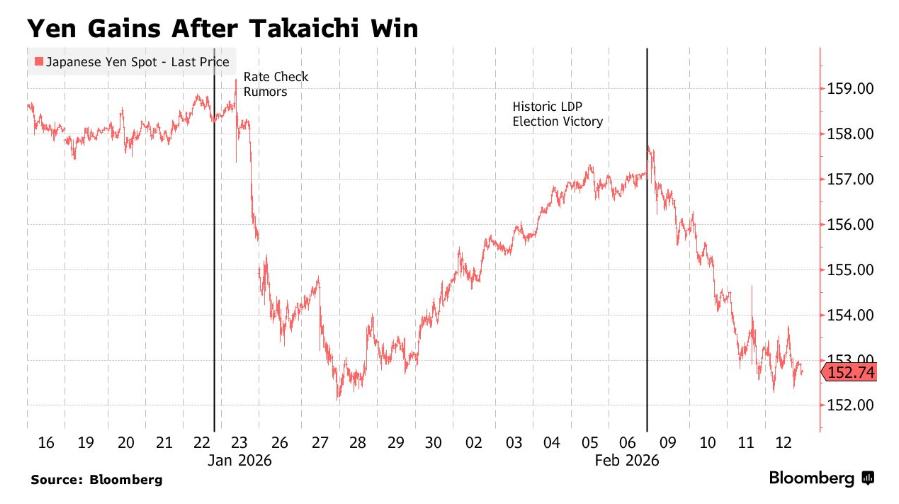
日元强势回归! 财政担忧降温+避险盘涌入 日元即将创2024年11月以来最强周涨幅
智通财经网· 2026-02-13 03:06
Core Viewpoint - The Japanese yen is experiencing significant appreciation against the US dollar, driven by market confidence in Prime Minister Fumio Kishida's electoral victory, which is expected to reduce political uncertainty and fiscal risks, while also supporting the yen amid strong demand for safe-haven assets [1][4]. Group 1: Yen Appreciation and Market Reactions - The yen has strengthened approximately 2.8% this week, marking its largest weekly gain since November 2024, following Kishida's decisive victory [1]. - The appreciation of the yen is supported by strong demand for safe-haven assets as the stock market faces significant sell-offs due to AI disruption expectations and increased risk asset sell-offs [1]. - Investors interpret Kishida's victory as a reduction in political uncertainty, which has helped push down long-term Japanese government bond yields from recent highs [1][4]. Group 2: Fiscal Policy and Market Expectations - Following the election, there is a growing expectation of a potential interest rate hike by the Bank of Japan, which has contributed to the yen's strength [4][5]. - The Japanese government remains vigilant regarding foreign exchange fluctuations, with concerns about possible coordinated interventions to support the yen [4]. - Kishida's administration is expected to implement a rare policy combination of tax cuts without worsening the fiscal deficit, potentially supported by internal funding pools [4]. Group 3: Risks of Yen Carry Trade - The yen carry trade, a highly leveraged cross-market financing strategy, poses a significant risk to global financial markets, particularly if the underlying conditions change [6][7]. - Analysts warn that the carry trade could lead to large-scale unwinding, amplifying market shocks, especially in the context of rising long-term Japanese government bond yields and expectations of fiscal stimulus [6][8]. - The potential for a rapid collapse of the carry trade, similar to past financial crises, is heightened by the current market dynamics, including rising interest rate expectations and deteriorating risk sentiment [7][8].

全球主要发达经济体降息周期预判落幕
Jin Rong Shi Bao· 2026-01-05 02:03
Group 1: Global Monetary Policy Trends - Global monetary policy is approaching a turning point, with major developed economies nearing the end of their interest rate cut cycles by 2026 [1] - The uncertainty in the global economy and international financial markets is increasing [1] Group 2: Federal Reserve's Actions - The Federal Reserve announced its last interest rate decision for 2025, lowering the federal funds rate target range by 25 basis points to 3.75%-3.5%, marking the sixth cut since the easing cycle began in September 2024 [2] - The U.S. economy faced challenges in 2025, with a rising unemployment rate of 4.4% and inflation at 3% in September, prompting the Fed to prioritize employment recovery over inflation concerns [3] - Positive economic changes were noted, with a GDP growth rate of 4.3% in Q3 2025, and a decrease in CPI growth to 2.7% in December, indicating a potential end to the current rate cut cycle [4] Group 3: Reserve Management Debt Purchase Plan - In December 2025, the Federal Reserve announced a "Reserve Management Debt Purchase" plan, starting with the purchase of $40 billion in short-term government bonds to maintain adequate reserve supply [5] Group 4: Bank of Japan's Actions - The Bank of Japan raised its benchmark interest rate by 25 basis points to 0.75% in December 2025, marking the end of an ultra-loose monetary policy era [6] - Japan's inflation rate has exceeded the central bank's 2% target for 44 consecutive months, driven by wage increases and a depreciating yen [7] - The Bank of Japan is expected to continue raising rates in 2026, potentially increasing the benchmark rate to 1.0% by the end of the year [11] Group 5: Bank of England's Actions - The Bank of England cut its interest rate by 25 basis points to 3.75% in December 2025, marking the fourth cut of the year due to rising unemployment and weak economic growth [12] - The UK unemployment rate rose to 5.1% by October 2025, the highest level since 2021, while inflation pressures eased with CPI growth at 3.2% in November [13] Group 6: European Central Bank's Actions - The European Central Bank maintained its interest rates in December 2025, indicating a pause in the rate cut cycle as inflation stabilized around the 2% target [15][16] - The Eurozone economy showed signs of moderate recovery, with a GDP growth rate of 0.3% in Q3 2025, leading to expectations that the ECB may not lower rates further and could enter a tightening phase by the end of 2026 [18] Group 7: Summary of Global Monetary Policy Outlook - The global monetary policy landscape is shifting, with major developed economies transitioning from a period of aggressive rate cuts to a potential tightening phase by 2026, as inflation pressures ease and economic conditions stabilize [19][20]
日本央行如期加息 对全球金融市场冲击几何?
Shang Hai Zheng Quan Bao· 2025-12-19 19:40
Core Viewpoint - The recent "super central bank week" highlighted a divergence in monetary policies among major economies, with Japan raising interest rates while the US and UK opted for cuts, reflecting differing economic fundamentals and impacting global capital flows [1][3]. Group 1: Central Bank Actions - On December 19, the Bank of Japan raised its policy rate by 25 basis points to 0.75%, the highest level in 30 years, marking its first rate hike in 11 months [2][3]. - The Federal Reserve and the Bank of England both cut rates by 25 basis points, with the Fed lowering its target range to 3.50% to 3.75% and the Bank of England reducing its rate to 3.75% [2][3]. - The European Central Bank decided to maintain its key rates unchanged, with the deposit rate at 2.00%, main refinancing rate at 2.15%, and marginal lending rate at 2.40% [2]. Group 2: Economic Implications - The divergence in monetary policy reflects the differences in economic fundamentals and policy goals among countries, significantly affecting global capital flows [3][6]. - The OECD report suggests that the space for further rate cuts among major economies is limited, with expectations that the easing cycle will conclude by the end of 2026 [6]. Group 3: Market Reactions and Predictions - Analysts believe that the impact of the Bank of Japan's rate hike will be limited, as the market had already priced in the increase, and the scale of carry trades has decreased over the past year [4]. - The potential for a repeat of last year's market turmoil following Japan's rate hike is considered low, with the current focus on US factors driving global liquidity and asset pricing [4][6]. - The outlook for Japan's monetary policy indicates a continued tightening trend, although challenges remain in balancing inflation control and economic support [6].