日本央行加息预期

Search documents
邦达亚洲:日本央行加息预期降温 美元日元刷新11日高位
Xin Lang Cai Jing· 2026-02-25 13:50
Group 1 - Japanese Prime Minister Fumio Kishida has pressured the Bank of Japan regarding monetary policy, leading to a rapid decline in the yen [1][6] - Kishida expressed concerns about potential further interest rate hikes during a meeting with Bank of Japan Governor Kazuo Ueda, showing a notably stronger stance compared to their previous meeting in November [1][6] - The Bank of Japan attempted to downplay the implications of political interference, stating that Kishida did not make any specific requests during the meeting [1][6] Group 2 - Boston Federal Reserve President Susan Collins indicated that due to recent economic data showing improvements in the labor market, interest rates are likely to remain unchanged for some time [2][7] - Collins noted that the labor market is showing signs of unusual stability and emphasized the need for more evidence that inflation is moving towards the 2% target [2][7] - She mentioned that after a cumulative easing of 175 basis points over the past year and a half, the current interest rate is close to a neutral level, which neither stimulates nor suppresses the economy [2][7] Group 3 - Gold prices experienced fluctuations, briefly falling below the 5100 mark, with current trading around 5210, influenced by profit-taking and hawkish comments from Federal Reserve officials [3][8] - Concerns over geopolitical tensions and trade uncertainties have limited the downside potential for gold prices [3][8] Group 4 - The USD/JPY exchange rate rose, breaking the 156.00 mark and reaching an 11-day high, trading around 155.70, supported by hawkish comments from Federal Reserve officials and Kishida's opposition to interest rate hikes [4][9] - The focus for the USD/JPY pair is on the resistance level around 156.50 and support at 155.00 [4][9] Group 5 - The USD/CAD exchange rate also increased, reaching a 12-day high and trading around 1.3680, driven by the strengthening of the US dollar due to hawkish comments from Federal Reserve officials and positive economic data [5][10] - The pair is expected to face resistance around 1.3750 and support at 1.3600 [5][10]
日本国债收益率走低 日本央行加息预期降温
Xin Lang Cai Jing· 2026-02-17 01:18
Group 1 - The Bank of Japan's recent interest rate hike expectations have cooled, leading to a decline in Japanese government bond yields [1] - Weaker-than-expected GDP data has reduced the prospects for further interest rate hikes by the Bank of Japan [1] - Investors are focusing on Prime Minister Fumio Kishida's policy measures aimed at reducing the cost of living, such as temporarily lowering the food consumption tax [1] Group 2 - The 5-year Japanese government bond yield fell by 2 basis points to 1.650% [1] - The 2-year Japanese government bond yield decreased by 1.5 basis points to 1.25% [1]
?日元强势回归! 财政担忧降温+避险盘涌入 日元即将创2024年11月以来最强周涨幅
Zhi Tong Cai Jing· 2026-02-13 03:20
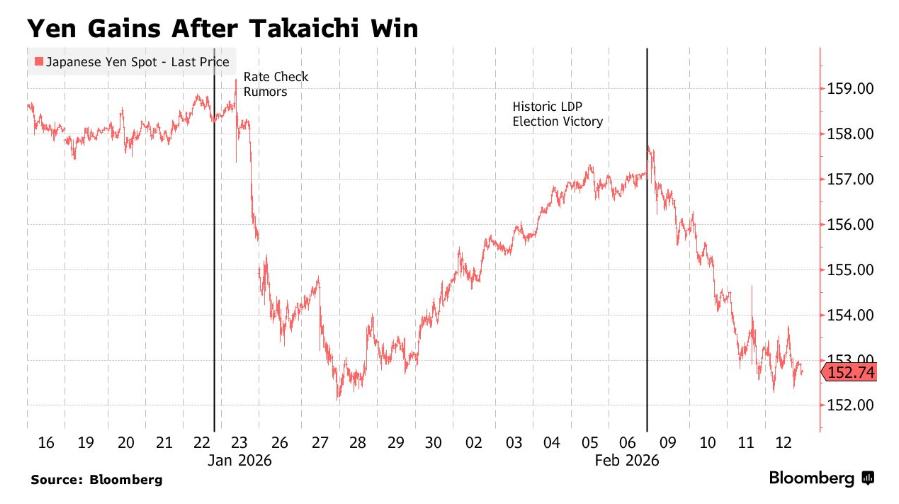
Core Viewpoint - The Japanese yen is experiencing significant appreciation, potentially achieving its largest weekly gain since November 2024, driven by reduced fiscal concerns and increased demand for safe-haven assets amid market volatility [1]. Group 1: Yen Appreciation Factors - The yen has strengthened approximately 2.8% against the US dollar this week, marking four consecutive days of appreciation [1]. - The market perceives Prime Minister Fumio Kishida's decisive victory as a reduction in political uncertainty, which has positively influenced the yen's value and led to a decline in long-term Japanese government bond yields from recent highs [1][2]. - Increased expectations for a Bank of Japan interest rate hike have also contributed to the yen's upward trend, with the probability of a rate increase in April rising to 78% [3]. Group 2: Market Reactions and Risks - The strong demand for the yen is partly due to significant sell-offs in the stock market and other risk assets, such as cryptocurrencies, which have heightened the appeal of safe-haven currencies [1]. - Concerns about the potential for large-scale unwinding of yen carry trades, which could lead to volatility across equity, bond, and currency markets, are emerging as the yen strengthens [1][4]. - The yen carry trade, a strategy that has been widely adopted due to low borrowing costs, poses systemic risks as it relies on stable interest rate differentials and a weak yen [5][6]. Group 3: Policy Implications - The Japanese government is cautious about foreign exchange fluctuations, with officials indicating a readiness to intervene if necessary to stabilize the yen [2]. - There is a potential for a unique policy combination of tax cuts without worsening the fiscal deficit, which could be supported by internal funding sources, but this may also lead to increased market volatility [2]. - The combination of rising interest rate expectations and fiscal stimulus could create conditions for significant market corrections if risk sentiment deteriorates [6].
日元强势回归! 财政担忧降温+避险盘涌入 日元即将创2024年11月以来最强周涨幅
智通财经网· 2026-02-13 03:06
Core Viewpoint - The Japanese yen is experiencing significant appreciation against the US dollar, driven by market confidence in Prime Minister Fumio Kishida's electoral victory, which is expected to reduce political uncertainty and fiscal risks, while also supporting the yen amid strong demand for safe-haven assets [1][4]. Group 1: Yen Appreciation and Market Reactions - The yen has strengthened approximately 2.8% this week, marking its largest weekly gain since November 2024, following Kishida's decisive victory [1]. - The appreciation of the yen is supported by strong demand for safe-haven assets as the stock market faces significant sell-offs due to AI disruption expectations and increased risk asset sell-offs [1]. - Investors interpret Kishida's victory as a reduction in political uncertainty, which has helped push down long-term Japanese government bond yields from recent highs [1][4]. Group 2: Fiscal Policy and Market Expectations - Following the election, there is a growing expectation of a potential interest rate hike by the Bank of Japan, which has contributed to the yen's strength [4][5]. - The Japanese government remains vigilant regarding foreign exchange fluctuations, with concerns about possible coordinated interventions to support the yen [4]. - Kishida's administration is expected to implement a rare policy combination of tax cuts without worsening the fiscal deficit, potentially supported by internal funding pools [4]. Group 3: Risks of Yen Carry Trade - The yen carry trade, a highly leveraged cross-market financing strategy, poses a significant risk to global financial markets, particularly if the underlying conditions change [6][7]. - Analysts warn that the carry trade could lead to large-scale unwinding, amplifying market shocks, especially in the context of rising long-term Japanese government bond yields and expectations of fiscal stimulus [6][8]. - The potential for a rapid collapse of the carry trade, similar to past financial crises, is heightened by the current market dynamics, including rising interest rate expectations and deteriorating risk sentiment [7][8].

日元终结五连跌 日美央行政策对决升级 技术面缺乏看涨信心
Sou Hu Cai Jing· 2026-02-06 06:26
Group 1 - The Japanese yen ended a five-day weakening trend, supported by buying interest during the Asian session, but lacks sufficient upward momentum due to ongoing policy divergence between Japan and the US [1][2] - The Bank of Japan (BOJ) has been signaling hawkish policies, with committee member Kazuyuki Masu advocating for interest rate hikes to normalize monetary policy and maintain inflation stability near the 2% target [1] - Concerns about Japan's fiscal situation and the upcoming temporary House of Representatives election are keeping investors cautious, limiting the yen's upward potential despite increased demand for it as a safe-haven currency [2] Group 2 - The market's risk sentiment has cooled, enhancing the yen's appeal as a traditional safe-haven currency, but the sustainability of this rebound faces multiple constraints [2] - The divergence in monetary policy between Japan and the US is exacerbated by market speculation regarding the potential appointment of Kevin Warsh as the next Federal Reserve Chair, impacting global liquidity expectations [1] - Technical indicators show that the upward momentum for the dollar against the yen is slowing, and if support levels are not maintained, a correction in the short-term trend may occur, indicating a lack of clear bullish confidence for the yen [2]
美日汇率巨震500点 日债曲线平坦化引加息预期升温
Jin Tou Wang· 2026-01-27 02:24
Core Viewpoint - The dramatic decline of the USD/JPY exchange rate on January 26, 2023, was primarily driven by market expectations of coordinated foreign exchange intervention by the US and Japan, reshaping traders' perceptions of the Bank of Japan's monetary policy and the pricing expectations in the Japanese bond market [1] Group 1: Market Reactions - The USD/JPY experienced a significant drop from a high of 159.213 to a low of 153.684, with a single-day fluctuation exceeding 500 points, triggering a chain reaction in the Japanese government bond market [1] - The market's shift in sentiment was largely influenced by reports of the New York Federal Reserve conducting currency inquiries, interpreted as a signal for potential joint intervention to curb the depreciation of the yen [1] Group 2: Japanese Bond Market Dynamics - Participants in the Japanese bond market are divided over the assessment of the Bank of Japan's interest rate path, with one side believing that effective currency intervention would reduce the urgency for the central bank to raise rates, while the other speculates that the New York Fed's actions may prompt the Bank of Japan to raise rates to combat imported inflation [2] - The yield curve exhibited a flattening pattern, with short-term rates rising and long-term rates falling, reflecting market pricing for a potential early rate hike by the Bank of Japan [2] - As of January 26, the probability of a 25 basis point rate hike at the Bank of Japan's March meeting increased from 25% to 31%, with expectations for the April meeting exceeding 80% [2] Group 3: Technical Analysis - The recent decline in the USD/JPY is significant on the 240-minute candlestick chart, with prices breaking through multiple key moving averages and the lower Bollinger Band [3] - Key support levels are identified between 153.35 and 153.60, which is crucial for psychological and technical convergence, while resistance levels are noted between 154.80 and 155.60, marking the initial resistance zone following the intervention-related panic [3] - A stronger resistance zone is identified between 156.50 and 157.50, which includes previous low points and the declining middle Bollinger Band, indicating potential selling pressure if prices rebound into this range [3]
STARTRADER :日银维稳利率 日元走弱倒逼4月加息?
Sou Hu Cai Jing· 2026-01-23 05:54
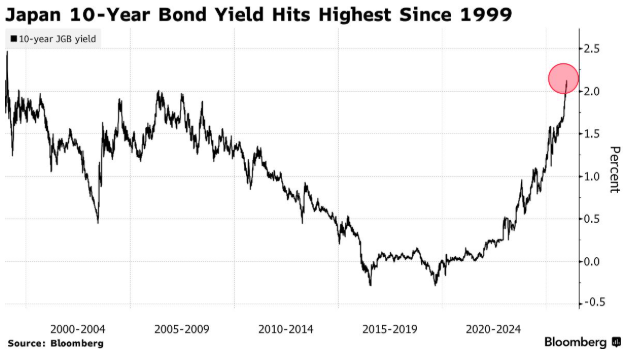
Core Viewpoint - The Bank of Japan (BOJ) decided to maintain the policy interest rate at 0.75%, aligning with market expectations, while one member voted for a rate hike to 1% [1][3] Group 1: Economic Indicators - Japan's core CPI rose by 3.1% year-on-year in 2025, exceeding the 2% target for four consecutive years, indicating persistent inflationary pressure [3] - The BOJ raised its GDP growth forecast for the fiscal year 2025 to 0.9%, reflecting moderate economic growth [3] - The 10-year Japanese government bond yield has reached a high of 2.239%, indicating rising bond yields amid concerns over the BOJ's policy lagging behind inflation [3] Group 2: Currency and Interest Rate Dynamics - The Japanese yen depreciated to 158.61 against the US dollar, approaching the intervention threshold of 160, driven by the widening interest rate differential with the US [1][4] - The actual interest rate differential between Japan and the US remains around 1.58%, diminishing the attractiveness of the yen [4] - Market expectations for a potential rate hike in April have increased, with a 58% probability of a 25 basis point increase if the yen breaches the 160 mark [4] Group 3: Policy Considerations and Market Reactions - The BOJ's decision to hold rates is seen as a balance between economic resilience and the need for policy adjustment [3] - There is a divergence in market expectations regarding the timing and necessity of a rate hike, with some analysts suggesting a delay until June or July [4] - Key variables influencing future policy include April wage growth data, core inflation trends, and the outcome of the upcoming elections [5]

普徕仕:预计日本央行本周会议按兵不动 或较预期提早加息
Zhi Tong Cai Jing· 2026-01-22 06:13
Core Viewpoint - The Bank of Japan is expected to maintain its current monetary policy in the upcoming meeting, although there are indications that an interest rate hike may occur earlier than anticipated, potentially in June or July [1] Group 1: Monetary Policy and Interest Rates - Market expectations suggest that the Bank of Japan may raise interest rates sooner than previously thought, despite the current stance of maintaining the status quo [1] - The reliance on verbal interventions alone is deemed insufficient to reverse the weakness of the Japanese yen [1] Group 2: Currency and Market Dynamics - The Japanese yen has been underperforming against other major currencies, and there is a significant risk of further depreciation due to the Bank of Japan's potentially lagging policy response [1] - The recent volatility in the Japanese government bond market, particularly in long-term bonds, is attributed to a lack of strategic capital allocation, making prices more sensitive to market conditions [1] Group 3: Future Outlook - The current market volatility in Japanese government bonds is expected to persist until 2026, indicating ongoing challenges in the bond market [1]
非农夜暴击!美日汇率大变局?日本数据引爆加息猜想
Jin Tou Wang· 2026-01-09 12:56
Group 1 - Japan's household spending in November 2025 surged by 6.2% month-on-month, reversing a 3.5% decline in October, and showed a year-on-year growth of 2.9%, compared to a 2.9% decline in October [1] - The strong spending data supports hawkish views within the Bank of Japan, potentially leading to an increase in neutral interest rates and the tightening of monetary policy [1] - Private consumption accounts for approximately 55% of Japan's GDP, indicating that robust consumer spending could drive demand-pull inflation, reinforcing the central bank's stance on tightening [1] Group 2 - The upcoming U.S. non-farm payroll report is expected to significantly influence market expectations regarding the Federal Reserve's interest rate cuts in March 2026, with economists predicting an increase of 60,000 jobs in December [2] - The ISM services PMI rose from 52.6 in November to 54.4 in December, indicating resilience in the U.S. economy and reducing the likelihood of a rate cut in March [2] - The expectation of continued rate hikes by the Bank of Japan, combined with a potentially dovish stance from the new Federal Reserve chair, remains a key factor influencing the medium-term outlook for the USD/JPY exchange rate [2] Group 3 - Technically, the USD/JPY is currently above the 50-day (155.22) and 200-day (151.56) exponential moving averages (EMA), indicating a bullish tendency; however, the prevailing bearish fundamentals are overshadowing this technical signal [3] - A break below the 50-day moving average and the key support level of 155 could accelerate downward momentum, with the 200-day moving average serving as significant support [3] - If the exchange rate consistently falls below the 50-day and 200-day EMAs, it would further reinforce a medium-term bearish price trend [3]
2026年首场日本国债拍卖稳健 但加息预期压制需求前景
智通财经网· 2026-01-06 07:04
Group 1 - The auction of Japan's 10-year government bonds was successful, attracting many investors seeking high yields, with a subscription ratio of 3.30 compared to 3.59 in the last issuance and an average of 3.24 over the past 12 months [1] - Japan's government bond yields have recently risen to multi-decade highs, with the 10-year yield reaching its highest level since 1999 this week [1] - The market is weighing the Bank of Japan's interest rate hike path and Prime Minister Kishida's spending plans, leading to increased uncertainty regarding future interest rates [2] Group 2 - Analysts noted that the strong demand for the first Japanese government bond auction of the year was within recent ranges, although the bond futures softened post-issuance [2] - Most observers expect the next interest rate hike from the Bank of Japan around mid-year, but some believe it could occur sooner due to the weak yen [2] - The Japanese government plans to reduce the issuance of ultra-long government bonds following the announcement of a record budget draft for the new fiscal year starting in April [3]