
日本和平宪法

Search documents
外交部:无论日本领导人是谁,都必须恪守中日四个政治文件
Ren Min Ri Bao· 2026-02-09 08:07
Core Viewpoint - The Chinese government maintains a firm stance against interference in its internal affairs and emphasizes the importance of adhering to established political agreements with Japan, regardless of the political leadership in Japan [1]. Group 1: China's Position on Japan - The Chinese government does not interfere in the internal affairs of other countries and opposes any actions that infringe upon its core interests or violate international law [1]. - China's policy towards Japan is described as clear, stable, and consistent, indicating a long-term approach to bilateral relations [1]. - The Chinese government insists that Japan must adhere to the four political documents between China and Japan, as well as Japan's pacifist constitution, fulfilling its commitments and international obligations [1].
外交部:无论日本领导人是谁都必须恪守中日四个政治文件
Yang Shi Xin Wen· 2026-02-09 07:32
Core Viewpoint - The Chinese government emphasizes its non-interference policy in other countries' internal affairs while firmly opposing any actions that infringe upon China's core interests and violate international law [1] Group 1: China's Position on Japan - The Chinese government maintains a clear, stable, and consistent policy towards Japan, regardless of the Japanese leadership or ruling party [1] - China insists that Japan must adhere to the four political documents between China and Japan, as well as fulfill its commitments under the Japanese Constitution and international obligations [1]
日本有识之士批评高市错误言论 呼吁恪守一个中国原则
Yang Shi Xin Wen Ke Hu Duan· 2026-02-04 13:56
Group 1 - The recent remarks by Japanese Prime Minister Sanae Takaichi have been criticized for undermining the political foundation between Japan and China, violating international consensus [1] - The principle of "One China" asserts that the government of the People's Republic of China is the only legitimate government representing all of China, and Taiwan is an inseparable part of its territory [1] - Takaichi's comments regarding Taiwan potentially constituting a "crisis situation" for Japan are seen as a blatant violation of the "One China" principle and the 1972 Japan-China Joint Statement and the 1978 Japan-China Peace and Friendship Treaty [1] Group 2 - Recent security policies promoted by Japan are viewed as contrary to the spirit of Japan's "Peace Constitution" and inconsistent with the post-war peace trajectory [2] - There are allegations that Japan's so-called "security legislation" may violate the constitution, which includes a pledge that Japan will never again engage in acts of aggression [4] - The development of Japan is believed to be closely tied to its relationship with China, emphasizing the importance of maintaining positive diplomatic relations [4]

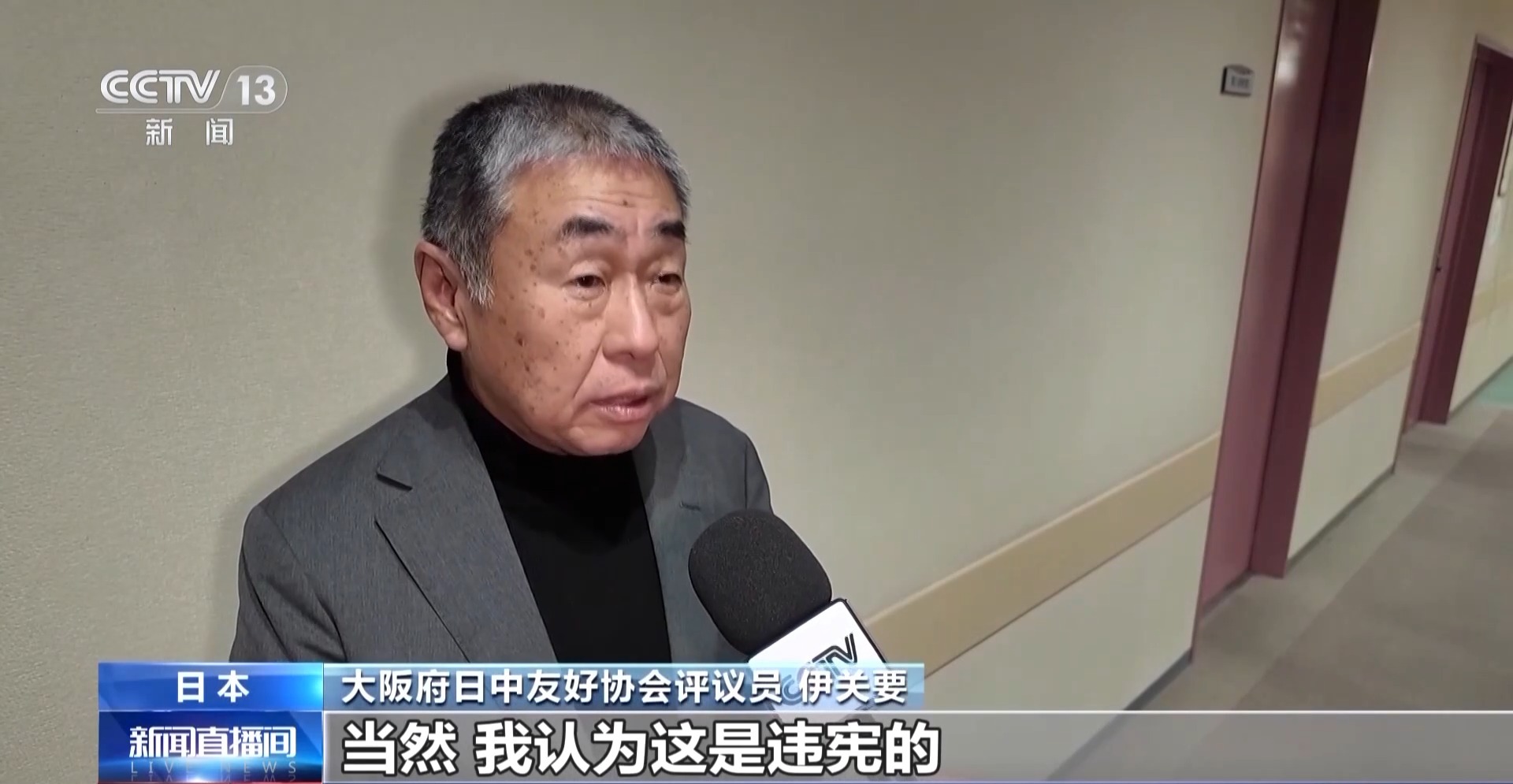
视频丨日本有识之士批评高市错误言论 呼吁恪守一个中国原则
Yang Shi Xin Wen Ke Hu Duan· 2026-02-04 11:41
Group 1 - The core viewpoint of the articles highlights the serious implications of Japanese Prime Minister Sanna Takashi's recent statements regarding Taiwan, which are seen as a violation of the One China principle and detrimental to Sino-Japanese political foundations [1][3] - The Osaka Prefectural Japan-China Friendship Association's council member, Ikan Yao, emphasizes that Takashi's remarks could be interpreted as Japan facing a "survival crisis," which blatantly undermines the One China principle and the agreements established in the 1972 Japan-China Joint Statement and the 1978 Japan-China Peace and Friendship Treaty [1] - Ikan Yao also criticizes Japan's recent security policies, arguing that they contradict the spirit of Japan's "Peace Constitution" and deviate from the post-war peace trajectory [1][3] Group 2 - Ikan Yao asserts that the so-called "security legislation" raises constitutional concerns, as Japan's constitution includes a pledge to never engage in acts of aggression [3] - The importance of maintaining a positive relationship with China is highlighted as crucial for Japan's future development [3]
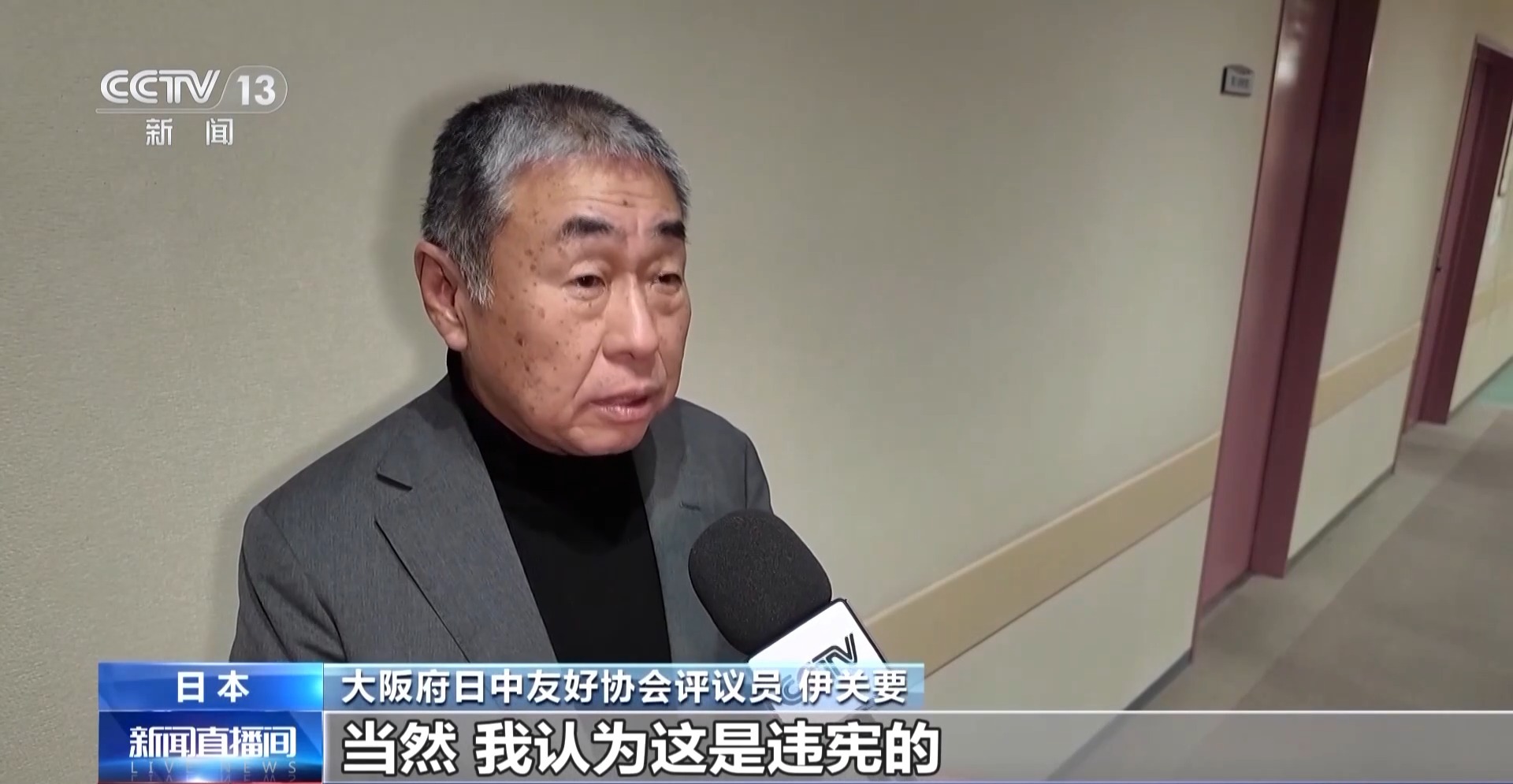
视频丨日本政界人士:高市错误言论动摇日中关系基础 极度危险
Yang Shi Xin Wen Ke Hu Duan· 2025-12-23 11:44
Group 1 - Japanese Prime Minister Sanae Takaichi's remarks regarding Taiwan have drawn strong criticism from various Japanese political figures, highlighting a significant discontent within the political landscape [1][3] - Senator Takaichi's statement equating "Taiwan's situation" with "Japan's situation" suggests that Japan could be drawn into conflict even without direct attacks, which poses a serious threat to Japan's principle of pacifism [3][5] - The comments are seen as undermining the political foundation established during the normalization of Japan-China relations in 1972, which emphasized respect for China's stance on Taiwan [5][10] Group 2 - The current Japanese government's military expansion is viewed as a violation of the pacifist constitution, raising concerns about its implications for Japan's security policy [6][8] - Senator Takaichi emphasized that Japan's constitution, particularly Article 9, prohibits the possession of offensive military capabilities, which contradicts the government's current military strategies [8][10] - The government is criticized for using the pretext of a deteriorating security environment to justify military expansion, which is seen as a departure from Japan's post-war commitment to peace [10]

国际人士表示高市早苗错误言论破坏地区及世界和平稳定
Yang Guang Wang· 2025-11-25 07:25
Group 1 - The statements made by Japanese Prime Minister Kishi Nobuo are seen as a serious violation of international law and basic principles of international relations, potentially undermining regional and global peace and stability [1][2] - Russian officials express that Kishi's remarks are provocative and an attempt to escape historical truths, challenging post-World War II international agreements, especially during the 80th anniversary of the victory in the anti-fascist war [1] - Concerns are raised about the implications of Kishi's comments on Taiwan, which are viewed as dangerous and indicative of a resurgence of militarism in Japan, prompting calls for international condemnation [1][2] Group 2 - Former Japanese Prime Minister Yukio Hatoyama criticizes Kishi's assertion regarding Taiwan, stating that it could lead Japan into a "survival crisis" and justifies China's criticism [2] - Japanese scholars highlight that Kishi's statements contradict Japan's pacifist constitution and violate international law, particularly regarding military intervention in Taiwan [2] - The remarks made by Kishi are characterized as reckless and a significant misstep, with implications for Japan's diplomatic stance on Taiwan and its adherence to the one-China principle [2]