日本军事扩张

Search documents
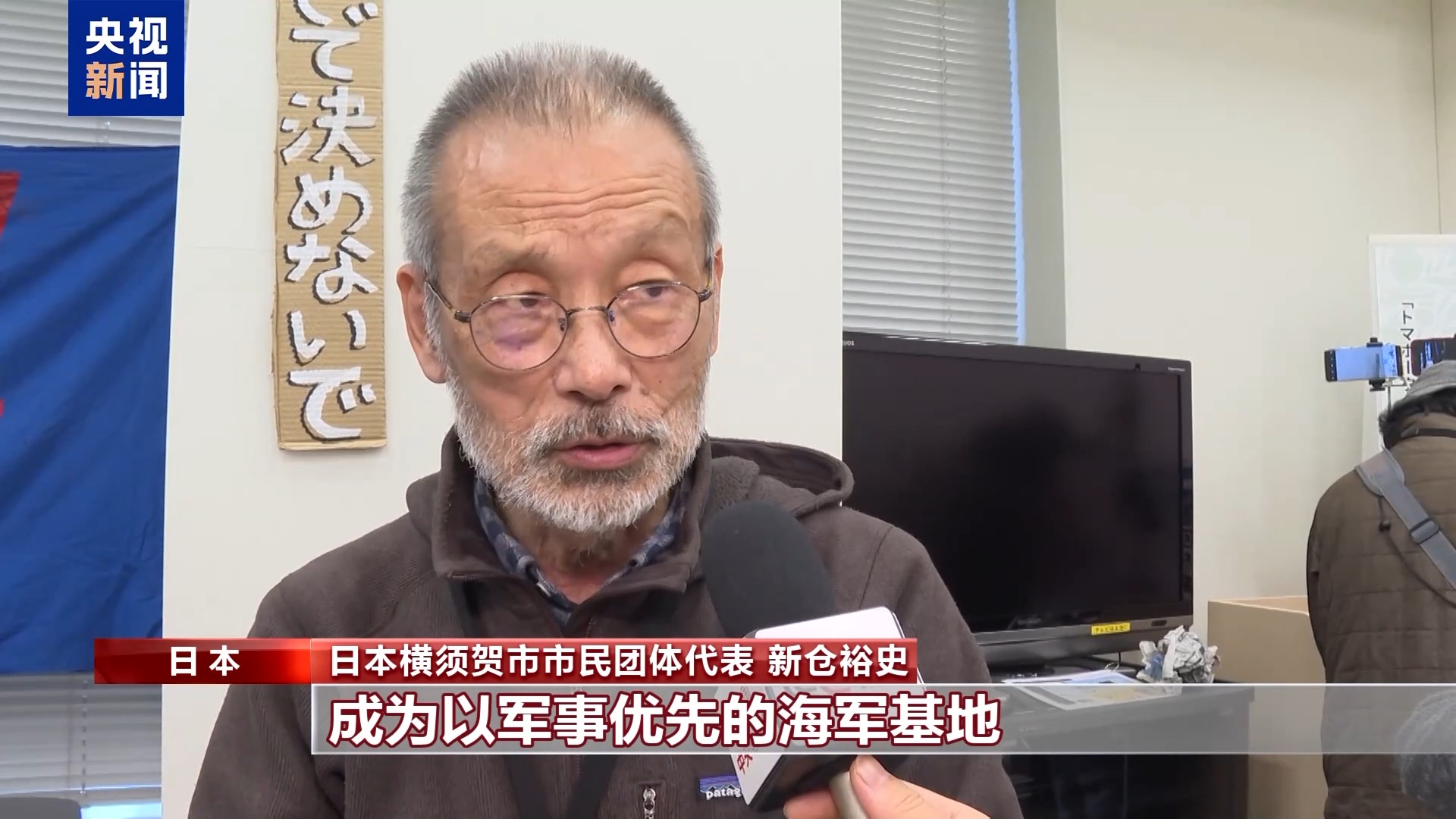
日本多地市民团体集会反对部署“战斧”导弹
Xin Lang Cai Jing· 2026-02-20 05:14
Core Viewpoint - Japan plans to procure approximately 400 U.S. "Tomahawk" cruise missiles from FY2025 to FY2027, which has sparked significant public opposition in various cities, including Yokosuka and Kure, where citizens are concerned about the implications of military expansion and the potential alteration of Japan's pacifist constitution [1][3][4]. Group 1: Public Opposition - Citizen groups in Yokosuka have collected over 30,000 signatures opposing the deployment of "Tomahawk" missiles, emphasizing a desire for peaceful resolutions to conflicts and a rejection of military expansion [1][3]. - Representatives from local citizen groups express concerns that the deployment of "Tomahawk" missiles signifies a return to militarization reminiscent of pre-World War II Japan, contradicting the post-war pacifist constitution [3][4]. Group 2: Defense Budget and Military Expansion - Japan's defense budget has been increasing for 13 consecutive years, with the FY2026 budget focusing on acquiring long-range missiles and attack drones for coastal defense systems [3]. - There is a growing fear among local groups that the current government may amend the constitution to allow Japan to engage in warfare, marking a significant shift in national policy [4]. Group 3: Societal Concerns - Citizens express anxiety about the militarization trend in Japan, particularly in cities historically associated with peace, such as Hiroshima, and the impact this may have on future generations [6]. - The desire for a peaceful society is a common sentiment among citizens, who wish to protect their children from the looming threat of war [6].

日本国内认为高市政府正将日本引向“战争国家”,专家:日本想打的不是一般小仗,它想打大战
Xin Lang Cai Jing· 2026-01-24 11:20
Core Viewpoint - Japan is significantly increasing its defense budget and continuously revising its "security three documents," leading to concerns that the government is steering the country towards becoming a "war nation" [1] Group 1: Defense Budget and Military Strategy - The Japanese government is enhancing its long-range strike capabilities and preparing for large-scale military operations in coordination with the United States in the Asia-Pacific region and globally [1] - The current development direction of the Self-Defense Forces includes advanced military assets such as stealth fighters and aircraft carriers, indicating a shift towards more aggressive military posturing [1] Group 2: Potential Consequences - Military commentator Du Wenlong warns that Japan's efforts to achieve victory against major powers independently are highly challenging and could lead to severe losses, potentially worse than those experienced in World War II [1] - Engaging in a war logic could result in catastrophic consequences for Japan, with the possibility of facing overwhelming devastation [1]
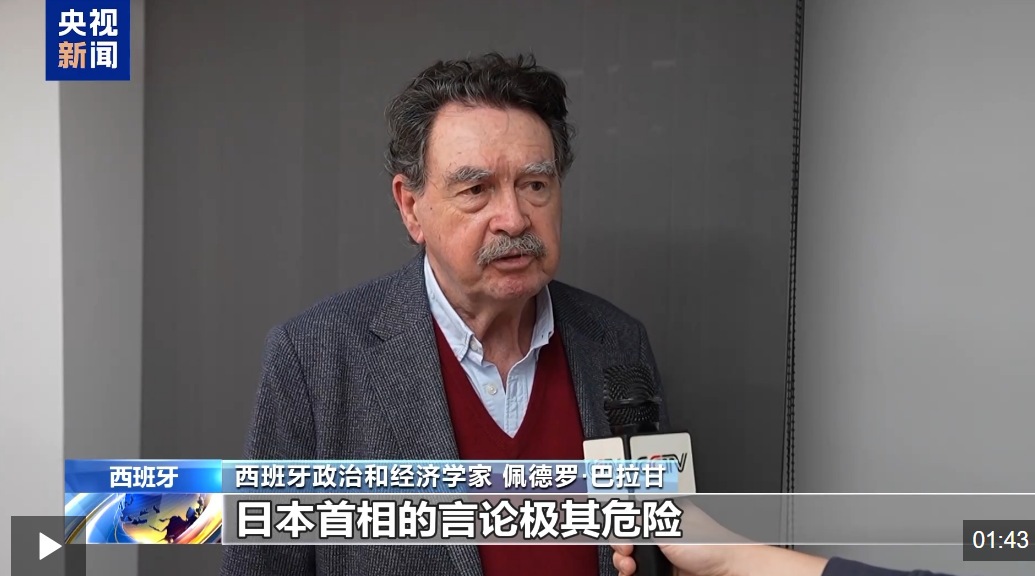
视频丨国际人士:日本首相高市早苗错误言论极其危险
Yang Shi Xin Wen Ke Hu Duan· 2026-01-20 02:22
Core Viewpoint - The recent statements and military expansion plans by Japanese Prime Minister Sanae Takaichi have raised significant concerns and criticisms from the international community, indicating a shift towards a more aggressive stance in Japan's foreign policy [1][3][4]. Group 1: Statements and Reactions - Multiple international figures have expressed that Takaichi's remarks are extremely dangerous, as they involve aggressive interference in neighboring countries' internal affairs and threaten military intervention in Taiwan [3]. - Takaichi's comments about Taiwan being a "survival crisis" for Japan have been labeled as unreasonable and a source of tension in the Asia-Pacific region [6]. Group 2: Military Expansion and Policy Changes - The Japanese government is perceived to be abandoning its long-standing pacifist policies enshrined in its constitution, moving towards a confrontational military expansion strategy that disrupts regional peace [4]. - There are concerns that Japan is reviving militarism, with discussions around nuclear armament, which could have serious implications for regional stability [3].
日本拟明年底前修订“安保三文件” 专家:只会让其面临更严峻困境
Yang Shi Xin Wen Ke Hu Duan· 2025-12-31 02:18
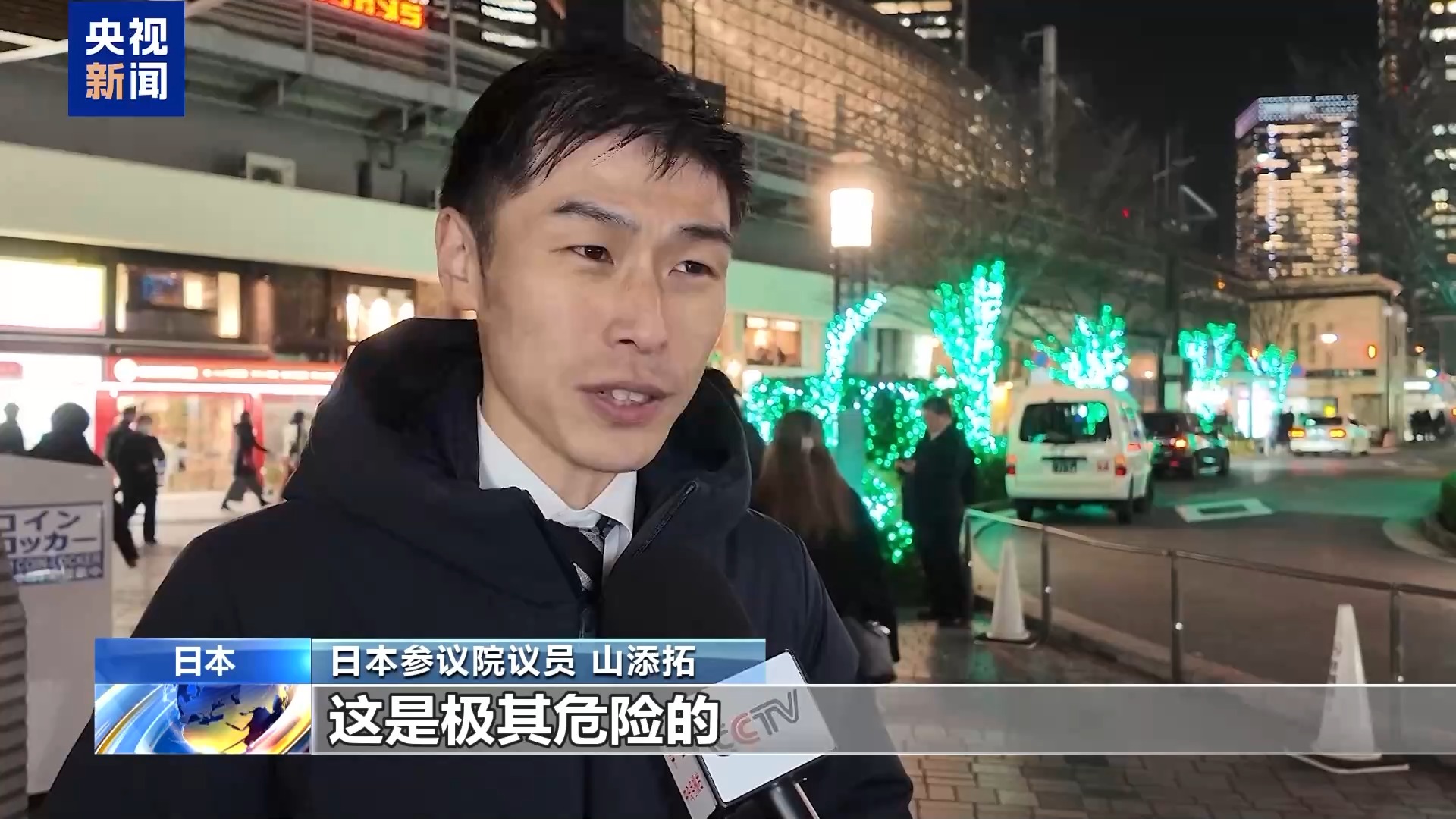
Core Viewpoint - The Japanese government, under Prime Minister Fumio Kishida, is planning to revise its "Three Security Documents" by the summer of 2026, aiming to accelerate military expansion and potentially modify the "Three Non-Nuclear Principles" [1][3][9] Group 1: Military Expansion Plans - The government intends to create a summary plan that will include concepts for Pacific defense and new combat methods utilizing drones, along with possible increases in defense spending targets [1] - The "Three Security Documents," which include the National Security Strategy, National Defense Strategy, and Defense Force Build-Up Plan, were established in 2022 and emphasize Japan's need for "counterstrike capabilities" [1] - The revision aims to significantly increase Japan's defense budget, establish missile units outside its defense zones, and strengthen military presence in the southwestern islands [1] Group 2: Changes to Nuclear Policy - There are discussions about potentially modifying the "Three Non-Nuclear Principles," which traditionally prohibit the introduction of nuclear weapons into Japan [3][6] - The revision of the "Three Security Documents" is seen as a fundamental shift in Japan's security strategy, moving away from post-war self-defense principles [9] Group 3: Domestic Reactions - The acceleration of military expansion under the Kishida administration has sparked strong discontent among various sectors in Japan [6] - Concerns have been raised regarding the lack of a clear stance from the Prime Minister on maintaining the "Three Non-Nuclear Principles," which has shocked some lawmakers [8]

视频丨日本政界人士:高市错误言论动摇日中关系基础 极度危险
Yang Shi Xin Wen Ke Hu Duan· 2025-12-23 11:44
Group 1 - Japanese Prime Minister Sanae Takaichi's remarks regarding Taiwan have drawn strong criticism from various Japanese political figures, highlighting a significant discontent within the political landscape [1][3] - Senator Takaichi's statement equating "Taiwan's situation" with "Japan's situation" suggests that Japan could be drawn into conflict even without direct attacks, which poses a serious threat to Japan's principle of pacifism [3][5] - The comments are seen as undermining the political foundation established during the normalization of Japan-China relations in 1972, which emphasized respect for China's stance on Taiwan [5][10] Group 2 - The current Japanese government's military expansion is viewed as a violation of the pacifist constitution, raising concerns about its implications for Japan's security policy [6][8] - Senator Takaichi emphasized that Japan's constitution, particularly Article 9, prohibits the possession of offensive military capabilities, which contradicts the government's current military strategies [8][10] - The government is criticized for using the pretext of a deteriorating security environment to justify military expansion, which is seen as a departure from Japan's post-war commitment to peace [10]
2025,日本加速右倾的一年
Xin Lang Cai Jing· 2025-12-23 04:37
Core Viewpoint - Japan is experiencing a significant political shift towards the right, driven by social and economic anxieties, as evidenced by the recent elections and the rise of far-right political forces [2][3][4]. Political Landscape - The July 2025 Senate elections marked a turning point, with the ruling Liberal Democratic Party (LDP) and its ally Komeito suffering losses, while the far-right party made significant gains, winning 14 seats [2]. - The election results reflect a broader societal shift towards right-wing politics, influenced by global trends [2]. - The election of Sanae Takaichi as Prime Minister represents a strategic move by the LDP to regain conservative voters amid crises [3]. Military and Defense Budget - Japan's defense budget is set to reach approximately 11 trillion yen for the 2025 fiscal year, marking a historical peak and achieving the goal of defense spending constituting 2% of GDP two years ahead of schedule [6][7]. - The focus of the defense budget includes enhancing "counterattack capabilities" and establishing new military bases in strategic locations [7]. - Legal frameworks are being adjusted to facilitate military expansion, including plans to significantly relax weapon export restrictions [7][8]. Societal Concerns - Rising social anxieties, including stagnant wages and high inflation, are contributing to a growing sense of disillusionment among the Japanese populace [4][9]. - The political climate has led to an increase in nationalist sentiments and anti-immigrant rhetoric, which far-right parties are capitalizing on [4][9]. Economic Policies - The government has proposed a comprehensive economic strategy with a spending plan of 21.3 trillion yen aimed at boosting the economy and defense spending [11]. - However, there are concerns regarding the sustainability of these policies, especially given Japan's high national debt, which stands at 250% of GDP [11]. - The potential deterioration of Japan-China relations could further complicate economic recovery efforts, as trade between the two countries exceeds 300 billion USD annually [11].
【环时深度】2025,日本加速右倾的一年
Huan Qiu Shi Bao· 2025-12-22 22:41
Core Viewpoint - Japan is experiencing a significant political shift towards the right, driven by social and economic anxieties, as evidenced by the recent elections and the rise of extreme right parties [3][4][5]. Political Developments - The 2025 summer elections marked a turning point, with the ruling Liberal Democratic Party (LDP) and its ally Komeito suffering losses, while the extreme right party gained 14 seats, indicating a broader societal shift to the right [3][4]. - The election results reflect Japan's susceptibility to global political trends, with analysts suggesting that mainstream parties may adopt more exclusionary policies to compete for votes [3][4]. - The appointment of Sanae Takaichi as Prime Minister represents a strategic move by the LDP to regain conservative voters, aligning with a more hardline nationalist agenda [4][5]. Economic Context - Japan's defense budget is set to reach a historical peak of approximately 11 trillion yen for the 2025 fiscal year, marking a continuous increase for 14 years [6][7]. - The government is focusing on enhancing offensive military capabilities, including the establishment of a joint operations command and the reorganization of military units [7]. - Economic policies under Takaichi aim to balance public welfare and defense spending, but face criticism for being outdated and potentially harmful in the context of rising inflation and national debt [11]. Social Dynamics - Rising social discontent, characterized by stagnant wages and high inflation, has fueled a populist sentiment that extreme right parties are capitalizing on [5][9]. - The political climate is marked by increasing polarization, which may hinder Japan's ability to address structural challenges such as an aging population [9][10]. International Relations - Japan's military expansion and rightward shift have raised concerns among neighboring countries, with potential implications for regional security dynamics [6][8]. - The government's discussions around nuclear policy and military capabilities have sparked domestic and international debates, reflecting a departure from Japan's post-war pacifism [8][10].
帅化民怒斥日本:在宫古 巴士海峡布雷达 刀都架中国脖子上了 还要我跟你“理性对话”?
Xin Lang Cai Jing· 2025-12-21 08:23
Group 1 - The core viewpoint of the article highlights Japan's military expansion in the southwestern region, particularly the deployment of radar in the Miyako Strait and the Bashi Channel, which is perceived as a direct threat to China's naval routes [1] - The article criticizes the inconsistency of Japan's rhetoric, where it calls for "rational dialogue" while simultaneously increasing military presence near Taiwan, leading to a loss of credibility in its claims of peace [1] - The commentary suggests that Japan's military actions are transparent in their intentions, indicating that the facade of peaceful dialogue is no longer credible given the aggressive military positioning [1]
高市早苗错误言论已致日本旅游业遇冷 日本民众再次举行抗议集会
Yang Guang Wang· 2025-12-12 00:22
Group 1 - The core viewpoint of the article highlights that Japanese Prime Minister Sanna Takashi's recent controversial statements have led to a significant decline in Japan's tourism industry, particularly affecting flight bookings to Osaka [1] - Flight bookings from China to Osaka have decreased by 55%-65% for the upcoming winter and spring seasons, indicating a substantial impact on the tourism sector [1] - A research team from the University of Tokyo estimates that if the current situation persists for six months, the economic losses in related sectors such as retail and transportation could exceed 2 trillion yen [1] Group 2 - Protests were held in Tokyo, where citizens demanded Prime Minister Takashi to retract his controversial statements and opposed Japan's military expansion [1] - A senior media figure, Soko Nariyuki, expressed concerns about the historical awareness among Japanese politicians, suggesting that the education system has downplayed Japan's wartime aggression, leading to a lack of understanding among the younger generation [1]
高市早苗何以有恃无恐,日本自卫队图穷匕见露出獠牙
Zhong Guo Xin Wen Wang· 2025-11-19 02:57
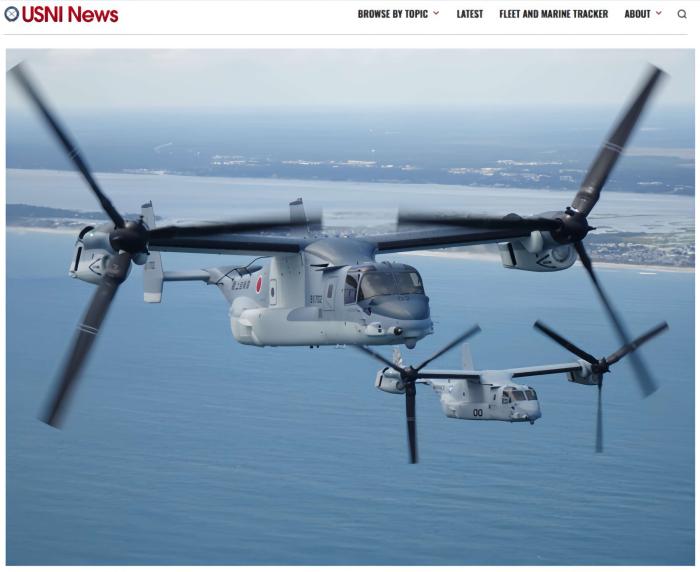
Group 1 - Japanese Prime Minister Kishi Nobuo has made provocative statements regarding Taiwan and is considering modifying the "Three Non-Nuclear Principles" to allow allied nuclear-armed vessels to dock in Japan [1] - The Japan Self-Defense Forces (JSDF) have significantly accelerated their military preparedness, enhancing capabilities in long-range attacks, amphibious operations, mine-sweeping, anti-submarine warfare, air defense, and reconnaissance [1][4] - The Ground Self-Defense Force has established seven coastal missile units, creating a comprehensive missile network across Japan, with plans to upgrade to the extended-range Type 12 anti-ship missile with a range of 1,000 kilometers starting in 2026 [1] Group 2 - The JSDF is acquiring 17 Osprey transport aircraft to bolster island seizure capabilities, stationed at Saga Airport for rapid deployment support [4] - The Maritime Self-Defense Force has explicitly stated its intention to enhance land attack capabilities, which contradicts Japan's pacifist constitution and presents an aggressive military posture [4] Group 3 - Japan is expediting the commissioning of new lithium battery submarines and has allocated 1.94 trillion yen for the construction of two new warships equipped with long-range missile detection radars [5] - The modifications to the "Kaga" and "Izumo" carriers are nearing completion, with the "Izumo" set to feature a 170-meter ski jump and expected to be operational by the fiscal year 2027 [5] Group 4 - The Air Self-Defense Force is accelerating the deployment of F-35A stealth fighters, with 47 aircraft already received by various squadrons, aiming for a total of nearly 150 F-35A/B aircraft [6] Group 5 - Japan is modernizing military infrastructure nationwide and significantly increasing ammunition reserves, with a budget increase of four times to over 800 billion yen for the fiscal year 2023 [7] - Plans include the procurement of 400 Tomahawk cruise missiles and the deployment of up to 1,500 long-range missiles by 2032 [7] - Japan is also enhancing domestic arms production capabilities and supporting numerous startups in the defense sector across various fields, including drones and electronic warfare [7]