日股上涨

Search documents
《海外非美经济探究》系列第五篇:解构日元贬值与日股大涨之谜
EBSCN· 2026-01-20 01:28
Group 1: Currency Dynamics - The Japanese yen depreciated by 0.9% against the US dollar since 2026, while the Japanese stock market surged by 7.1%[1] - The depreciation of the yen cannot be solely explained by narrowing interest rate differentials, as it is influenced by three factors: weak sustainability of US-Japan interest rate differentials, imbalances in the international balance of payments, and uncertainties in Japan's economic recovery[2] - The yen's depreciation is exacerbated by structural trade imbalances and capital outflows, with net foreign investment in Japanese securities reaching -1.58 trillion yen as of December 2025[20] Group 2: Stock Market Drivers - The Nikkei 225 index rose by 26.2% in 2025 and 7.1% in early 2026, driven by high inflation, moderate economic recovery, and government fiscal policies[24] - Key factors supporting the stock market include high inflation leading to increased corporate profits, expectations of fiscal expansion under Prime Minister Kishida, and strong exports in the AI sector[3] - The fiscal budget for 2025 saw a 31.0% increase in supplementary budget and a 6.3% increase in the initial budget compared to the previous fiscal year, indicating a commitment to economic stimulus[10] Group 3: Future Outlook - The Japanese stock market is expected to maintain high levels in 2026, with potential boosts from rising consumer spending as inflation recedes and real income levels improve[4] - The yen may continue to face pressure in the first half of 2026, but there is potential for a reversal in the second half as the Federal Reserve enters a rate-cutting cycle, narrowing the interest rate differential[5] - The yield curve for Japanese government bonds is anticipated to exhibit a "bear steepening" trend in the first half and a "bear flattening" trend in the second half of 2026[6]
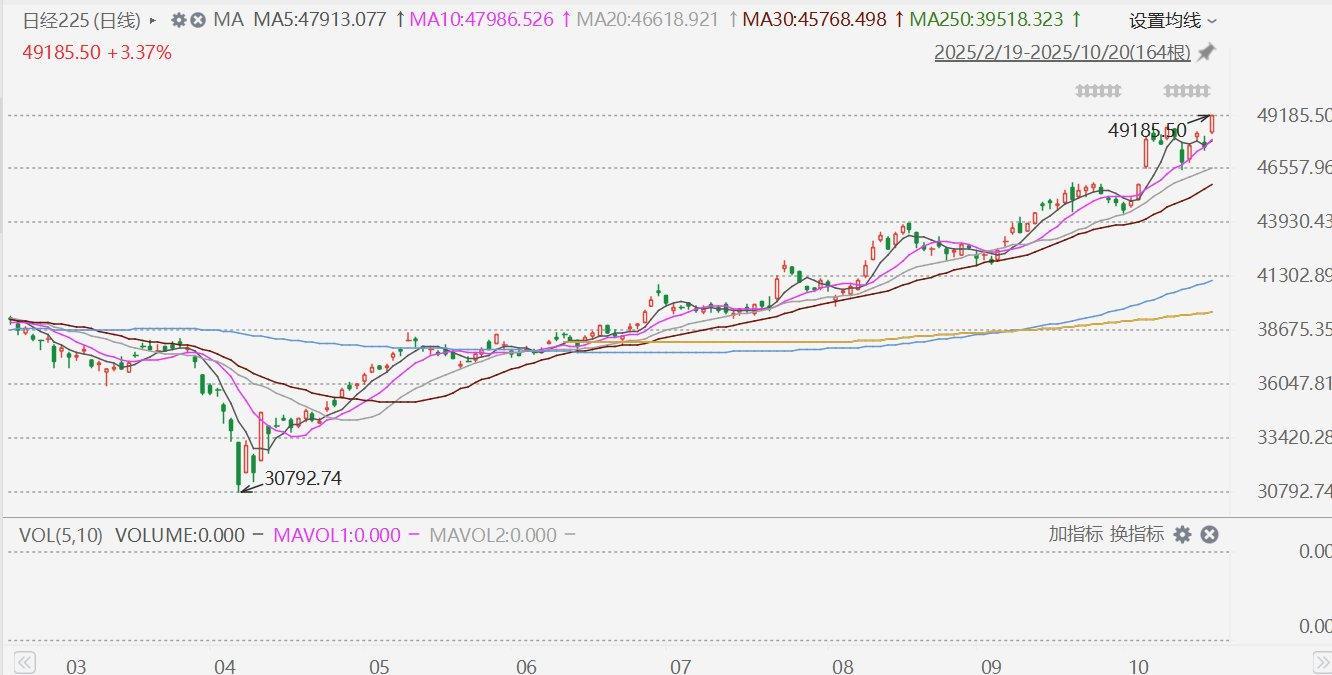
高市早苗出任日本首相几成定局,日股涨3.37%报49185.5点,收在历史最高位!日经225指数年内累涨23.29%
Ge Long Hui· 2025-10-20 07:10
Group 1 - The core viewpoint of the article indicates that the path for Takamori Asano to become Prime Minister is almost certain, leading to a significant rise in the Japanese stock market [1] - The Nikkei 225 index closed up by 3.37%, reaching 49,185.5 points, marking a historical high [1] - The Nikkei 225 index has increased by 23.29% year-to-date [1]

史上首次升破43000点,日经225指数再创新高
Feng Huang Wang· 2025-08-13 02:30
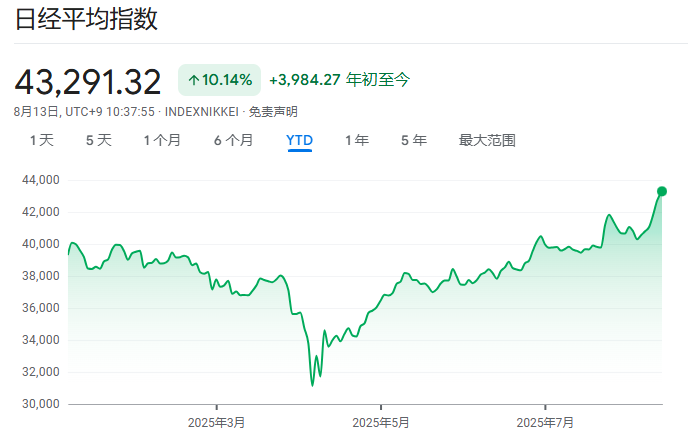
Core Viewpoint - The Nikkei 225 index has reached a historic high, surpassing 43,000 points for the first time, driven by optimism over trade and expectations of interest rate cuts in the U.S. [1][4] Group 1: Market Performance - The Nikkei 225 index opened with a jump of over 1% and reached a peak of 43,289.20 points during the day, marking a new historical high [1] - The index has recorded five consecutive days of gains, reflecting a recovery from previous concerns over tariffs and interest rates [4] - The Tokyo Stock Exchange index also hit a record high, with an increase of 0.8% to 3,092.05 points [1] Group 2: Trade Agreements and Economic Factors - The rise in the Nikkei 225 is attributed to a partial consensus on the execution of a trade agreement between Japan and the U.S., which was reached on July 22 [4] - The U.S. has agreed to amend an executive order regarding tariffs, allowing for a lower effective tax rate for Japanese goods [5] - Analysts suggest that the easing of tariff impacts has contributed to the positive performance of Japanese stocks [4][5] Group 3: Sector Performance - The electronics and automotive sectors led the gains, with Advantest rising by 3.5% and Subaru increasing by 2.2% [4] - The Nikkei 225 index primarily focuses on export-oriented companies, particularly in the automotive and technology sectors [6] Group 4: Market Sentiment and Future Outlook - Analysts express optimism about the potential for further increases in the Nikkei 225, citing improved clarity on tariffs and positive corporate outlooks [7] - The weak yen is seen as a favorable factor for Japanese companies, potentially enhancing their competitiveness [7] - Despite the recent rapid gains, there are indications that the market may be overheating, suggesting caution moving forward [8]