春节效应前置

Search documents
数据点评 | 1月PMI:春节效应前置(申万宏观·赵伟团队)
Xin Lang Cai Jing· 2026-01-31 16:26
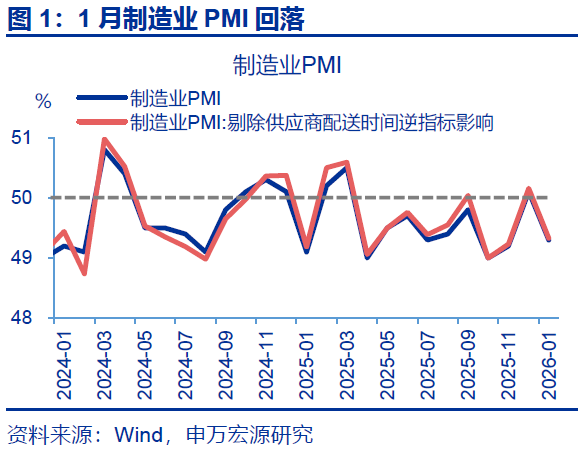
Core Viewpoint - The significant decline in January PMI is attributed to the early return of workers for the Spring Festival and weak domestic demand, with manufacturing PMI dropping to 49.3% from 50.1% and non-manufacturing PMI falling to 49.4% from 50.2% [1][6][7] Group 1: Manufacturing PMI Analysis - The manufacturing PMI fell below the growth threshold, decreasing by 0.8 percentage points to 49.3%, influenced by statistical factors and the early return of workers for the Spring Festival [1][7] - The production index decreased by 1.1 percentage points to 50.6%, while the new orders index fell by 1.6 percentage points to 49.2%, indicating a decline in manufacturing activity [4][38] - The purchasing index dropped significantly by 2.4 percentage points to 48.7%, reflecting a weaker supply side due to the early return of workers [2][16] Group 2: Sector-Specific Insights - Labor-intensive sectors such as consumer goods and high-energy industries experienced a more pronounced decline in PMI, with consumer goods PMI down 2.1 percentage points to 48.3% and high-energy PMI down 1 percentage point to 47.9% [2][22] - In contrast, capital-intensive sectors like high-tech and equipment manufacturing saw smaller declines, with PMIs of 52% and 50.1%, respectively, remaining above the growth threshold [2][22] Group 3: Non-Manufacturing PMI Insights - The non-manufacturing PMI also showed a decline, dropping by 0.8 percentage points to 49.4%, primarily due to a significant decrease in the construction sector, which fell by 4 percentage points to 48.8% [4][43] - The service sector PMI remained relatively resilient, only decreasing by 0.2 percentage points to 49.5%, with certain areas like railway transport showing strong performance [3][25] Group 4: Economic Outlook - The early Spring Festival may distort PMI readings for January and February, but the overall economic recovery trend is expected to continue, supported by consumer demand and service sector policies [3][32] - Despite short-term weaknesses in manufacturing and construction, the average PMI over the next two months is anticipated to reflect ongoing economic recovery [3][32]

数据点评 | 1月PMI:春节效应前置(申万宏观·赵伟团队)
赵伟宏观探索· 2026-01-31 16:03
Core Viewpoint - The significant decline in January PMI is primarily attributed to the early return of workers for the 2026 Spring Festival and weak domestic demand, with manufacturing PMI dropping to 49.3% from 50.1% and non-manufacturing PMI falling to 49.4% from 50.2% [2][8][61] Group 1: Manufacturing PMI Analysis - The manufacturing PMI fell below the neutral line, decreasing by 0.8 percentage points to 49.3%, influenced by statistical factors and the early return of workers [2][8][61] - The manufacturing production index declined by 1.1 percentage points to 50.6%, while the new orders index decreased by 1.6 percentage points to 49.2% [5][41] - The purchasing index for manufacturing dropped significantly by 2.4 percentage points to 48.7%, indicating a notable contraction in supply [3][15][62] Group 2: Sector-Specific Insights - Labor-intensive sectors such as consumer goods and high-energy industries experienced a more pronounced decline in PMI, with consumer goods PMI falling by 2.1 percentage points to 48.3% and high-energy PMI down by 1 percentage point to 47.9% [3][22][62] - In contrast, capital-intensive sectors like high-tech and equipment manufacturing saw smaller declines, with PMIs of 52% and 50.1%, respectively [3][22][62] Group 3: Non-Manufacturing PMI Insights - The non-manufacturing PMI showed asymmetric characteristics, with the construction PMI dropping to 48.8%, a decline of 4 percentage points, while the service sector PMI only slightly decreased by 0.2 percentage points to 49.5% [4][25][62] - The construction sector's decline is more significant than historical averages, indicating a substantial impact from the early return of workers [4][25][62] Group 4: Economic Outlook - The early Spring Festival may disrupt PMI readings for January and February, but the overall economic outlook remains positive, with expectations of recovery in the coming months [4][34][63] - Recent trends in service consumption and travel during the Spring Festival are expected to support service sector growth, highlighting the importance of monitoring consumer demand [4][34][63]
数据点评 | 1月PMI:春节效应前置(申万宏观·赵伟团队)
申万宏源宏观· 2026-01-31 14:49
Core Viewpoint - The significant decline in January PMI is primarily attributed to the early return of workers for the 2026 Spring Festival and weak domestic demand, with manufacturing PMI dropping to 49.3% from 50.1% and non-manufacturing PMI falling to 49.4% from 50.2% [2][7][61] Group 1: Manufacturing PMI Analysis - The manufacturing PMI fell below the neutral line, decreasing by 0.8 percentage points to 49.3%, influenced by statistical factors and the early return of workers [2][8][61] - The manufacturing production index declined by 1.1 percentage points to 50.6%, while the new orders index decreased by 1.6 percentage points to 49.2% [5][41][64] - The purchasing index for manufacturing dropped significantly by 2.4 percentage points to 48.7%, indicating a notable contraction in supply [3][15][62] Group 2: Sector-Specific Insights - Labor-intensive sectors such as consumer goods and high-energy industries experienced a more pronounced decline in PMI, with consumer goods PMI falling by 2.1 percentage points to 48.3% and high-energy PMI down by 1 percentage point to 47.9% [3][22][62] - In contrast, capital-intensive sectors like high-tech and equipment manufacturing saw smaller declines, with PMIs of 52% and 50.1%, respectively [3][22][62] Group 3: Non-Manufacturing PMI Insights - The non-manufacturing sector showed asymmetric effects from the early return of workers, with the construction PMI dropping to 48.8%, a decline of 4 percentage points, while the service sector PMI only slightly decreased by 0.2 percentage points to 49.5% [4][25][62] - The construction sector's decline is more significant than the average historical drop of 1.4 percentage points for January since 2017 [4][25][62] Group 4: Economic Outlook - The early Spring Festival may disrupt PMI readings for January and February, but the overall economic recovery trend is expected to continue, supported by travel and consumption during the holiday [4][34][63] - Recent policies aimed at boosting service consumption are anticipated to support the service sector's recovery, with a focus on changes in consumer demand [4][34][63]