
服务业

Search documents
2026年3月PMI数据点评:制造业景气重回扩张区间,产需两端均有所改善
KAIYUAN SECURITIES· 2026-04-01 06:15
Group 1: Report Industry Investment Rating - Not provided in the content Group 2: Core Viewpoints of the Report - In March 2026, the manufacturing PMI returned to the expansion range, with the production and demand sides both improving. The non - manufacturing and comprehensive PMIs also returned to the expansion range [2][3] - The improvement in demand on the market's demand side was stronger than that on the supply side, but the differentiation between domestic and foreign demand may continue. Domestic demand in the market may remain insufficient in the short term, and policy support is needed to boost demand [4] - There are positive signals in prices, but the gap between purchase prices and ex - factory prices has widened, which may compress corporate profit margins [5] - The PMIs of the construction and service industries have both increased, and the service industry PMI has returned to the expansion range. The construction industry remains confident in its future development [5] - The target range for the 10 - year treasury bond is expected to be 2 - 3%, with a central value of 2.5% [5] Group 3: Summary by Relevant Catalogs 3.1 PMI Data in March - The manufacturing PMI in March was 50.4%, a 1.4 - percentage - point increase from the previous value, higher than the market expectation. The non - manufacturing PMI was 50.1%, a 0.6 - percentage - point increase, and the comprehensive PMI was 50.5%, a 1.0 - percentage - point increase [2][3] - After the Spring Festival, as enterprises resumed work and production, the production index increased by 1.8 percentage points, the new order index increased by 3.0 percentage points, and the new export order index increased by 4.1 percentage points. The production and operation activity expectation index was 53.4%, a 0.2 - percentage - point increase [4] 3.2 Price Situation - The purchase price of major raw materials increased by 9.1 percentage points to 63.9%, and the ex - factory price increased by 4.8 percentage points to 55.4%. The ex - factory price index has remained in the expansion range for three consecutive months [5] 3.3 Industry Situation - The construction industry PMI was 49.3%, a 1.1 - percentage - point increase from the previous value, and the service industry PMI was 50.2%, a 0.5 - percentage - point increase. The business activity expectation index of the construction industry was 50.5%, a 0.4 - percentage - point decrease but still in the expansion range [5] 3.4 Bond Market Viewpoint - The target range for the 10 - year treasury bond is expected to be 2 - 3%, with a central value of 2.5%. The economic recovery is accelerating, and factors such as inflation, monetary policy, and real estate need to be considered [5]
数据点评 | 为何3月PMI大幅反弹?(申万宏观·赵伟团队)
赵伟宏观探索· 2026-03-31 16:02
Core Viewpoint - The significant rebound in the March PMI is attributed to the fading effects of the Spring Festival and accelerated demand recovery [3][9]. Manufacturing PMI - The manufacturing PMI rose to 50.4% in March, up 1.4 percentage points from the previous month, reflecting a recovery post-Spring Festival [2][3]. - The new orders index increased by 3 percentage points to 51.6%, indicating stronger demand recovery compared to previous years [3][16]. - The production orders index only rose by 1.8 percentage points to 51.4%, suggesting slower recovery in production due to delayed resumption of work [3][16]. Industry Analysis - The consumer goods sector saw a larger PMI increase of 2 percentage points to 50.8%, indicating a faster demand recovery compared to other sectors [4][20]. - The equipment manufacturing and high-tech manufacturing PMIs increased by 1.7 and 0.6 percentage points to 51.5% and 52.1%, respectively, but showed weaker production performance [4][21]. Non-Manufacturing PMI - The non-manufacturing PMI rose to 50.1%, with the construction sector's PMI increasing by 1.1 percentage points to 49.3%, which is lower than the previous year's recovery rate [4][24]. - The construction project resumption rate was 62%, down 2.6 percentage points from the same period in 2025, indicating slower recovery in the sector [4][24]. Future Outlook - The focus on expanding domestic demand and promoting consumption is expected to enhance the recovery of domestic demand, which may outpace external demand [5][34]. - However, rising oil prices due to geopolitical risks could negatively impact manufacturing profitability, with a transmission lag of about 3-4 months [5][34]. Regular Tracking - The manufacturing PMI showed a recovery, with the new orders index rising significantly [6][43]. - The service sector PMI increased slightly to 50.2%, but the new orders index fell by 0.4 percentage points to 45.3% [6][52]. - The construction sector's new orders index improved marginally by 1.3 percentage points to 43.5% [6][54].

3月PMI数据点评:一场来自外需的及时雨
Changjiang Securities· 2026-03-31 13:43
Group 1: Manufacturing PMI Insights - The manufacturing PMI for March rose to 50.4%, exceeding market expectations, indicating a recovery driven by external demand[3] - The new orders index increased by 3.0 percentage points (pp) to 51.6%, while the production index rose by 1.8 pp to 51.4%, reflecting a clear trend of supply recovery driven by demand[7] - The PMI for large enterprises remains high, but the recovery in March was primarily driven by small and medium-sized enterprises[7] Group 2: External Demand and Production Recovery - The new export orders index improved significantly, rising by 4.1 pp to 49.1%, indicating a strong recovery in external demand[7] - High-frequency data, such as container shipping metrics, also showed robust recovery in March, suggesting increased resilience in domestic exports[7] - The production index's increase was less than seasonal expectations, indicating cautious production choices by enterprises[7] Group 3: Price Dynamics and Inventory Management - The main raw material purchase price index surged by 9.1 pp to 63.9%, the highest level since May 2022, reflecting significant price pressures[7] - Despite rising input costs, companies are hesitant to increase inventory levels, as indicated by the raw material and finished goods inventory indices not exceeding seasonal trends[7] Group 4: Non-Manufacturing Sector Performance - The non-manufacturing PMI rose to 50.1%, with the construction PMI at 49.3%, still in contraction territory and below seasonal expectations[7] - The service sector PMI increased by 0.5 pp to 50.2%, but also underperformed against seasonal norms, indicating weaker consumer demand in sectors like tourism[7] Group 5: Economic Outlook and Policy Implications - The recovery in manufacturing PMI suggests a positive economic outlook driven by external demand, reducing the necessity for preemptive policy measures[7] - The improvement in external demand may lead to a virtuous cycle, potentially easing the improvement cycle for domestic industries like construction[7]
价格端信号更值得关注
Xinda Securities· 2026-03-31 12:34
Group 1: Manufacturing Sector Insights - The manufacturing PMI rose to 50.4% in March, indicating a seasonal rebound post-Spring Festival, surpassing the market expectation[5] - The new orders index increased significantly, becoming the highest among the five sub-indices of PMI, driving the overall PMI growth[5] - The raw material purchase price index reached 63.9%, while the factory price index was at 55.4%, marking an 8.5 percentage point gap, the largest since May 2022[9] Group 2: Price Dynamics and Profitability - The widening "scissors gap" between raw material purchase prices and factory prices may negatively impact corporate profits, particularly affecting downstream consumption[10] - Historical data shows that similar price dynamics in March and April 2022 led to increased upstream profits while downstream consumption profits declined[10] - The manufacturing sector's price indicators are crucial to monitor, as they are not part of the PMI composition but significantly influence future trends[9] Group 3: Non-Manufacturing Sector Recovery - The non-manufacturing PMI returned to the expansion zone at 50.1%, but the recovery pace is slower than that of the manufacturing sector[16] - Construction-related activities, particularly in civil engineering, showed improvement, with the business activity index rising above 55%[16] - The government plans to implement more proactive macro policies to stimulate domestic demand, which may support the construction sector further[18] Group 4: Risk Factors - Key risks include slow recovery of consumer confidence, policy implementation falling short of expectations, and potential escalations in trade tensions and geopolitical issues[20]
兼评3月PMI数据:PMI重回扩张,预计Q1GDP同比约5.0%
KAIYUAN SECURITIES· 2026-03-31 12:16
Manufacturing Sector - March manufacturing PMI improved to 50.4%, up 1.4 percentage points month-on-month, indicating a return to expansion[3] - The production index rose by 1.8 percentage points to 51.4%, while new orders increased by 3.0 percentage points to 51.6%[14] - Industrial raw material prices have rebounded significantly, with March PPI expected to rise by approximately 0.3% year-on-year[20] Non-Manufacturing Sector - Construction PMI increased by 1.1 percentage points to 49.3%, benefiting from the gradual resumption of projects post-holiday[22] - Service sector PMI rose to 50.2%, a 0.5 percentage point improvement, although new orders remain weak[30] Economic Outlook - Q1 GDP is projected to grow by approximately 5.0% year-on-year, supported by AI demand and fiscal spending[6] - The growth forecast includes primary, secondary, and tertiary industries at approximately 3.5%, 5.2%, and 5.0% respectively[34] - Input inflation may pressure profits in downstream enterprises, necessitating timely policy responses to support economic recovery[33] Risks - Potential risks include unexpected policy changes and a possible recession in the U.S. economy impacting domestic exports[35]
03月中国PMI观察:供需改善、预期谨慎
Yin He Qi Huo· 2026-03-31 10:12
1. Report Industry Investment Rating - Not provided in the given content 2. Core Viewpoints of the Report - In March 2026, the manufacturing PMI rebounded beyond expectations, indicating an economic recovery, but the recovery strength is average and the expectations are cautious. Without considering external uncertainties, the prices of domestically - priced commodities are expected to rise. The manufacturing PMI in April 2026 is likely to decline, which is a crucial observation window [4][5][6]. - In March 2026, the non - manufacturing PMI rose, but multiple sub - items are at historically low levels, and the non - manufacturing industry is still in the bottom - building process. The construction industry is still in a downward trend, but the sales price sub - item has bottomed out [29][32]. 3. Summary by Relevant Catalogs Part 1: Review of China's Manufacturing and Non - manufacturing PMI Data Tables - Manufacturing PMI: In March 2026, all sub - items of the manufacturing PMI increased compared to February. The significant increases include the purchase price of main raw materials (up 9 to 63.9), ex - factory price (up 4.8 to 55.4), import (up 4.2 to 49.8), new export orders (up 4.1 to 49.1), and new orders (up 3 to 51.6) [3][4]. - Non - manufacturing PMI: In March 2026, the business activity of non - manufacturing PMI was 50.1, up 0.6 from the previous month. The sub - items with relatively large increases were new export orders, input prices, sales prices, and delivery time. The sub - items with relatively large decreases were domestic demand, inventory, business activity expectations, and employees [3][29]. Part 2: March Manufacturing PMI Reflects Economic Service Beyond Expectations - Manufacturing PMI reached 50.4 in March 2026, up 1.4 from the previous month, higher than the market expectation of 50.1, and above the 50 boom - bust line again after two months. All sub - items increased, indicating an economic recovery. However, some key sub - items are still below 50, and some sub - items are at the second - lowest or lowest levels in the same period since 2018. The economic recovery is influenced by factors such as the arrival of the demand peak season, economic improvement, and price increases due to the Middle East conflict. The recovery strength is average, and expectations are cautious. The prices of domestically - priced commodities are expected to rise. In April 2026, the manufacturing PMI is likely to decline, which is a crucial observation window [4][5][6]. Part 3: Multiple Sub - items of March Non - manufacturing PMI are at Historically Low Levels - In March 2026, the non - manufacturing PMI business activity was 50.1, up 0.6 from the previous month and higher than the expected 49.9, returning above 50 again after two months. The sub - items of non - manufacturing PMI showed mixed trends. The new orders and domestic demand sub - items decreased against the season, indicating that the non - manufacturing industry is still in the bottom - building process. Some sub - items are at the lowest or second - lowest levels in the same period over the years. The construction industry PMI shows a downward trend, but the sales price sub - item has bottomed out, suggesting that the housing price may be stabilizing, but the sustainability needs to be observed [29][32].
3月PMI数据点评:产需两旺,制造业PMI重回扩张区间
Tai Ping Yang Zheng Quan· 2026-03-31 09:16
Group 1: Manufacturing PMI Insights - The manufacturing PMI for March 2026 is 50.4%, an increase of 1.4 percentage points from the previous month, indicating a return to the expansion zone[3] - The production index rose by 1.8 percentage points to 51.4%, while the new orders index increased by 3 percentage points to 51.6%, both indicating expansion[4] - The new export orders index improved by 4.1 percentage points to 49.1%, and the import index rose by 4.2 percentage points to 49.8%, suggesting a recovery in internal demand[4] Group 2: Price and Inventory Trends - The raw material purchase price index surged by 9.1 percentage points to 63.9%, indicating increased upstream cost pressure[22] - The factory price index increased by 4.8 percentage points to 55.4%, driven by rising commodity prices and accelerated procurement activities[22] - The finished goods inventory index rose by 0.9 percentage points to 46.7%, while the raw materials inventory index increased by 0.2 percentage points to 47.7%[22] Group 3: Non-Manufacturing Sector Performance - The non-manufacturing business activity index for March is 50.1%, a slight increase of 0.6 percentage points from the previous month[5] - The construction activity index is at 49.3%, up by 1.1 percentage points, while the services activity index is at 50.2%, an increase of 0.5 percentage points[5] - Key sectors such as railway transport and financial services have business activity indices above 55%, indicating strong performance[5] Group 4: Business Size Analysis - Large enterprises' PMI increased by 0.1 percentage points to 51.6%, remaining in the expansion zone[15] - Medium and small enterprises saw PMIs rise by 1.5 and 4.5 percentage points to 49.0% and 49.3%, respectively, showing significant improvement but still below the critical point[15] - The recovery in manufacturing is uneven, with smaller enterprises facing more operational pressures compared to larger ones[15]
2026年3月PMI数据点评:受节后复工复产拉动,制造业景气显著回升
BOHAI SECURITIES· 2026-03-31 09:14
Manufacturing Sector - In March 2026, the manufacturing PMI rose to 50.4%, indicating a return to the expansion zone, with both production and demand improving[4] - The production index increased by 1.8 percentage points to 51.4%, primarily due to the resumption of work after the Spring Festival[4] - The new orders index rose by 3.0 percentage points to 51.6%, reflecting significant improvement in manufacturing demand[4] - New export orders increased by 4.1 percentage points to 49.1%, indicating a slowdown in contraction, influenced by high international energy prices and China's supply chain advantages[4] - The import index also rose to 49.8%, showing a positive trend in imports[4] Non-Manufacturing Sector - The non-manufacturing business activity index increased by 0.6 percentage points to 50.1%, returning above the threshold[5] - The construction sector's business activity index rose by 1.1 percentage points to 49.3%, driven by post-holiday resumption of work[5] - The service sector's business activity index increased by 0.5 percentage points to 50.2%, indicating expansion[5] Overall Economic Outlook - The comprehensive PMI output index rose by 1.0 percentage point to 50.5%, driven by improvements in both manufacturing and non-manufacturing sectors[5] - The recovery in both sectors is primarily attributed to seasonal factors, with external demand remaining a critical support[5] - Risks include potential weakening of external demand due to geopolitical uncertainties in the Middle East, which may affect production and investment willingness[5]
【数据发布】2026年3月中国采购经理指数运行情况
中汽协会数据· 2026-03-31 09:13
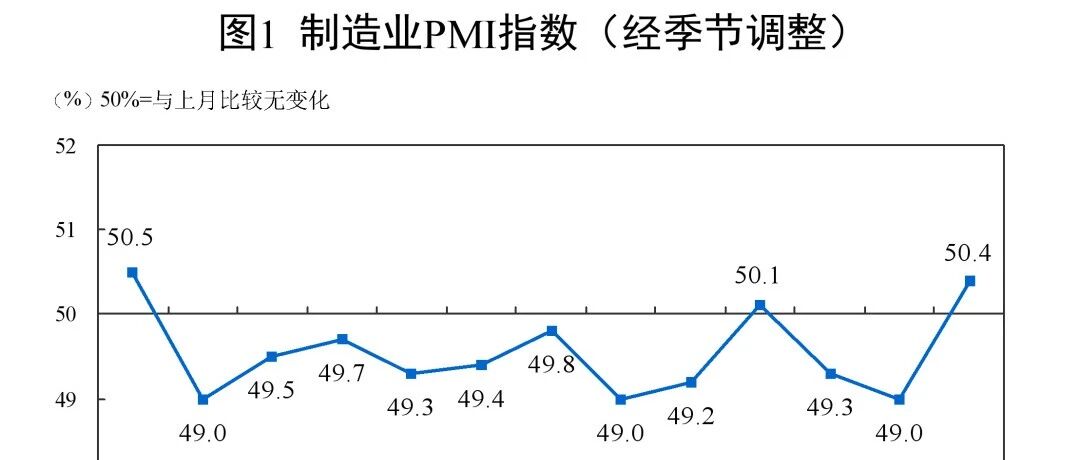
Group 1: Manufacturing PMI Overview - The Manufacturing Purchasing Managers' Index (PMI) for March is 50.4%, an increase of 1.4 percentage points from the previous month, indicating a recovery in manufacturing sentiment [1][4] - Large enterprises have a PMI of 51.6%, while small and medium enterprises have PMIs of 49.0% and 49.3%, respectively, both below the critical point [4] - The production index is at 51.4%, up 1.8 percentage points, indicating accelerated manufacturing activity, while the new orders index is at 51.6%, up 3.0 percentage points, showing improved market demand [5] Group 2: Manufacturing Sub-Indices - The raw materials inventory index is at 47.7%, indicating a narrowing decline in inventory levels, while the employment index is at 48.6%, suggesting a slight recovery in employment sentiment [5][6] - The supplier delivery time index is at 49.5%, indicating extended delivery times for raw materials compared to the previous month [7] Group 3: Non-Manufacturing PMI Overview - The Non-Manufacturing Business Activity Index for March is 50.1%, an increase of 0.6 percentage points, indicating an improvement in non-manufacturing sentiment [10] - The construction industry activity index is at 49.3%, up 1.1 percentage points, while the services industry index is at 50.2%, up 0.5 percentage points [11] Group 4: Non-Manufacturing Sub-Indices - The new orders index for non-manufacturing is at 45.0%, down 0.2 percentage points, indicating a decline in market demand [14] - The input price index is at 52.3%, up 1.4 percentage points, indicating rising costs for non-manufacturing enterprises [14] - The employment index for non-manufacturing is at 45.2%, down 0.8 percentage points, indicating a decline in employment sentiment [14] Group 5: Composite PMI Overview - The Composite PMI Output Index for March is 50.5%, an increase of 1.0 percentage points, indicating an overall improvement in production and business sentiment across sectors [21]
【权威解读】3月份中国采购经理指数重回扩张区间
中汽协会数据· 2026-03-31 09:13
Core Viewpoint - In March 2026, China's Purchasing Managers' Index (PMI) returned to the expansion zone, indicating a recovery in economic sentiment with manufacturing PMI at 50.4%, non-manufacturing business activity index at 50.1%, and composite PMI output index at 50.5% [1]. Group 1: Manufacturing PMI - The manufacturing PMI rose to 50.4% in March, reflecting increased market activity as companies resumed operations post-Spring Festival [2]. - Both production index and new orders index improved, reaching 51.4% and 51.6% respectively, indicating accelerated production activities and improved market demand [2]. - Large, medium, and small enterprises all saw a rise in PMI, with large enterprises at 51.6%, medium at 49.0%, and small at 49.3%, showing significant improvement in sentiment for smaller firms [2]. Group 2: Key Industries - High-tech manufacturing PMI stood at 52.1%, marking 14 consecutive months above the critical point, indicating a positive development trend [3]. - Equipment manufacturing and consumer goods industries also showed expansion with PMIs of 51.5% and 50.8% respectively [3]. - The price index for major raw materials surged, with purchasing price index at 63.9% and factory price index at 55.4%, reflecting a significant increase in market prices [3]. Group 3: Non-Manufacturing PMI - The non-manufacturing business activity index rose to 50.1%, indicating an improvement in the non-manufacturing sector [5]. - The service sector's business activity index reached 50.2%, with certain industries like telecommunications and financial services showing strong growth [5]. - The construction industry also saw an improvement, with a business activity index of 49.3%, reflecting a recovery in construction projects post-holiday [5]. Group 4: Composite PMI - The composite PMI output index increased to 50.5%, indicating an overall positive trend in production and business activities across sectors [6]. - The manufacturing production index and non-manufacturing business activity index contributed to this increase, standing at 51.4% and 50.1% respectively [6].
