智电化转型

Search documents
万马奔腾迎春来:上汽2025的体系破局与价值重估
Xin Lang Cai Jing· 2026-01-13 11:33
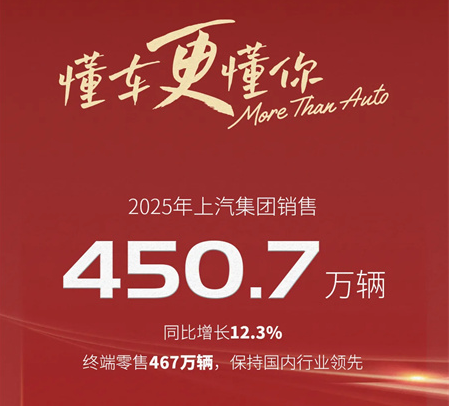
Core Insights - In 2025, SAIC Motor Corporation achieved significant growth, selling 4.507 million vehicles, a 12.3% increase year-on-year, and maintaining its position as the leading player in the domestic automotive industry [1][28] - A notable internal transformation occurred, with sales of self-owned brands reaching 2.928 million units, a substantial 21.6% increase, marking a historic high of 65% in total sales share [3][28] - The company's strategic focus on self-owned brand development and technological breakthroughs in smart electric vehicles is validated by market performance, indicating a successful transition from joint ventures to self-owned brands [5][30] Market Recognition - SAIC Motor's return to the SSE 50 Index in 2025 signifies a re-evaluation of its growth logic and intrinsic value by the capital market, reflecting a shift in focus from traditional manufacturing scale to sustainable high-quality development potential [6][30] - The return to the SSE 50 is seen as a "trust ticket" for future expectations, confirming that SAIC has successfully navigated its transformation [6][30] User Engagement and Product Innovation - The company is set to welcome its 100 millionth user in 2026, marking a significant milestone in its user-centric approach [7][31] - SAIC showcased a "cluster of blockbuster" products in 2025, demonstrating its capability to create star products across various market segments [7][31] Brand Highlights - The launch of the new generation of Zhiji LS6, featuring the "Star Super Range System" with a class-leading range of 1508 km, exemplifies SAIC's ability to establish a high-end intelligent electric brand [8][34] - The MG4, launched in August 2025, achieved over 10,000 deliveries for four consecutive months, driven by innovative technologies and a strong marketing strategy [11][35] - The Roewe M7 DMH, equipped with the latest DMH 6.0 hybrid system, addresses key consumer pain points with impressive range and fuel efficiency, solidifying its reputation as the "King of Family Cars" [14][38] - The launch of the SAIC Shangjie H5, developed in collaboration with Huawei, showcases a successful integration of smart travel solutions and manufacturing quality [17][41] Systematic Support for Innovation - SAIC's ability to produce multiple successful brands simultaneously is attributed to a robust systemic support structure that facilitates the "batch incubation of blockbusters" [20][44] - The company's comprehensive reform strategy aims to integrate management across passenger and commercial vehicle sectors, enhancing resource allocation and market responsiveness [21][45] - A focus on technology-driven and user-oriented product development has led to significant R&D investments, resulting in products with distinct technological features [23][47] Strategic Partnerships and Global Expansion - SAIC's strategic partnerships with leading tech companies like Huawei and OPPO enhance its technological capabilities and address gaps in smart vehicle features [24][48] - The company's global strategy has evolved to include localized R&D, production, and marketing, expanding its market reach and potential for blockbuster products [25][49] Future Outlook - SAIC's transformation serves as a model for upgrading traditional manufacturing in China, emphasizing strategic determination, technological resilience, ecological collaboration, and organizational vitality [26][50] - The company is positioned to lead the automotive industry towards a new phase of productivity, transitioning from scale leadership to quality leadership [26][50]


从“十件大事”看一汽-大众2025年高质量发展之路
Zhong Guo Jing Ji Wang· 2025-12-22 02:31
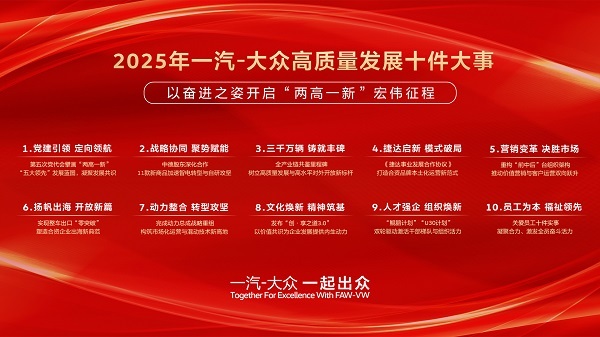
Core Viewpoint - The Chinese automotive industry is experiencing a significant transformation, with a focus on high-quality development and strategic initiatives, as exemplified by FAW-Volkswagen's ambitious goals and achievements in the market [1][23]. Group 1: Industry Overview - In the first eleven months, China's automotive production and sales both exceeded 31 million vehicles, marking a pivotal year for the industry as it transitions towards 2025 [1]. - FAW-Volkswagen has set a sales target of 2 million vehicles over the next five years, celebrating the production of its 30 millionth vehicle [1][10]. Group 2: Strategic Initiatives - FAW-Volkswagen has outlined ten key initiatives for high-quality development by 2025, focusing on aspects such as strategic collaboration, marketing transformation, and talent development [3][20]. - The company emphasizes the integration of party leadership with business operations, which is seen as essential for adhering to national strategies and achieving corporate goals [5][6]. Group 3: Technological Advancements - The company is committed to a "hybrid and electric" strategy, planning to launch 11 new models, including 10 electric vehicles, to meet diverse market demands [8]. - FAW-Volkswagen has restructured its powertrain strategy to enhance market operations and hybrid technology, aiming to boost competitiveness and profitability [16]. Group 4: Localization and Globalization - FAW-Volkswagen is enhancing its localization efforts by establishing a new company for the Jetta brand, allowing for quicker market responses and more autonomous decision-making [12]. - The company has achieved its first vehicle exports to the Middle East, marking a significant step in its global expansion strategy [14]. Group 5: Organizational Development - The company has restructured its marketing framework to improve service systems across its brands, aiming for enhanced customer engagement and value marketing [18]. - FAW-Volkswagen is investing in talent development through initiatives like the "Kunpeng Plan" and "U30 Plan," focusing on building a younger, professional workforce [20].