智己LS6

Search documents
净利暴跌86%,李想要把“增程神话”换成AI+机器人
阿尔法工场研究院· 2026-03-13 08:04
Core Viewpoint - Li Auto is facing significant challenges as its competitive advantage in range-extended technology diminishes, leading to a sharp decline in profits and revenues, while the market becomes increasingly saturated with competitors and pure electric vehicles [2][3][7]. Financial Performance - In 2025, Li Auto reported a net profit of 1.139 billion yuan, a staggering decline of 85.8% year-on-year, with revenue dropping 22.3% to 112.3 billion yuan [2][3]. - The total vehicle deliveries for 2025 were 406,300 units, down 18.8% from the previous year, failing to meet both the initial target of 700,000 and the revised target of 640,000 [3][4]. - The gross margin for 2025 fell to 18.7%, down from 20.5% in 2024, with vehicle gross margin decreasing from 19.8% to 17.9% [4]. Market Competition - The range-extended vehicle market has become increasingly competitive, with multiple automakers introducing similar technologies, diminishing Li Auto's previous advantage [7][8]. - In 2025, the sales of pure electric vehicles reached 7.877 million units, a 24.4% increase year-on-year, while range-extended vehicle sales only grew by 6% to 1.235 million units [8][9]. Internal Challenges - Li Auto has experienced significant management turnover, with several key executives leaving the company, raising concerns about operational stability [5]. - A recall of 11,000 units due to safety issues has negatively impacted the brand's image and consumer trust, further complicating its recovery efforts [5][6]. Strategic Initiatives - To combat declining sales, Li Auto aims to achieve a sales target of 500,000 units in 2026, focusing on both range-extended and pure electric vehicles [9][10]. - The company plans to launch a new range-extended model, the Li L9 series, in the second quarter of 2026, featuring advanced charging technology and improved electric range [10]. - Li Auto is heavily investing in AI technology, with 50% of its 11.3 billion yuan R&D budget in 2025 allocated to AI, indicating a strategic pivot towards integrating AI into its vehicle offerings [10][11].

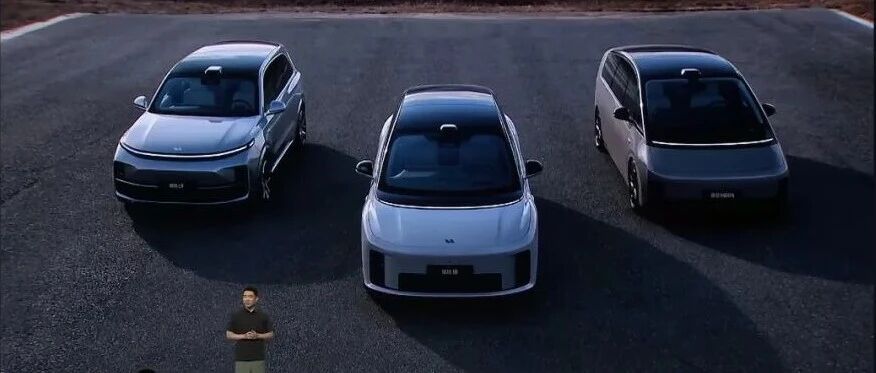
理想i6车主分享:顺路试驾后激情下单,空间大充电方便是优势
车fans· 2026-03-13 00:29
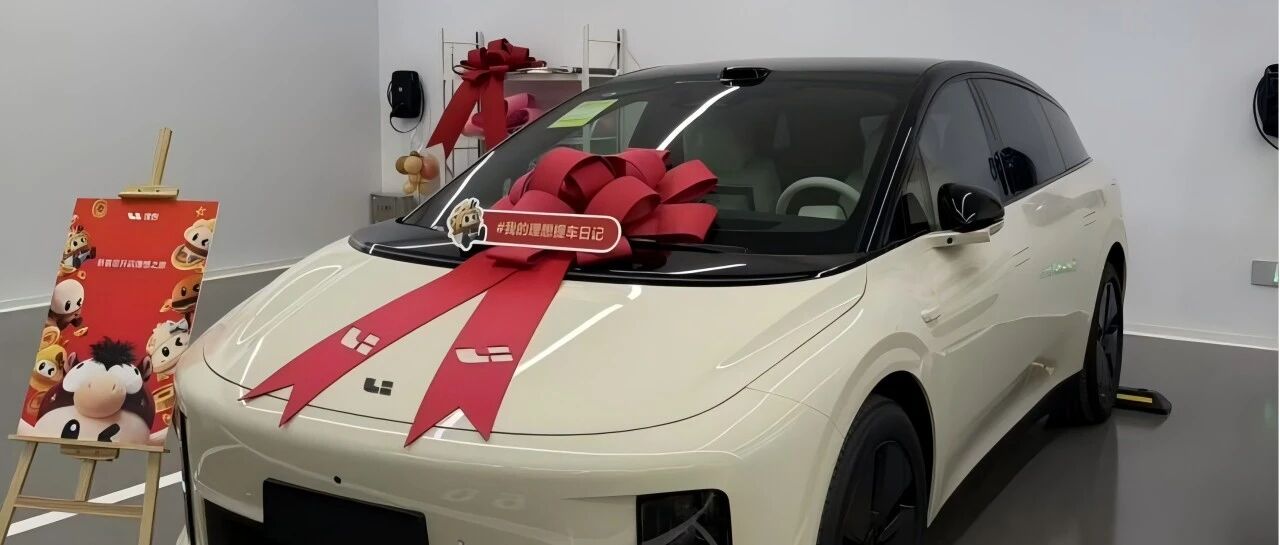
Core Viewpoint - The article presents a detailed account of a car owner's experience in purchasing the Li Auto i6, highlighting the decision-making process, dealership experience, and initial impressions of the vehicle. Purchase Details - The car owner, referred to as Xiao K, purchased the Li Auto i6 two-wheel drive version from the Li Auto retail center in Jinan, Shandong, on February 28, 2026, with a total cost of 251,320 yuan after discounts and fees [2][4]. - The base price of the two-wheel drive version was 239,800 yuan, with additional costs for color and insurance [4]. Comparison with Competitors - The owner compared the Li Auto i6 with competitors such as Avita, Xiaopeng, and the Zhiji LS6, ultimately favoring the i6 due to its superior interior quality and intelligent features [6][8]. - The decision-making process involved test-driving multiple vehicles, with the owner initially leaning towards the Zhiji LS6 before being swayed by the i6's performance and features during a spontaneous visit to the Li Auto retail center [8][9]. Dealership Experience - The sales experience was described as straightforward, with clear communication regarding the vehicle's features and charging capabilities [11][12]. - The owner appreciated the direct sales model of Li Auto, which minimized haggling over prices and included promotional offers such as cash discounts and additional features [12][14]. Delivery Experience - The delivery process faced delays, with the owner initially expecting to receive the vehicle by the end of January but ultimately experiencing a longer wait [14]. - The dealership provided a satisfactory delivery experience, including a small ceremony for new owners and thorough explanations of vehicle features [17]. Vehicle Impressions - Initial impressions of the Li Auto i6 included spaciousness, comfort, and a smooth operating system, with no significant issues reported so far [18]. - However, the owner noted some drawbacks, such as the manual closing of the front trunk and the lack of certain comfort features in the seating [19].

上汽集团:整体销量逆市增长,自主品牌及出口表现较好-20260307
Orient Securities· 2026-03-07 13:25
Investment Rating - The report maintains a "Buy" rating for the company with a target price of 17.1 CNY [3][6] Core Views - The company is expected to see EPS of 0.91, 1.14, and 1.28 CNY for the years 2025-2027, with slight adjustments made to gross margin and expense ratios [3] - The company has shown resilience with overall sales growth of 6.8% year-on-year in the first two months, outperforming the industry average [9] - The company is focusing on expanding its presence in overseas markets, with significant growth in export sales, particularly in Europe [9] Financial Information Summary - Revenue for 2023 is projected at 726,199 million CNY, with a slight growth of 0.7% year-on-year, followed by a decline of 15.4% in 2024 [5] - Operating profit is expected to drop significantly to 10,376 million CNY in 2024, before rebounding to 17,234 million CNY in 2025, reflecting a growth of 66.1% [5] - Net profit attributable to the parent company is forecasted to be 14,106 million CNY in 2023, with a substantial recovery to 10,492 million CNY in 2025, marking a growth of 529.6% [5] - The gross margin is expected to improve from 9.5% in 2023 to 11.4% by 2027 [5] - The company’s PE ratio is projected to be 15.5 for 2025, decreasing to 11.1 by 2027 [5][10]

上汽集团(600104):整体销量逆市增长,自主品牌及出口表现较好
Orient Securities· 2026-03-07 12:39
Investment Rating - The report maintains a "Buy" rating for the company with a target price of 17.1 CNY, based on an average PE valuation of 15 times for comparable companies in 2026 [3][6]. Core Insights - The company has shown resilience with overall sales growth of 6.8% year-on-year in the first two months, outperforming the industry average during a period of consumer hesitation [9]. - The company is expected to benefit from new vehicle launches, which are anticipated to drive sales and market share for its self-owned brands [9]. - The export performance has been strong, with significant year-on-year growth in overseas sales, indicating that international markets will be a key growth driver moving forward [9]. Financial Forecasts - The earnings per share (EPS) are projected to be 0.91 CNY, 1.14 CNY, and 1.28 CNY for the years 2025, 2026, and 2027 respectively, with slight adjustments made to gross margin and expense ratios [3]. - Revenue is forecasted to reach 726.199 billion CNY in 2023, with a decline to 614.074 billion CNY in 2024, followed by a gradual recovery to 742.172 billion CNY by 2027 [5][12]. - The net profit attributable to the parent company is expected to rebound significantly from 1.666 billion CNY in 2024 to 14.698 billion CNY in 2027, reflecting a growth rate of 529.6% in 2025 [5][12]. Key Financial Metrics - The company’s gross margin is projected to improve from 9.5% in 2023 to 11.4% by 2027, while the net profit margin is expected to increase from 1.9% to 2.0% over the same period [5][12]. - The return on equity (ROE) is anticipated to rise from 5.0% in 2023 to 4.6% in 2027, indicating a gradual recovery in profitability [5][12]. - The price-to-earnings (PE) ratio is forecasted to decrease from 11.5 in 2023 to 11.1 in 2027, suggesting a more favorable valuation over time [5][12].
上汽集团(600104):自主占比提升,新能源与出口贡献增量
Shanghai Aijian Securities· 2026-03-03 05:42
Investment Rating - The report maintains a "Buy" rating for the company [6] Core Insights - The company experienced a decline in February sales due to the Spring Festival holiday, but cumulative sales for January and February showed a 6.8% year-on-year increase [6] - The contribution from self-owned brands is significant, with a 14% year-on-year increase in sales, accounting for 67.2% of total sales [6] - The company plans to launch several new models in 2026, which is expected to drive growth [6] - The company aims for a sales target of 4.5 million vehicles in 2025, achieving a completion rate of 100.2% in 2025 [6] - The report forecasts net profits of 10.8 billion, 13.3 billion, and 16.2 billion for 2025, 2026, and 2027 respectively, with corresponding P/E ratios of 15, 12, and 10 [6] Financial Data and Profit Forecast - Total revenue for 2023 is projected at 744.7 billion, with a slight year-on-year growth of 0.1% [4] - Net profit for 2023 is estimated at 14.1 billion, reflecting a year-on-year decrease of 12.5% [4] - Earnings per share for 2023 is expected to be 1.23 [4] - The gross margin is projected to improve from 1.7% in 2023 to 11.1% by 2027 [4] - The return on equity (ROE) is expected to increase from 4.9% in 2023 to 4.9% in 2027 [4]
技术平权,用户为王:上汽的“开门红”不只是一场销量胜利
Xin Lang Cai Jing· 2026-02-28 02:33
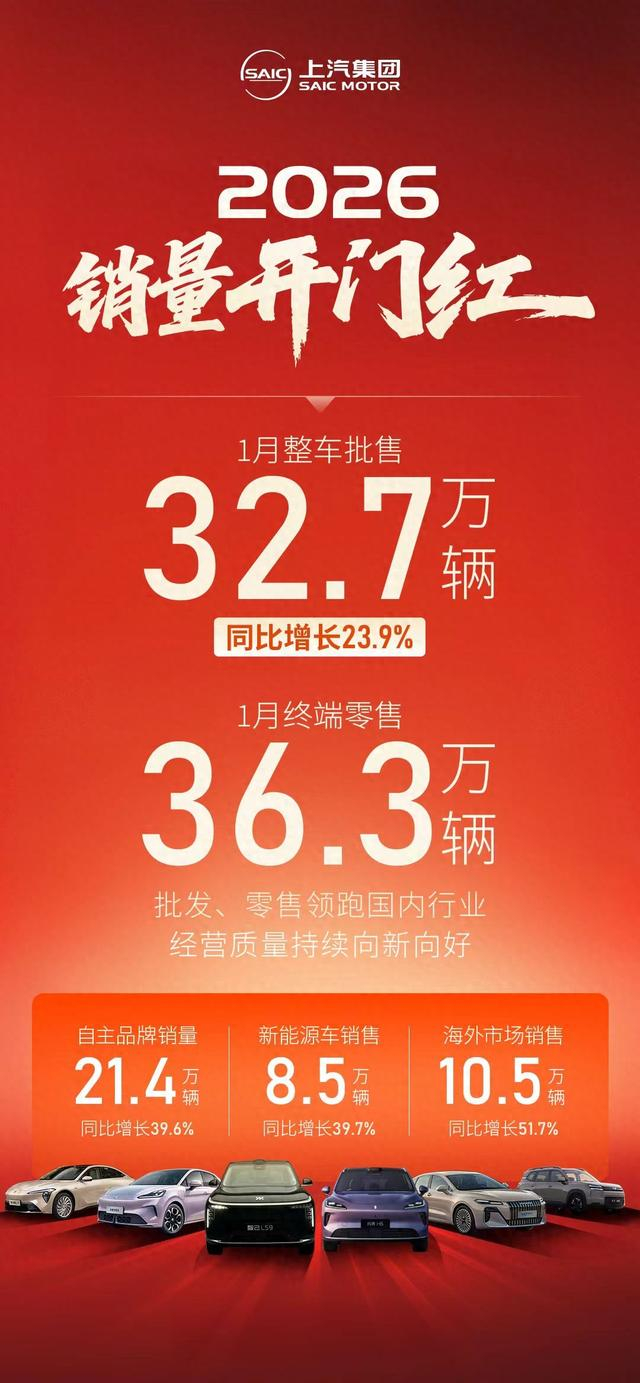
Core Insights - In January 2026, SAIC Motor Corporation achieved significant sales growth, with wholesale sales reaching 327,000 units, a year-on-year increase of 23.9%, and retail sales of 363,000 units [1] - The growth is attributed not only to scale but also to the implementation of "technology equality" and a "user-centric" approach, allowing the company to differentiate itself in a competitive market [1][5] - The company's self-owned brands played a crucial role, with sales of 214,000 units in January, up 39.6%, accounting for 65.3% of total sales, an increase of 7.3 percentage points year-on-year [1][6] Sales Performance - In the new energy vehicle segment, SAIC Motor's sales reached 85,000 units in January, marking a nearly 40% year-on-year increase, positioning the company among the industry leaders [1] - The MG4 model, featuring semi-solid-state batteries and integrated battery body technology, has become a standout product, achieving over 75,000 pre-orders and monthly sales exceeding 10,000 units [7][9] Overseas Strategy - Under the guidance of its Overseas Strategy 3.0, SAIC Motor's overseas sales reached 105,000 units in January, a 51.7% increase year-on-year, with MG delivering nearly 26,000 units in Europe, up approximately 15% [2] Reform and Innovation - The company initiated comprehensive reforms in the second half of last year, enhancing product definition, R&D, production, and marketing, which have begun to translate into improved sales and profitability [5] - SAIC Motor has invested over 150 billion yuan in electric and intelligent technologies, resulting in nearly 26,000 effective patents across various platforms [13][15] User-Centric Approach - The company has established a unified value expression of "understanding cars and understanding you," focusing on reshaping product and service logic to meet diverse user needs [12] - In early 2026, SAIC launched a series of promotional activities to enhance user experience and satisfaction, reinforcing its commitment to a user-centric philosophy [12] Future Product Launches - In 2026, SAIC plans to introduce a range of new products, including the A+ class sedan i6 and the LS9 Hyper version, which will feature advanced technologies such as line control steering [16][18] - The company aims to solidify its position in the high-end electric vehicle market with innovative models that leverage its technological advancements [18] Conclusion - The strong sales performance in January 2026 reflects the successful implementation of SAIC's reform and innovation strategies, marking a significant step towards establishing a new development paradigm focused on user needs and technological capabilities [19][21] - The company's ability to convert technological investments into user value will be crucial for maintaining its competitive edge in the evolving automotive landscape [21]
政策金融双轮驱动新春车市回暖 超20家车企力推超长低息贷
Zhong Guo Zheng Quan Bao· 2026-02-26 23:50
Group 1 - The domestic automotive market is experiencing a consumption boom driven by both policy and financial incentives, with various promotional activities and discounts from car manufacturers [1][4] - There is a notable increase in foot traffic at dealerships for both new energy and luxury fuel brands, with significant discounts being offered by brands like BMW and Mercedes-Benz [1][3] - Financial policies are becoming the mainstream promotional strategy, with over 20 car manufacturers offering long-term low-interest loans, indicating a shift from direct price reductions to financing options [1][4] Group 2 - The consumer purchasing behavior is shifting from basic needs to a focus on quality and personalization, as seen in the sales performance of different brands [2][3] - The implementation of the new vehicle trade-in policy has led to a significant increase in new car sales, with over 60,700 vehicles traded in by mid-February, generating sales worth 995.6 billion [5] - Industry experts suggest that the automotive market is entering a high-end consumption phase, emphasizing the need for manufacturers to enhance product value rather than relying solely on price reductions [6]
超20家车企力推超长低息贷 政策金融双轮驱动 新春车市回暖
Zhong Guo Zheng Quan Bao· 2026-02-26 21:40
Core Insights - The domestic automotive market is experiencing a consumption boom driven by both policy and financial incentives, with significant consumer interest in both new energy and luxury fuel vehicles [1][4] - Financial policies are becoming the mainstream promotional strategy for automakers, with over 20 companies offering long-term low-interest loans as a key selling point [4][5] - There is a noticeable shift in consumer purchasing behavior from basic needs to a focus on quality and personalization, indicating a trend towards consumption upgrading [1][5] Group 1: Market Dynamics - The automotive market is seeing increased foot traffic in showrooms, particularly for brands like BMW, Mercedes-Benz, and various new energy brands, driven by attractive financial offers [1][2] - Promotional activities such as the "Lego New Spring" event are enhancing market engagement, providing consumers with various incentives and subsidies [3][5] - Consumer sentiment is divided, with some buyers eager to take advantage of multiple subsidies while others remain cautious, reflecting concerns over price trends and policy sustainability [3][6] Group 2: Financial Strategies - The shift from direct price cuts to financial incentives is evident, with automakers offering extended low-interest loans and combining these with government subsidies to lower purchase costs [4][5] - Specific financial offers include 7-year loans with zero down payments and low-interest rates, which are becoming a standard promotional tool across the industry [4][5] - The implementation of the new vehicle trade-in policy has already led to significant sales figures, with over 60,700 vehicles traded in, generating sales worth approximately 995.6 billion yuan [5][6] Group 3: Future Outlook - Experts predict a potential decline in sales post-holiday due to cautious consumer attitudes and limited effective sales days in February, which may alleviate inventory pressures [6] - The automotive industry is entering a high-end consumption phase, where mere price reductions are insufficient, necessitating a focus on technology and product experience to meet evolving consumer demands [6]
政策金融双轮驱动 新春车市回暖
Zhong Guo Zheng Quan Bao· 2026-02-26 20:28
Core Viewpoint - The domestic automotive market is experiencing a consumption boom driven by both policy and financial incentives, with a notable shift towards financing options over direct price reductions [1][3][5]. Group 1: Market Trends - The automotive market is seeing a strong influx of customers, particularly for new energy and luxury fuel brands, with significant foot traffic reported at stores for brands like BMW, Mercedes-Benz, and others [1][2]. - There is a noticeable shift in consumer purchasing behavior from basic needs to a focus on quality and personalization, as evidenced by the diverse customer profiles visiting dealerships [2][3]. - The "Lego New Spring" promotional events across various regions are contributing to increased consumer engagement and sales activity in the automotive sector [3][5]. Group 2: Financial Policies - Over 20 automotive brands have introduced long-term low-interest financing options, with some offering up to 7 years of financing at low or zero interest rates, reflecting a strategic shift in promotional tactics [4][5]. - Major brands like Tesla and BYD are leading the way with attractive financing plans, which are becoming the primary method of promotion rather than direct price cuts [4][5]. - The combination of national and local subsidies, including the new vehicle replacement policy, is further reducing the cost of purchasing vehicles, enhancing consumer incentives [5][6]. Group 3: Consumer Sentiment - Consumer sentiment is divided, with some buyers eager to take advantage of multiple subsidies while others remain cautious, reflecting concerns over price trends and policy sustainability [3][6]. - The market is expected to face challenges post-holiday, with a potential decline in sales due to cautious consumer attitudes and high inventory levels [6]. Group 4: Industry Outlook - The automotive industry is entering a high-end consumption phase, where simple price reductions are no longer effective, necessitating a focus on technology and product experience to meet evolving consumer demands [6]. - Experts predict that the market will see a temporary adjustment period for new energy vehicles after the holiday season, as promotional activities may slow down [1][6].



9天高速充电600万次!最堵春节长假,依然充电难?
电动车公社· 2026-02-24 16:34
Core Viewpoint - The article discusses the challenges and improvements in the charging infrastructure for electric vehicles (EVs) during the recent Spring Festival holiday, highlighting the significant increase in charging demand and the measures taken to manage it effectively. Group 1: Charging Demand and Infrastructure - During the Spring Festival from February 15 to February 23, there were a total of 6.021 million charging sessions for EVs on highways, with an average daily charging volume of 16.64 million kWh, representing a 52.01% increase compared to the same period last year [8][10]. - The article notes that despite the surge in charging demand, there were few reports of charging pile shortages at service areas, indicating improved management and infrastructure [8][10]. - The number of charging stations has significantly increased, with over 70,000 charging piles established at highway service areas, and plans for an additional 20,000 by 2025 [18][33]. Group 2: User Experience and Challenges - The article outlines the challenges faced by EV users during peak travel times, including long wait times for charging and limited service area capacity, which led to increased congestion [11][13]. - It emphasizes the importance of route planning to avoid congestion, suggesting that early departures and strategic stops can enhance the travel experience [20][24]. - The article also highlights the improved charging environment compared to previous years, with better connectivity and real-time information available through apps, reducing user anxiety [18][30]. Group 3: Technological Innovations - The article discusses three main technological advancements aimed at improving the charging experience: battery swapping, ultra-fast charging, and larger battery capacities [30][36]. - NIO's battery swapping stations set a record during the holiday, with 193 battery swaps in one day, showcasing the growing adoption of this model [33]. - The introduction of megawatt-level fast charging technology, capable of delivering 400 km of range in just 5 minutes, is expected to revolutionize the charging experience, making it comparable to refueling traditional vehicles [36][40].