智能仿生

Search documents
冠盛股份:二代产品会如期发布
Zheng Quan Ri Bao Wang· 2026-02-09 12:11
Core Viewpoint - Guansheng Co., Ltd. (605088) emphasizes the advantages of its integrated intelligent bionic joints, including low cost, reduced inertia, and increased payload capacity, while confirming the timely release of its second-generation products [1] Group 1 - The company has responded to investor inquiries regarding the benefits of its bionic joints [1] - The second-generation products are expected to be released on schedule, with updates on product sampling to be disclosed promptly [1]

蓝思科技(300433.SZ):凭借强脑科技等项目积累的量产经验以及强大的精密制造能力,正积极争取合作
Ge Long Hui· 2026-01-06 06:52
Core Viewpoint - Lens Technology (300433.SZ) is a strategic investor in Qiangnao Technology and has exclusively undertaken the mass production of Qiangnao's core hardware modules [1] Group 1: Strategic Partnerships - Lens Technology has a long-term partnership with a major North American client, having collaborated for over 10 years and serving as a primary core supplier [1] - The company is actively seeking further cooperation opportunities, leveraging its mass production experience and strong precision manufacturing capabilities gained from projects like Qiangnao Technology [1] Group 2: Social Responsibility - In November 2025, Lens Technology and Qiangnao Technology plan to donate a large number of intelligent bionic limbs to the Hunan Provincial Disabled Persons' Federation, with all core modules sourced from Lens Technology's production line [1]

蓝思科技:独家承接强脑科技核心硬件模组的量产 同时正与北美大客户积极争取合作
Zheng Quan Shi Bao Wang· 2026-01-06 05:23
Core Insights - Blues Technology (300433) is a strategic investor in Qiangnao Technology and has exclusively undertaken the mass production of Qiangnao's core hardware modules [1] - In November 2025, Blues Technology and Qiangnao Technology will donate a large number of intelligent bionic limbs to the Hunan Provincial Disabled Persons' Federation, with all core modules sourced from Blues' production line [1] - The company has over 10 years of deep cooperation with major North American clients and is a primary core supplier for them [1] - Blues Technology is actively seeking collaborations, leveraging its mass production experience and strong precision manufacturing capabilities gained from projects like Qiangnao Technology [1]
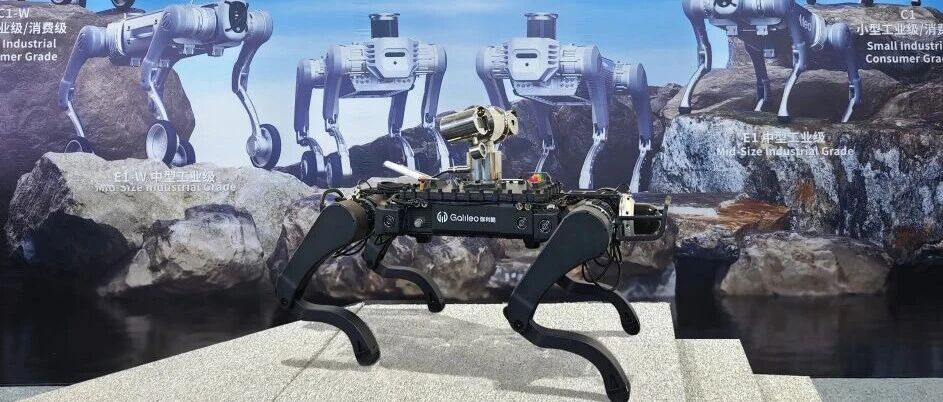
国产防爆机器人重大突破!伽利略EX-1“全地形适配”防爆机器人,真正做到落地应用
机器人大讲堂· 2025-11-29 04:04
Core Viewpoint - The article highlights the launch of the EX-1 intelligent bionic quadruped explosion-proof robot by Galileo (Tianjin) Technology Co., Ltd., which addresses critical pain points in high-risk industries by providing safety, all-terrain adaptability, and intelligent operation capabilities [1][3][5]. Industry Pain Points - High-risk industries face significant challenges in safety inspections and emergency responses due to extreme environments that require high explosion-proof performance, excellent terrain adaptability, and real operational capabilities [4]. - The lack of products that meet these stringent requirements has led to continued reliance on human operations, posing safety risks [4][5]. Product Features and Capabilities - The EX-1 robot is designed with four core advantages: explosion-proof safety, all-terrain adaptability, intelligent operation, and modular expansion [7]. - It adheres to national explosion-proof standards (GB3836 series) and achieves a high-level explosion-proof standard (Ex IIB T4 Gb) and IP66 protection, allowing it to operate safely in hazardous environments [8][9]. - The robot features 12 motors for flexible movement, enabling it to navigate complex terrains and handle water depths of up to 45 centimeters [9]. - It incorporates AI technology for enhanced operational efficiency, with capabilities for real-time path planning, obstacle avoidance, and a load capacity of 30 kilograms [9][11]. Strategic Positioning - Galileo aims to build a comprehensive "air-ground-space" integrated digital ecosystem, with the EX-1 being a key component of this strategy [12][14]. - The robot can work in conjunction with other self-developed products, such as radar and drones, to provide a cohesive operational framework for high-risk industries [14][16]. Future Outlook - The launch of the EX-1 signifies a step towards the modernization and intelligent upgrade of emergency management equipment in China, with a focus on meeting the growing demand for smarter, more flexible, and safer solutions in high-risk environments [17].

比肩马斯克Neuralink,揭秘“杭州六小龙”中最神秘的一家
华尔街见闻· 2025-04-14 10:01
Core Viewpoint - The article discusses the significant advancements in brain-computer interface (BCI) technology, particularly focusing on the Chinese company BrainCo, which is positioned as a leading player in the non-invasive BCI sector, competing with Elon Musk's Neuralink in the invasive sector. The narrative emphasizes the potential of BCI technology to transform the lives of millions suffering from disabilities and neurological disorders, highlighting the importance of innovation and collaboration in this emerging field [1][2][59]. Group 1: Global Market Context - Recent global market fluctuations have been influenced by Trump's "reciprocal tariffs," leading to declines in the dollar and U.S. Treasury bonds, raising questions about the "American exceptionalism" narrative [1]. - The latest Stanford AI Index Report indicates a significant narrowing of performance gaps between top AI models from China and the U.S., with Chinese companies like Alibaba making notable contributions [1]. Group 2: BrainCo's Development Journey - BrainCo, founded by Han Bicheng, has made substantial progress in the BCI field, focusing on non-invasive technology that avoids the risks associated with invasive procedures [21][42]. - The company has successfully developed a smart prosthetic hand that allows users to control each finger independently, marking a significant milestone in BCI applications [38][39]. Group 3: Technological Innovations and Challenges - BrainCo's initial challenges included developing sensitive sensors capable of accurately capturing weak brain signals without the need for conductive gel, which was a significant barrier to user adoption [15][16][20]. - The company overcame these challenges by innovating new electrode materials and algorithms, enabling the production of portable brainwave devices with professional-grade accuracy [21][24]. Group 4: Market Position and Future Goals - BrainCo aims to help 1 million individuals with physical disabilities and 10 million patients with neurological disorders over the next decade, leveraging its innovative products to improve lives [46][55]. - The company is also focused on reducing the costs of its products to make them accessible to a larger population, addressing the low penetration of advanced prosthetics in the Chinese market [48][49]. Group 5: Competitive Landscape - The article positions BrainCo and Neuralink as leading competitors in the BCI space, each pursuing different technological pathways—non-invasive versus invasive—while acknowledging the potential for both approaches to coexist and benefit patients [42][44]. - BrainCo's strategy emphasizes broad applicability across various conditions, contrasting with Neuralink's focus on severe cases requiring surgical intervention [42][44].