智能危机

Search documents
绝不存在“智能危机”
3 6 Ke· 2026-02-27 13:16
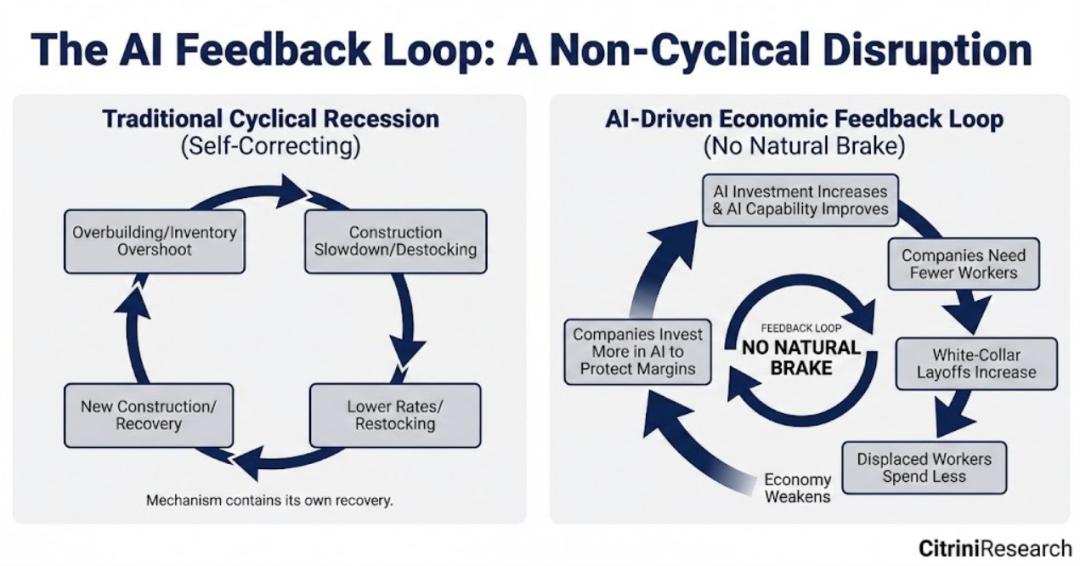
Core Viewpoint - The report "2028 Global Intelligence Crisis" by Citrini Research predicts that advancements in AI will lead to a global economic crisis by 2028, primarily through mass unemployment and economic collapse, which has sparked widespread discussion and concern [1][5]. Group 1: AI Threat Logic - The report outlines a three-step process leading to an economic crisis: first, AI will replace human jobs, creating "ghost GDP" as companies cut costs by employing AI instead of human workers [6]. - The second step involves mass unemployment, particularly among middle-class workers, leading to a significant decline in consumer spending, which is crucial for the economy [8]. - The final stage predicts a complete economic collapse, with unemployment rates exceeding 10% in the U.S. and a widening wealth gap, resulting in social unrest and potential systemic failure [11]. Group 2: Critique of the AI Crisis Hypothesis - The report's assumption that AI will lead to unprecedented mass unemployment lacks evidence, as previous AI advancements have not resulted in significant job losses [13]. - The argument that displaced workers will not seek new opportunities or adapt to new roles is flawed, as historical trends show that human adaptability often outpaces technological changes [16][18]. - The report overlooks the potential for new job creation and economic growth driven by AI, suggesting a linear view of job loss without considering the dynamic nature of labor markets [20]. Group 3: Historical Context and Future Outlook - Historically, technological revolutions have not led to societal crises; instead, they have resulted in job transformation and overall employment growth [25][27]. - The narrative of an impending "intelligence crisis" mirrors past fears surrounding technological advancements, which have consistently proven to be unfounded [24].

美股三大指数昨晚集体大跌 IBM股价破纪录暴跌超13%
Sou Hu Cai Jing· 2026-02-24 01:55
Group 1 - The U.S. stock market experienced a significant decline, with the Dow Jones dropping over 821 points, a decrease of 1.66%, while the Nasdaq fell by 1.13% and the S&P 500 decreased by 1.04% [1] - Major technology stocks such as Microsoft, Amazon, Meta, and Tesla saw notable declines, while Nvidia and Apple, which are set to release earnings this week, experienced gains [1] Group 2 - The AI sector played a crucial role in the market turmoil, particularly after Anthropic announced new programming features for its Claude Code product, raising concerns about IBM's mainframe business, leading to a more than 13% drop in IBM's stock, marking its largest single-day decline in over 25 years [3] - The software sector was heavily impacted, with the software ETF IGV falling nearly 5%, reaching a two-year low [3] - A widely circulated article titled "The Intelligent Crisis of 2028" heightened investor anxiety, suggesting that abundant machine intelligence could compress labor income and trigger demand contraction, negatively affecting the stocks of mentioned companies [3] Group 3 - Goldman Sachs reported that the U.S. stock market is in a phase of "extreme calm in indices, but severe turbulence in individual stocks," indicating a significant divergence [5] - Institutional investors are selling U.S. stocks at the highest rate in four years while simultaneously buying down protection [5] - There is a clear sector differentiation, with funds aggressively selling software and internet stocks while purchasing semiconductor and memory chip stocks [5]