智能原生企业

Search documents
新春走基层|这个春节,关于AI的二三事
2 1 Shi Ji Jing Ji Bao Dao· 2026-02-24 12:01
大厂间的AI大战在春节前引爆。 跳出企业纷争来看,AI也正改变公众的日常生活。从AI拜年视频,到将AI用作春节出游的生活助手, 这个春节假期,AI含量高的事实已毋庸置疑。 春节期间,21世纪经济报道记者走访北京昌平的多个商场门店后发现,随着"人工智能+"行动的深入实 施,加之产品升级与国补推动,一些智能穿戴产品受到的关注也在升温。与此同时,当AI走入日常、 生成的画面趋于真实,就业冲击与"真假难辨"的问题引发热议。 线上线下热潮涌动 大年初一的下午,重庆市民阿飞收到了朋友发来的拜年视频,特别的是,以红色为主色调的视频中,朋 友喜气洋洋地手拿红包,随后张开双手,红包便化作金币喷薄而出。视频右下角,标注着不大不小 的"AI生成"几个字。 阿飞并非唯一一个收到AI拜年视频的人。在社交平台上搜索"AI拜年视频",手把手教学的教程视 频、"和财神干杯"的视频成果展示,应有尽有,多个视频已获上万点赞。 线上,用AI拜年,已是今年春节的一大潮流。 根据微信公众号"豆包"披露内容,除夕当天,豆包AI总互动达19亿次。豆包过年活动帮用户生成超5000 万张新春头像,写下超1亿条拜年祝福等。 线下,AI也成为诸多用户的生活助手。 ...
专访国家信息中心主任徐强:智能原生企业有望实现“一人独角兽”
2 1 Shi Ji Jing Ji Bao Dao· 2025-09-11 06:32
Core Insights - The recently released "Opinions on Deepening the Implementation of 'Artificial Intelligence+' Action" outlines actions in six key areas: scientific technology, industrial development, consumption enhancement, public welfare, governance capability, and global cooperation, along with three phased development goals [1][3] Group 1: Development Goals and Implementation - The document sets three phased goals to ensure the large-scale application of artificial intelligence, addressing the uncertainties posed by rapid technological and external changes [3][4] - A focus on establishing a fault-tolerant mechanism and leaving appropriate policy space is emphasized to stimulate creativity and dynamism across society [3][4] Group 2: Technological and Economic Implications - By 2027, the goal is to achieve over 70% penetration of new intelligent terminals and intelligent agents, which signifies a shift towards more efficient and intelligent interaction methods [4][5] - The proliferation of intelligent terminals and agents is expected to create new economic growth points and consumption markets, driving demand in hardware, software services, and content ecosystems [4][5] Group 3: Barriers to Universal Access - Major technical barriers to achieving widespread access to artificial intelligence include the need for low-cost, reliable, and easily deployable applications, as well as high costs associated with research and talent acquisition [6][10] - The establishment of national AI application pilot bases aims to address common issues in AI application development, facilitating resource sharing and lowering innovation barriers [6][10] Group 4: Market Dynamics and Standards - To convert market scale advantages into technological standards and industrial rules, a virtuous cycle of innovation and application is necessary, leveraging China's market scale to foster continuous feedback for AI innovation [7][10] - The transition from market scale advantages to institutional competitive advantages is crucial for the strategic development of the AI sector [7][10] Group 5: Comparison with Previous Initiatives - The societal understanding and expectations surrounding "Artificial Intelligence+" differ significantly from those during the "Internet+" era, with a stronger consensus and demand for AI applications today [8][9] - The technological independence in AI has improved, with significant advancements in domestic AI capabilities, contrasting with the reliance on foreign technologies during the "Internet+" phase [8][9] Group 6: Intelligent Native Enterprises - The development of intelligent native enterprises is expected to redefine productivity and organizational structures, enabling individuals to manage entire processes with the assistance of AI agents [11][12] - These enterprises will focus on creating new value dimensions through AI, moving beyond mere efficiency improvements to offer highly customized experiences [11][12] Group 7: Research and Industry Transformation - The shift towards AI-driven research paradigms will transform the scientific research landscape, enabling discoveries without predefined hypotheses and fostering human-machine collaboration [13] - The competitive landscape will evolve from patent barriers to data and algorithm barriers, with high-quality scientific datasets becoming critical strategic assets [13]


深度解读“人工智能+”行动计划:70%的目标应如何实现?
3 6 Ke· 2025-08-28 12:28
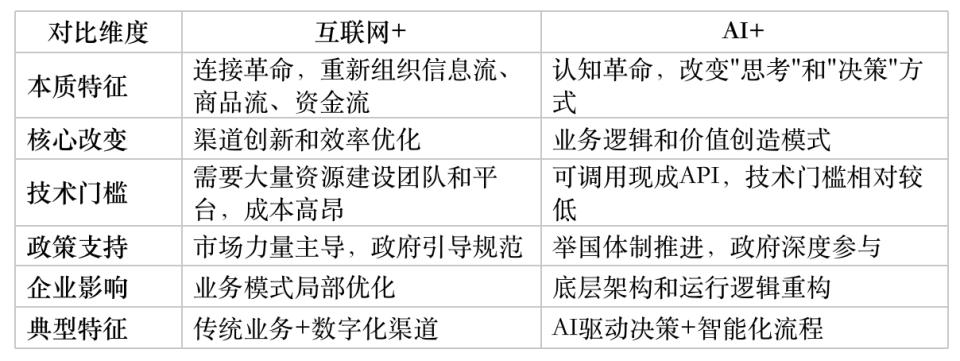
Group 1 - The core document outlines a clear roadmap for AI development in China, aiming for over 70% application penetration of new intelligent terminals and agents by 2027, and positioning the intelligent economy as a key growth driver by 2030 [1] - The transition from "Internet+" to "AI+" signifies a shift from a connection revolution to a cognitive revolution, fundamentally altering decision-making processes and business logic [2][3] - AI+ requires organizations to rethink their value creation logic, moving beyond mere efficiency optimization to a deeper integration of AI into their core operations [5][6] Group 2 - The document emphasizes the need for a new organizational structure that promotes human-machine collaboration, which poses significant challenges in terms of traditional management practices [7] - There is a notable gap between the adoption of AI technologies and the necessary organizational changes, with many companies failing to achieve deep integration of AI into their business models [8][9] - The ambitious goal of achieving over 70% penetration of intelligent applications by 2027 raises questions about feasibility, given that only 16.4% of the population had used generative AI products by mid-2024 [10][11] Group 3 - The government's commitment to enhancing AI infrastructure and reducing costs is expected to accelerate the adoption of AI applications, potentially exceeding current expectations [11] - The emergence of "intelligent native enterprises" represents a significant shift in business models, requiring companies to adapt to AI-driven decision-making and operational processes [11][12] - The competitive landscape will be reshaped as companies leveraging AI gain substantial advantages, emphasizing the urgency for traditional businesses to adapt quickly to avoid being left behind [12]