智能驾驶算力

Search documents
蔚来汽车:多品牌战略
数说新能源· 2026-01-06 08:28
Core Viewpoint - The article emphasizes the importance of technological innovation and market recognition in driving the success of electric vehicle models, highlighting the company's focus on safety, cost reduction, and maintaining high average vehicle prices in the premium segment [1][2]. Part 1: Review of 2025 - The success of popular models is attributed to technological innovation gaining market acceptance [1]. - The average vehicle price for the brand is over 200,000, with an expected increase in the second half of 2025 [1]. Part 2: Achieving 1 Million Units - The company has reached 1 million units, which is considered modest in the industry, emphasizing the commitment to high-end pure electric vehicles and user-centric development [2][3]. - The company acknowledges the support from Anhui province, which has contributed to lower logistics costs and a high talent density in automotive R&D [3]. Part 3: 2026 Business Goals - The main focus for 2026 will be on third-generation vehicle models and aggressive goals for battery swap stations [5]. - The company aims for a sales growth of 40%-50% and plans to expand its sales network into lower-tier markets [5]. - The company will not set specific sales targets but expects to maintain a growth rate of 40%-50% annually [5]. Part 4: Product Planning - New vehicle launches are planned for the second and third quarters, with the ES9 model entering mass production [7]. - The company is also exploring new vehicle formats, including smaller cars [7]. Part 5: Multi-Brand Strategy - The company is collaborating with celebrities and events to promote its brand, with steady growth in sales orders for its new platform [8]. - The goal is to establish 10,000 battery swap stations in China by 2030, with significant investments in smart driving capabilities [8]. Part 6: Q&A Insights - There are currently no plans to pass supply chain cost increases onto end prices, with future pricing dependent on industry developments [9]. - The company is focused on achieving its sales targets for the Firefly brand this year [9]. Additional Insights - The company has captured 61% of the domestic high-end small car market, with future growth expected from overseas markets [10].


中国智能驾驶产业的算力巨变
3 6 Ke· 2025-12-30 10:36
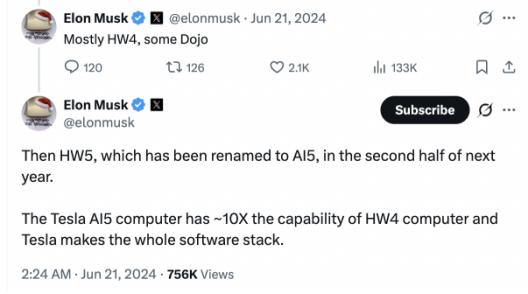
Core Insights - In 2025, the Chinese smart driving industry is experiencing an unprecedented shift in computing power, driven by the evolution of software algorithms and the emergence of competing technical paradigms [1][2] - The differentiation in high-level intelligent driving commercial applications is evident, with a K-shaped market split between affordable and high-end models, leading to fragmentation in the industry [2] - The demand for computing power is increasingly recognized as a core element in the development of smart driving technologies, both at the vehicle and cloud levels [2] Group 1: Technological Evolution - The transition to an end-to-end framework in smart driving is marked by significant advancements, as seen in Tesla's FSD Beta V12 software, which utilizes a computing power standard of 144 TOPS [3][4] - Tesla's shift from HW3 to HW4 signifies a major milestone in its autonomous driving evolution, with the latter becoming the preferred platform for future software updates [5][6] - The upcoming FSD V14 version is expected to have ten times the parameters of its predecessor, indicating a substantial leap in the vehicle's ability to process complex environmental information [6] Group 2: Market Dynamics - Chinese smart driving players, including Xpeng, Li Auto, and NIO, are adopting end-to-end strategies but are initially relying on existing computing platforms, primarily NVIDIA's Orin-X [7][12] - By 2025, a clear division among smart driving companies has emerged, categorized into three main factions based on their computing power strategies: self-developed chips, NVIDIA-based solutions, and Huawei's offerings [12][13] - The self-developed chip faction includes NIO's NX9031 and Xpeng's Turing AI chip, while the NVIDIA faction is represented by the latest Thor platform, which is gaining traction in various models [13][14] Group 3: Cloud Computing and Future Prospects - The industry is witnessing a race for cloud computing power, which is essential for the evolution of smart driving algorithms and the transition from L2 to L4 capabilities [19][20] - The reliance on cloud computing is becoming increasingly critical, as it supports data processing, model training, and simulation necessary for addressing complex driving scenarios [23][24] - The ongoing competition for cloud resources is expected to intensify, with companies recognizing that enhanced cloud capabilities are vital for future advancements in autonomous driving technology [20][21]