有色金属战略地位提升

Search documents
太会买了!紫金矿业连涨4天,这家机构15只基金集体“吃肉”超亿元
Hua Xia Shi Bao· 2026-01-15 14:40
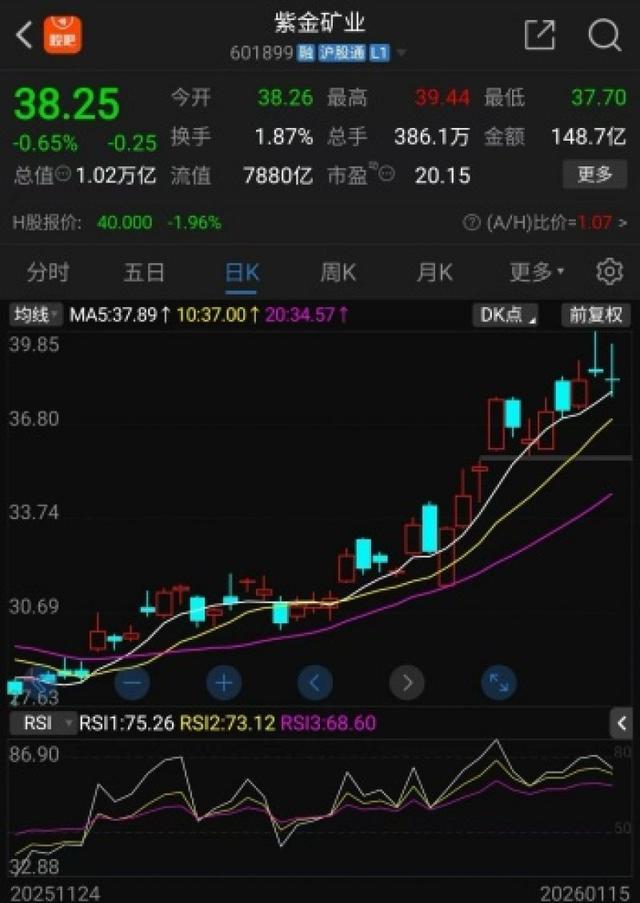
Core Viewpoint - Zijin Mining experienced a stock price correction after four consecutive days of increase, closing at 38.25 yuan on January 15, down 0.65% from the previous day, while maintaining a market capitalization above 1 trillion yuan [2][3]. Group 1: Stock Performance and Institutional Holdings - Zijin Mining's stock rose 6.06% over the previous four trading days, leading to significant paper profits for institutional investors, particularly for Oriental Red Asset Management [3]. - Oriental Red Asset Management holds a total of 49.41 million shares of Zijin Mining across 15 funds, with a daily floating profit of approximately 12.84 million yuan on January 14, and a cumulative floating profit of 109 million yuan during the four-day increase [3]. - Different fund managers within Oriental Red Asset Management exhibited varied strategies regarding Zijin Mining, with some reducing their holdings while others increased them significantly [4][5]. Group 2: Fund Manager Strategies - Zhang Weifeng, managing the Oriental Red Ruixi three-year holding mixed fund, reduced his holdings in Zijin Mining by 30.79%, indicating a strategy to realize profits and manage risk [4]. - In contrast, Wang Zhuo and Miao Yu, managing the Oriental Red Industry Upgrade mixed fund, increased their holdings by 84.30%, reflecting a positive outlook on the company's short-term performance and long-term value [5]. - Other funds managed by Kong Lingchao also included Zijin Mining among their top holdings, with varying degrees of increases [5]. Group 3: Market Dynamics and Metal Demand - The divergence in institutional strategies is attributed to evolving perceptions of non-ferrous metals, with copper being viewed as a strategic resource akin to oil in previous decades [8]. - The demand for metals is expected to be driven by global inflation expectations and the transition to green energy, although macroeconomic uncertainties, such as U.S. Federal Reserve policies, may create volatility [7][8]. - Analysts predict that Zijin Mining will maintain strong profit growth through 2025-2026, supported by rising copper and gold prices, despite facing cost pressures from mining operations [9]. Group 4: Company Growth and Production Capacity - Zijin Mining is actively expanding its production capacity, with the domestic Jilong copper mine's second phase expected to contribute significant copper output by the end of 2025 [10]. - The company's gold segment is also projected to grow, with Zijin Gold International expected to contribute approximately 46.5 tons of gold, representing over 50% of the company's total gold production [10].


广发证券郭磊:有色金属战略地位跃升,成为“新阶段的原油”
Sou Hu Cai Jing· 2026-01-15 02:53
Core Viewpoint - The current performance of global major asset classes is driven by multiple "mainstream narratives," including the long-term weakening of the dollar credit cycle, the formation of a new monetary system with gold as a pricing anchor, the restructuring of global industrial and supply chains, AI computing power becoming a new phase of infrastructure, and non-ferrous metals emerging as the "new oil" of this phase [1] Group 1: Global Asset Dynamics - The narratives are interconnected and form a "narrative constellation" that is systematically reshaping global asset pricing logic, with no indication that this narrative phase is nearing its end [1] - Non-ferrous metals have significantly enhanced their strategic position in the context of global industrial restructuring and energy transition, akin to the role of oil in previous decades [1] Group 2: Chinese Economic Consumption - The consumption structure of the Chinese economy is undergoing a significant transformation, shifting from a focus on goods consumption to a balanced emphasis on both goods and services consumption [1] - There is strong demand for service consumption in areas such as cultural tourism, elderly care, and childcare, with policy incentives for service consumption expected to become an important macroeconomic clue for 2026, driving optimization of domestic demand structure [1]