
机器人租赁

Search documents
机器人,日租金自3万降至3000元
第一财经· 2026-03-18 14:08
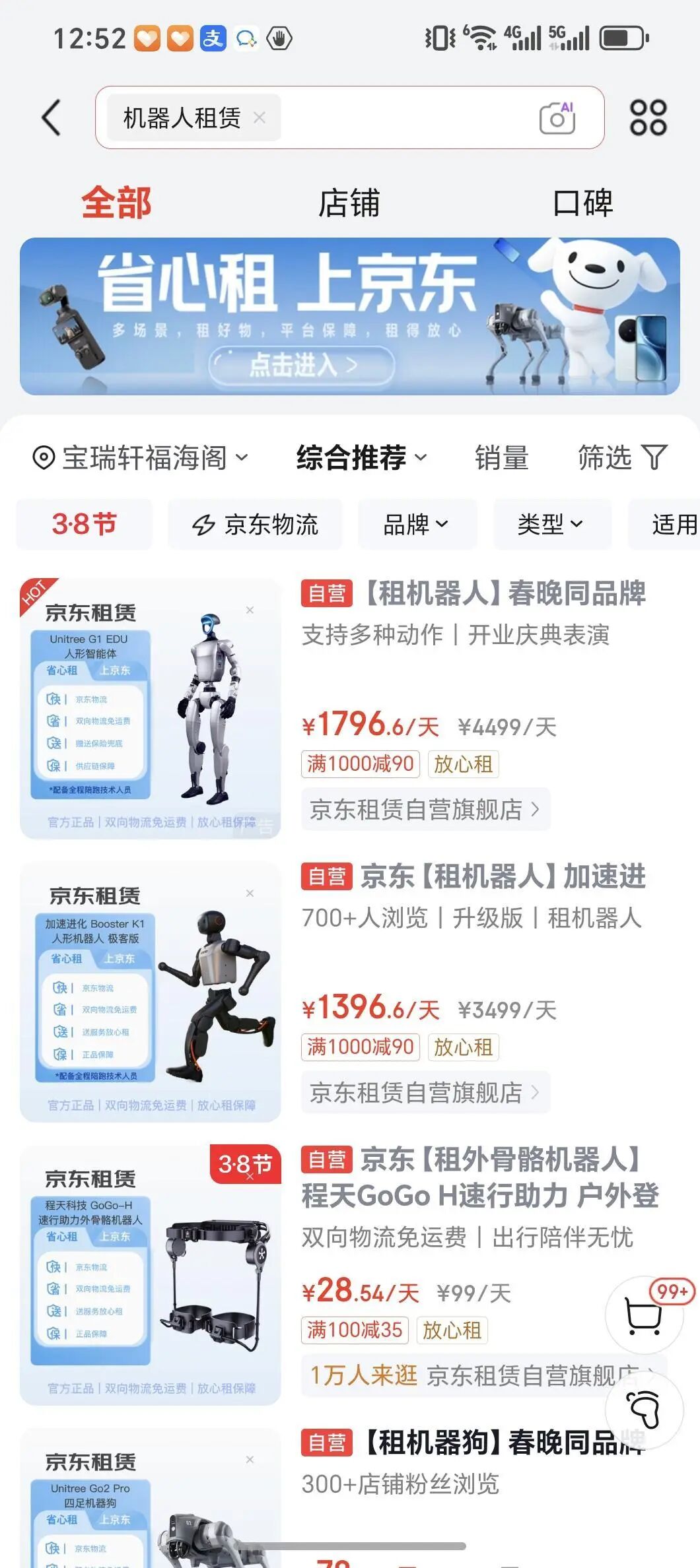
Core Viewpoint - The article discusses the recent developments in the robot rental platform Qingtian Rental, highlighting its successful fundraising and the evolving landscape of the robot rental market in China [4][5]. Group 1: Financing and Business Model - Qingtian Rental announced the completion of angel and angel+ rounds of financing, raising a total of over 100 million yuan, primarily led by Dayang Electric, Muhua Kechuang, and Minzhu Jidian, with follow-up investments from Lehua Entertainment and Fuzhuo Investment Germany [4]. - The funds will be used for building a national fulfillment network, enhancing robot asset scheduling capabilities, and developing mid-platform technology [4]. - The CEO of Qingtian Rental, Li Yiyan, mentioned that the Pre-A round of financing is currently over halfway completed [4]. - A new city partner strategy was launched, where the platform handles order dispatch while partners are responsible for fulfillment, allowing them to also source their own orders [4]. - Unlike traditional franchise models, the city partner model does not charge franchise fees and provides support in asset, scheduling, settlement, and service standards [4]. Group 2: Market Trends and Pricing - The robot rental market is gaining traction, with competitors like JD's self-operated robot rental and Wanjiyi Rental entering the space [4]. - Rental prices have decreased from a peak of 10,000-30,000 yuan per day in early 2025 to a range of 3,000-5,000 yuan, reflecting a healthier market [4][5]. - Qingtian Rental's CSO, Wang Mingfeng, stated that the price adjustment is a sign of market health, moving away from early-stage information asymmetry [5]. - Post-Spring Festival, the robot rental industry has seen a surge in order volume, indicating a shift towards long-term rentals, particularly in the catering sector [5]. - The article notes that businesses are beginning to recognize the value of robots in customer engagement, moving from traditional methods to robotic solutions [5].


擎天租三个月融资3轮:机器人租赁赛道迎首笔亿元级融资,黄晓明杜华入局
IPO早知道· 2026-03-18 02:55
Core Viewpoint - The article discusses the rapid growth and strategic positioning of "Qingtian Rental," the world's first robot leasing platform, which has successfully completed multiple rounds of financing and aims to establish a nationwide standardized service network for robot leasing [3][4][6]. Financing and Valuation - Qingtian Rental has completed three rounds of financing in less than three months, achieving a valuation of 3 billion yuan [4]. - The total financing amount reached hundreds of millions, with major investments from companies like Dayang Electric and Minhua Technology [3]. Strategic Partnerships - The recent financing round introduced diverse industrial capital, aiming for strategic collaboration across application scenarios, channel expansion, supply chain systems, and regional service networks [6]. - Notable partnerships include collaborations with hard-tech giants and entertainment companies, enhancing the platform's capabilities in both industrial and entertainment sectors [6][10]. Market Positioning and Growth - Qingtian Rental is not merely a transaction platform but is building a comprehensive "leasing infrastructure" for the robot industry, addressing key industry pain points [7]. - The platform has already processed over 5,500 orders and has more than 3,000 robots available for dispatch, with over 20,000 city partners registered [8]. Future Prospects - The integration of technology and entertainment is expected to unlock significant opportunities, with plans to explore innovative leasing services in high-exposure events like concerts and large-scale performances [10]. - The company aims to expand its local service network and enhance delivery and operational capabilities in real-world scenarios [10].

独家|40家机构抢一个天使轮
投中网· 2026-03-18 01:52
Core Viewpoint - The article discusses the rapid growth and investment in the robotics industry, particularly focusing on the robot rental platform, Qingtian Rental, which has achieved a valuation of 3 billion yuan within three months of its establishment [2][8]. Investment and Financing - The robotics industry has seen over 20 billion yuan in financing since the beginning of the year, with valuations frequently reaching new heights, making a 10 billion yuan valuation almost a starting point [4]. - Qingtian Rental completed two rounds of angel financing, raising over 100 million yuan, with notable investors including publicly listed companies and various venture capital firms [5]. - Despite the rapid decision-making process, there are concerns about the future of robot rentals, with over 40 investment institutions expressing interest, indicating a competitive investment landscape [6]. Business Model and Operations - Qingtian Rental focuses on the entertainment sector, with a significant portion of its orders during the Spring Festival related to entertainment performances and commercial marketing, accounting for 70% of its business [6]. - The platform has successfully processed over 1,000 orders during the Spring Festival, indicating strong demand, although it faces challenges in fulfilling orders due to staffing shortages and geographic coverage limitations [10][12]. - The company has initiated a "City Partner" recruitment program to enhance local service delivery, receiving over 16,000 applications, which suggests a higher-than-expected demand for its services [12]. Market Dynamics and Future Outlook - The robotics rental market is characterized by intense competition, with various players entering the space, including manufacturers and logistics companies [10]. - Qingtian Rental has a competitive edge in financing, brand partnerships, and operational capabilities, with plans to increase its robot fleet from over 3,000 to potentially over 10,000 by 2026 [10]. - The company aims to create a robust operational model that connects asset providers with rental partners, positioning itself as a key player in the emerging robotics rental market [15][17].

擎天租亮相AWE获大量观众驻足围观:机器人租赁的现实价值进一步凸显
IPO早知道· 2026-03-12 14:03
Core Viewpoint - The article emphasizes the transition of robots from being mere novelty displays to becoming practical commercial tools that can be utilized in various business scenarios [2][7]. Group 1: Robot Leasing Platform - The global first robot leasing service platform, "Qingtian Rental," was showcased at AWE 2026, signaling that robots are evolving into new choices for brand building, traffic operation, and offline scene interaction [2]. - Qingtian Rental has developed a one-stop service capability that includes robot leasing, scene deployment, on-site delivery, and operational support, offering customized solutions for different commercial scenarios [4]. Group 2: Application and Interaction - Robots like Zhiyuan Lingxi X2 and Yuanzheng A2 were deployed at the exhibition, demonstrating their capabilities in guiding, engaging, and promoting brands in various rental scenarios [4]. - The deployment of robots at the event attracted significant audience attention and prompted inquiries from clients about integrating robots into their offline businesses for activities like traffic generation and brand interaction [7]. Group 3: Benefits of Leasing Model - The leasing model allows clients to lower the entry barrier and enhance equipment usage efficiency, providing a more flexible and lightweight intelligent solution for businesses [7]. - Qingtian Rental's CEO highlighted that the key to robot commercialization is not just visibility but also effectively serving clients' brand expression, traffic acquisition, and offline operations [7]. Group 4: Future Directions - Qingtian Rental aims to leverage its platform capabilities to connect more robot brands with real commercial needs, promoting the creation of actual value in various offline scenarios [9].

机器人租赁行业能否跑出下一个“滴滴”?
3 6 Ke· 2026-03-11 09:19
Core Insights - The rapid rise and subsequent decline of the robot rental market post-Spring Festival highlights the volatility of demand driven by novelty and seasonal events [1][2][15] - The emergence of multiple rental platforms and aggressive pricing strategies has transformed robots from luxury items to accessible consumer goods, significantly increasing market participation [11][12][14] Group 1: Market Dynamics - The robot rental market experienced a surge during the Spring Festival, with orders increasing nearly 70% compared to previous periods, driven by festive events [4] - The average daily rental price for robots has drastically decreased, with some models now available for as low as 78 yuan, compared to previous highs of 15,000 yuan [6][11] - The influx of new rental companies, with over 1,500 established in 2025 alone, has led to a supply-demand mismatch, resulting in price drops and increased competition [26][29] Group 2: Consumer Behavior - A significant portion of rental orders (30%) during the Spring Festival came from first-time users, indicating a growing interest in robotic experiences among the general public [4] - The novelty effect of robots has diminished, leading to consumer fatigue as many performances and interactions appear repetitive and lack differentiation [30][32] Group 3: Future Outlook - The robot rental market is projected to grow from 1 billion yuan in 2025 to at least 10 billion yuan by 2026, driven by capital investment and the need for innovative applications beyond entertainment [14][15] - To sustain growth, the industry must evolve from providing novelty entertainment to offering practical applications in various sectors, such as manufacturing and healthcare [33][34] - Establishing a robust risk management framework and enhancing service quality will be crucial for long-term success in the competitive landscape [35][40]


租赁开始跑通人形机器人落地第一公里
机器人大讲堂· 2026-03-01 04:52
Core Insights - The robot rental market experienced significant growth at the beginning of 2026, with the platform "Qingtian Rental" reporting over 1,000 orders during the Spring Festival and an expected total of over 5,000 orders, representing an 80% month-on-month growth [2][4]. Group 1: Market Dynamics - The rental of robots is not a new concept, but the current surge in the robot rental market is notable, with rental prices for humanoid robots previously reaching over 10,000 to 20,000 yuan per day, now reduced to 3,000 to 6,000 yuan [6][10]. - The market has seen a completion of education, leading to increased participation, with over 16,000 individuals signing up for the city partner strategy, including event planners and individual investors [3][8]. - The demand for robot rentals is diversifying, with 30% of Spring Festival orders coming from new users, indicating a shift from corporate clients to individual consumers [11][12]. Group 2: Platform Development - The emergence of "Qingtian Rental" is seen as a necessary platformization of the previously fragmented robot rental market, which lacked transparency and standardization [19][22]. - The platform currently has over 3,000 robots available for dispatch across more than 100 cities, with over 200 suppliers, streamlining the rental process for users [25][26]. - The city partner strategy is designed to empower local partners without charging franchise fees, focusing on co-building a network that supports local fulfillment [26][30]. Group 3: Future Outlook - The robot rental market is projected to grow significantly, with estimates suggesting it could reach 100 billion yuan by 2026, driven by increased production capacity and a growing user base [10][11]. - The industry is expected to evolve as technology advances, with the potential for robots to transition from entertainment to practical applications in various sectors [35][39]. - The current rental model serves as a precursor to broader commercialization of humanoid robots, with the expectation that as capabilities improve, demand will surge [41][42].

订单排至5月,涨幅超70%!青岛机器人租赁迎开门红
Qi Lu Wan Bao· 2026-02-27 13:59
Core Insights - The robot rental market is experiencing a significant surge in demand, with some companies reporting order increases of over 70% after the Spring Festival, and rental schedules booked until May [2][3][4] Group 1: Market Dynamics - The 2026 Spring Festival showcased robots prominently, leading to a notable increase in rental inquiries and orders, indicating a strong market response [3] - Companies like Qingdao Qinyang Intelligent Technology Co., which entered the rental market in 2025, are capitalizing on this demand, with orders expected to peak around holidays and events [3][4] Group 2: Pricing Trends - The rental prices for robots have stabilized, with daily rental rates now ranging from 3,000 to 4,000 yuan, compared to over 10,000 yuan earlier in 2025 [5] - The decrease in rental prices is attributed to increased supply from manufacturers and a normalization of customer excitement after the initial surge [5] Group 3: Application and Service Evolution - The robot rental market is shifting from merely providing equipment to offering integrated solutions, including operational services [6][9] - Robots are being utilized in diverse applications beyond entertainment, such as educational settings, where they serve as teaching aids and engage in programming training [9]

机器人租赁火出圈,有企业机器人租赁订单排到3月底
Xin Lang Cai Jing· 2026-02-27 04:58
Core Viewpoint - The robot rental market is experiencing significant growth as robots are increasingly applied in various new scenarios, particularly following the Spring Festival celebrations in China [1] Group 1: Industry Trends - The demand for robot rentals has surged, with companies actively seeking to incorporate robots into events and activities [1] - A specific robot company in Hangzhou, Zhejiang, is customizing dance routines for robots to meet the needs of local businesses [1] - The company's rental business has expanded to multiple regions, indicating a broader trend in the adoption of robotic technology across different sectors [1] Group 2: Business Operations - The robot rental company has received a high volume of orders, with bookings extending into the end of March [1] - The customization of robot performances for specific events highlights the growing importance of tailored solutions in the robotics market [1]
机器人“上春晚” 带火线下租赁市场
Xin Lang Cai Jing· 2026-02-26 17:40
Core Insights - The 2026 Spring Festival Gala featured an unprecedented lineup of robots from four companies, showcasing their capabilities in various performance and interaction scenarios, which has sparked significant public interest [1][2] - Following the gala, the offline robot rental market experienced a surge, with a nearly 70% increase in orders during the Spring Festival holiday, particularly in entertainment and commercial marketing categories [1][2] Group 1: Robot Performance and Market Impact - The robots showcased at the Spring Festival Gala included advanced models capable of complex performances, such as martial arts and interactive scenes with celebrities, highlighting the evolution of robotic technology [2] - The rental market for these robots has seen a rapid increase, with platforms launching "Spring Festival Gala" themed rental services, making high-tech robots accessible to the general public at lower costs [2][3] Group 2: Rental Market Dynamics - The rental prices for robots vary significantly, ranging from 399 yuan to 13,500 yuan per day, with a notable trend of decreasing rental costs over time, making it more affordable for consumers [3] - The rental service has expanded to cater to various events, including corporate gatherings, exhibitions, and personal celebrations, indicating a broadening customer base beyond just businesses [3][5] Group 3: Consumer Engagement and Trends - The use of robots in public events, such as the New Year temple fairs and shopping malls, has led to increased foot traffic, with reports of customer visits rising by 30% to 70% when robots are employed as promotional tools [5][6] - The customer demographic for robot rentals is shifting from primarily corporate clients to individual consumers, with an increasing number of personal events, such as birthday parties, utilizing robot rentals [6]
春节期间机器人租赁迎近七成增长 节庆场景成主要拉动力
Jiang Nan Shi Bao· 2026-02-26 13:52
Core Insights - The core viewpoint of the article highlights a significant increase in orders for a robot rental service platform during the Chinese New Year period, indicating a growing demand for robotic solutions in various sectors [1] Group 1: Order Growth - The platform experienced a nearly 70% month-on-month increase in orders during the Chinese New Year period from February 17 to February 23 [1] - The breakdown of order categories includes 34% for entertainment performances, 31% for commercial marketing, 19% for educational and cultural tourism functions, and 16% for life events and emotional consumption [1] Group 2: Seasonal Demand Drivers - Orders related to festive scenarios such as New Year greetings, temple fairs, and shopping mall activities accounted for over 54% of total orders, reflecting a strong seasonal demand [1] - This festive-related order segment saw a month-on-month growth of over 76%, becoming the core driver of robot rental demand during the holiday [1]