杠铃型策略

Search documents
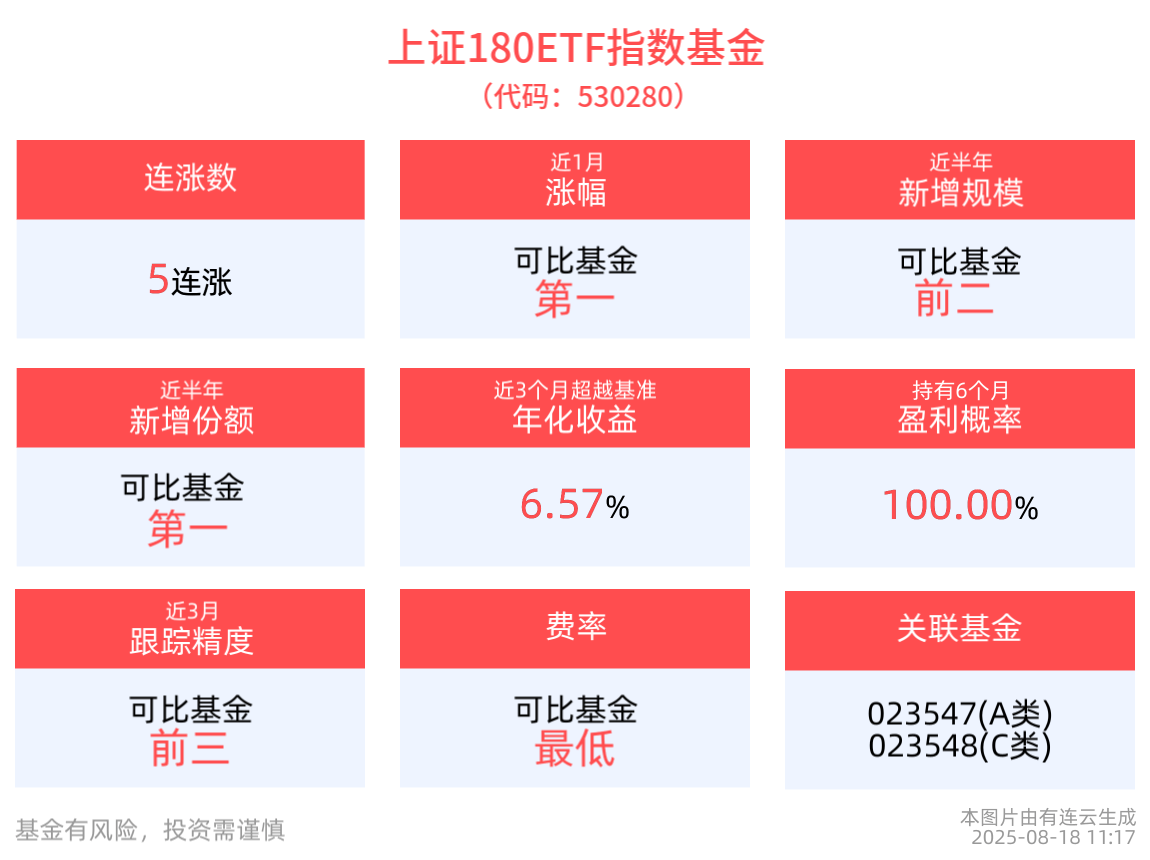
上证180指数上涨1.12%,自带杠铃配置的上证180ETF指数基金(530280)冲击5连涨
Sou Hu Cai Jing· 2025-08-18 03:37
Group 1 - The Shanghai 180 Index (000010) has shown a strong increase of 1.12% as of August 18, 2025, with notable gains from stocks such as Stone Technology (688169) up 14.10%, Northern Rare Earth (600111) up 10.00%, and Great Wall Motors (601633) up 8.32% [3] - The Shanghai 180 ETF Index Fund (530280) has risen by 0.44%, marking its fifth consecutive increase, with a latest price of 1.13 yuan. Over the past week, the fund has accumulated a rise of 2.46%, ranking 1st among comparable funds [3] - The Shanghai 180 Index employs a barbell strategy consisting of 90% dividend stocks and 10% technology stocks, providing a good option for equity market allocation. This strategy allows for potential benefits from rapid technological development while maintaining a solid dividend base [3] Group 2 - As of July 31, 2025, the top ten weighted stocks in the Shanghai 180 Index include Kweichow Moutai (600519), Hengrui Medicine (600276), and Ping An Insurance (601318), with these stocks collectively accounting for 25.4% of the index [4] - The weightings of the top stocks are as follows: Kweichow Moutai at 4.92%, Ping An Insurance at 2.75%, and Hengrui Medicine at 2.62%, among others [6]







策略聚焦|牛市的烦恼
中信证券研究· 2025-03-09 09:03
Core Viewpoint - The current market dynamics show a significant divergence between the Hong Kong and A-share markets, with Hong Kong stocks experiencing a bull market while A-shares remain in a state of fluctuation. This divergence is primarily driven by the concentration of high-quality core assets in the Hong Kong market, particularly in sectors such as the internet, hard technology, smart vehicles, and innovative pharmaceuticals [1][2][3]. Market Divergence - As of March 7, the Hang Seng Technology Index has recorded a cumulative return of 27.8%, leading global major indices, while the A-share market has shown only modest gains, with the STAR 50 Index rising by 16% and the CSI 300 Index showing minimal increase. The cumulative performance of core assets in A-shares and Hong Kong stocks from January 10, 2025, indicates a 9% increase for A-shares compared to a 51% increase for Hong Kong stocks [3][4]. - The concentration of new economy assets in Hong Kong is notable, with high consensus and strong certainty in sectors such as domestic computing power, the internet, smart vehicles, and innovative pharmaceuticals. The Hang Seng Technology Index covers key assets in these areas, and many Hong Kong companies are still in the early stages of profit recovery, suggesting significant potential for future earnings improvement [3][4]. A-share Market Characteristics - A-share core assets exhibit cyclical characteristics, with approximately 45% of companies yet to reach an operational turning point. The distribution of market capitalization among core assets shows a balanced representation across technology (25.1%), consumer (27.8%), and advanced manufacturing (19.2%). The cyclical nature of A-share core assets is closely tied to macroeconomic conditions, with historical turning points indicating a potential operational turning point between late 2024 and early 2025 [4][5]. - Many public funds face restrictions on investing in Hong Kong stocks, leading to performance anxiety among institutional investors. Approximately 60% of equity public funds lack Hong Kong Stock Connect permissions, which limits their investment scope and forces them to focus on A-shares, resulting in a disparity in asset quality and performance [5][6]. Transition from Macro to Industry Focus - The market is transitioning from a macro-driven environment to one focused on industry dynamics. The clarity of policy direction and the reduction of macroeconomic volatility suggest that market participants should shift their attention from macro concerns to industry trends, particularly in technology and innovation sectors [6][7]. - The current macroeconomic environment is characterized by stabilization in consumption and real estate, with a focus on structural opportunities driven by technological advancements. This shift mirrors the asset recovery period seen in the U.S. from 2010 to 2015, indicating a need for investors to prioritize industry trends over macroeconomic fluctuations [8][9]. Investment Opportunities - In light of the clear policy expectations and the normalization of macroeconomic volatility, the focus should be on A-share "new core assets." Key sectors such as domestic computing power, edge AI, high-density energy batteries, and innovative pharmaceuticals are expected to see significant thematic catalysts and industry upturns, particularly with new product launches from leading companies [11][12].