枢纽类投资

Search documents
热点思考 | 设备投资,能否“持续高增”?(申万宏观·赵伟团队)
Xin Lang Cai Jing· 2026-01-06 16:25
Group 1 - The core argument is that the high growth in equipment investment is not primarily driven by the "Two New" policies or the manufacturing Juglar cycle, but rather by strong investment in broad infrastructure and the service sector [1][8][69] - Equipment investment growth is significantly higher in sectors such as construction (65.5%), narrow infrastructure (46.1%), public utilities (16.5%), and services (13.9%) compared to manufacturing (6.5%), contributing an additional 8.1 percentage points to overall equipment investment [1][8][69] - In 2025, manufacturing investment growth is expected to decline to 1.9%, while equipment investment is projected to maintain high growth at 12.2%, driven by digital infrastructure and energy infrastructure [1][8][69] Group 2 - The strong growth in equipment investment is fueled by the establishment of a modern industrial system, which enhances digital infrastructure, alongside natural renewal cycles and recovering travel demand, thus boosting narrow infrastructure and construction equipment investment [3][24][69] - Key sectors such as software and computer services are experiencing growth rates of 53%, while aviation and road transport equipment investments are also high, correlating with a 17.9% year-on-year increase in civil aviation passenger transport [3][24][69] - The acceleration of energy transition and infrastructure investment in central and western regions, particularly since the intensification of the "dual carbon" policy in 2021, has led to a significant increase in public utility equipment investment [3][31][69] Group 3 - Fiscal policies have increased research spending and improved travel chain demand, leading to a notable rise in service sector equipment investment, which has outpaced construction investment since 2023 [4][40][69] - The growth rate for service sector equipment investment reached 13.9% in 2024, while construction investment only grew by 2.8% [4][40][69] - The recovery gap in service sector investment is estimated to be around 2-3 trillion yuan, indicating a strong potential for future growth in this area [4][56][69] Group 4 - Equipment investment is expected to continue its high growth into 2026, supported by both domestic and external demand chains [5][69] - Narrow infrastructure investment is anticipated to rebound significantly, particularly in digital infrastructure and hub-related investments [5][46][69] - The "dual carbon" policy is expected to further drive investment in equipment for carbon reduction, including modifications in high-energy-consuming industries and investments in renewable energy [5][51][69]

热点思考 | 设备投资,能否“持续高增”?(申万宏观·赵伟团队)
申万宏源宏观· 2026-01-06 11:19
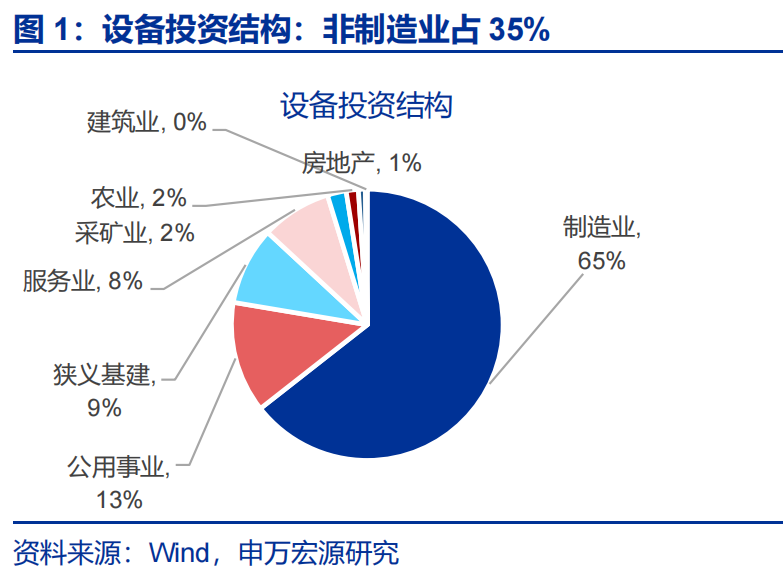
Core Viewpoint - The article argues that the high growth in equipment investment is not primarily driven by the "Two New" policies or the manufacturing Juglar cycle, but rather by strong investment in broad infrastructure and the service sector [2][9][71]. Group 1: Misconceptions about Equipment Investment Growth - Misconception 1: The strong equipment investment is attributed to the Juglar cycle; however, it is actually driven by robust growth in broad infrastructure and service sector investments. In 2024, the growth rates for equipment purchases in construction (65.5%), narrow infrastructure (46.1%), public utilities (16.5%), and services (13.9%) significantly outpaced manufacturing (6.5%), contributing an additional 8.1 percentage points to overall equipment investment [2][9][71]. - Misconception 2: The strong equipment investment is influenced by the "Two New" policies; however, the investment rhythm and structure contradict this view. The special government bonds supporting "Two New" policies will only ramp up in the second half of 2024, while manufacturing and equipment purchase investments had already surged in February 2024 [2][9][71]. - Misconception 3: The strong manufacturing investment is a result of strong equipment investment; in reality, it stems from construction and installation investments (expansion investments). Since 2024, while manufacturing and equipment purchase investments have grown simultaneously, the growth in equipment investment is not solely derived from manufacturing [3][21][71]. Group 2: Drivers of High Equipment Investment Growth - Reason 1: The establishment of a modern industrial system has boosted digital infrastructure, combined with natural renewal cycles and recovering travel demand, driving equipment investment in narrow infrastructure and construction. In 2024, narrow infrastructure equipment purchases contributed 4.3 percentage points to total equipment investment, exceeding manufacturing's contribution [4][25][77]. - Reason 2: The acceleration of energy transition and thermal power renovation investments in central and western regions has strengthened public utility equipment investments, particularly since the intensification of the "dual carbon" policy in 2021 [4][32][77]. - Reason 3: Increased fiscal spending on research and improvements in travel chain demand have driven strong service sector equipment investments. Since 2023, service sector equipment investments have shown a trend of outpacing construction investments [5][42][77]. Group 3: Sustainability of High Equipment Investment Growth - Main Line 1: Narrow infrastructure is expected to rebound significantly, especially in digital infrastructure and hub-related investments. Recent policy measures, including a reduction in the proportion of special refinancing bonds, are anticipated to support a rebound in infrastructure investment in 2026 [6][48][79]. - Main Line 2: The "dual carbon" policy is expected to enhance investments in equipment for carbon reduction, including renovations in high-energy-consuming industries and investments in renewable energy [6][53][79]. - Main Line 3: Policies related to "investment in people" are likely to be significantly strengthened, with service sector equipment investments related to consumer infrastructure expected to recover actively [6][58][79]. - Main Line 4: Equipment investments related to external demand are expected to remain resilient, particularly in sectors supporting the industrialization of emerging economies [6][63][79].