楼市结构性机会

Search documents
中国金茂董事长陶天海:楼市反弹可期 结构性机会依然存在
2 1 Shi Ji Jing Ji Bao Dao· 2026-03-25 04:03
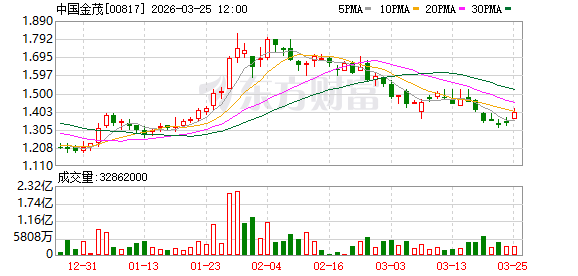
Core Viewpoint - China Jinmao reported a revenue of 59.371 billion yuan for 2025, marking a 1% year-on-year increase, with a net profit of 1.253 billion yuan, up 18% from the previous year [2] Group 1: Financial Performance - The gross profit for 2025 was 9.221 billion yuan, reflecting a 7% increase year-on-year [2] - The company achieved a signed sales amount of 113.5 billion yuan, a 16% increase year-on-year, ranking eighth in the industry [2][3] - The overall gross margin improved to 16%, influenced by regional optimization, price increases, and operational enhancements [4] Group 2: Sales and Market Position - In first and second-tier cities, signed sales accounted for 96% of total sales, with North China and East China regions contributing 73% [3] - The average residential contract price was 27,000 yuan per square meter, a 24% increase year-on-year [4] - The company plans to have a total saleable value of 220 billion yuan for the current year, expecting a steady increase in sales scale [4] Group 3: Debt and Land Acquisition - As of the end of 2025, the total debt balance was 129 billion yuan, with approximately 22% due within one year, indicating a reasonable level of debt [5] - The company invested 57.7 billion yuan to acquire 21 land parcels, ranking eighth in land acquisition spending among national real estate companies [5] Group 4: Market Outlook - The chairman indicated that while the market is currently stabilizing, structural opportunities remain, particularly in core first and second-tier cities [4][6] - The overall market showed weak performance last year, but positive factors for stabilization are accumulating, with expectations for recovery in high-capacity cities by 2026-2027 [6]

专家说出实话:2026年,“咬牙买房”还是“趁早卖房”?涨知识了
Sou Hu Cai Jing· 2026-02-25 06:42
Core Viewpoint - The real question for property owners in 2026 is not whether to buy or sell, but rather the quality and location of the properties they hold [3][38]. Group 1: Market Overview - The overall market is characterized by stable transaction volumes but declining prices, indicating an L-shaped bottoming process with increasing differentiation among cities [6]. - In 2025, the cumulative price of second-hand residential properties in 100 cities fell by 8.36%, marking four consecutive years of decline, while new home prices saw slight structural increases driven by improved properties [8][10]. Group 2: Recommendations for Buying and Selling - Recommendation 1: Focus on "city + district" rather than concepts when buying; 2026 presents structural opportunities in "good cities + good properties," not a general price increase [12][19]. - Recommendation 2: Sellers should be willing to "clean up poor-quality assets"; properties in weak second-tier and third- and fourth-tier cities, especially those without industrial support, should be sold promptly [21][23]. - Recommendation 3: Buyers should be bold in selecting "good properties" in core areas of first- and strong second-tier cities, focusing on quality and long-term living needs rather than trying to time the market [26][28]. Group 3: Market Dynamics and Strategy - The market is expected to continue a slight decline in sales area, but at a reduced rate, with overall prices stabilizing; structural opportunities exist in strong cities and quality properties [10][38]. - The emphasis is on returning to a "self-use logic," treating properties as living necessities rather than financial products, and avoiding high leverage in uncertain market conditions [30][36].
《人民日报》最新发声,看好房地产未来潜力,楼市要触底反弹了?
Sou Hu Cai Jing· 2026-02-02 12:11
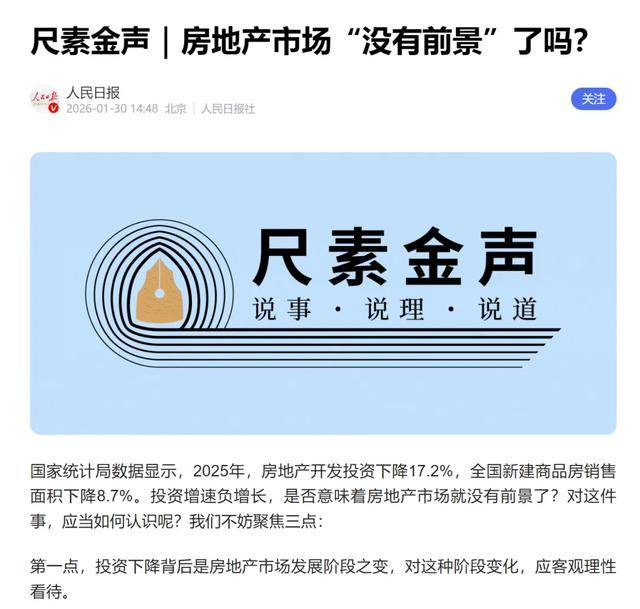
Core Viewpoint - The recent media focus on stabilizing the real estate market indicates a shift from a "rescue" mentality to a "stabilization" approach, suggesting that while the market has potential, it is not necessarily on the verge of a rebound [4][12]. Market Sentiment - There is a prevailing pessimism in the real estate market, with recent articles from state media aimed at calming public anxiety rather than promoting speculative buying [1][4]. - The psychological state of homebuyers is conflicted, with many fearing they will miss out on future price increases while also worrying about buying at a high point [7][10]. Investment Trends - In January 2026, the total land acquisition by the top 100 real estate companies was 57.99 billion, a year-on-year decrease of 52.1%, indicating caution among developers [5]. - The current market environment shows that only state-owned enterprises are actively acquiring land, while private companies remain hesitant [5][11]. Market Dynamics - The real estate market is experiencing a significant divide, with first-tier cities showing signs of recovery while third and fourth-tier cities face substantial declines in new home sales, with a year-on-year drop of 46.6% [11]. - The recovery in core urban areas does not equate to a nationwide rebound, as many properties in non-core areas struggle to sell [11][12]. Future Outlook - The long-term potential of the real estate market lies in its transformation and the release of demand for improved housing, rather than short-term price surges [13]. - Key indicators for assessing the market's future include improvements in residents' income expectations, resolution of real estate companies' debt issues, and a reduction in inventory pressure, which currently stands at a 22.3-month supply in major cities [12].
不看全国房价!2026楼市结构性机会凸显,分化加剧,该买还是卖?
Sou Hu Cai Jing· 2026-01-10 14:52
Core Viewpoint - The 2026 real estate market outlook is focused on identifying evidence of a "stable bottom" rather than merely predicting price fluctuations, with significant implications for the financial market and macroeconomy [1] Policy Direction - The central economic work conference at the end of 2025 shifted its policy focus from "stopping the decline" to "stabilizing the real estate market," emphasizing three core directions: "controlling increments, reducing inventory, and optimizing supply" [2] - Financial regulatory bodies are promoting the inclusion of housing project loans in a whitelist, with over 3 trillion yuan approved by the end of November 2025 [2] Market Stability - The policy focus for 2026 is on "breaking the cycle" and structural optimization, moving from a total shortage to a basic balance in the real estate market, addressing the upgrade in residents' demand from "availability" to "quality" [5] - Institutions generally believe that the 2026 real estate market will not experience a "V-shaped reversal," but rather a trend of "overall stability with continued differentiation" [7] Evidence Chain for Market Bottom - The capital market assesses the sustainability of the market bottom through a complete evidence chain of "transaction volume - inventory - credit - price," with transaction volume being a primary observation point [9] - The current market is in a phase of stabilizing transaction volume declines, with institutions tracking key cities' transaction rhythms and the effectiveness of loan rate and down payment adjustments [11] Inventory and Credit Factors - The efficiency of inventory reduction is crucial for determining the thickness of the market bottom, with concerns about local fiscal pressures and execution mechanisms potentially hindering progress [13] - Positive signals are emerging, with a significant reduction in narrow inventory by 42.85 million square meters since the beginning of 2025, alleviating short-term inventory pressure [15] Price Expectations - Price predictions focus on structural differences rather than national averages, with attention on the resilience of core urban areas and the structural support from quality new homes [15] - The mainland market is expected to see new home prices outperforming second-hand homes, with increasing disparities between cities [17] Variables Influencing Recovery - Despite a consensus on "stability," different institutions have varying estimates for core indicators due to differing assumptions about three key variables: policy strength, implementation efficiency, and recovery models [19][21] - The uncertainty of policy strength is a primary concern, with expectations that confidence recovery will take time, leading to continued pressure on investment and sales in 2026 [19]
深圳这些楼盘房价在涨
Sou Hu Cai Jing· 2025-07-12 02:52
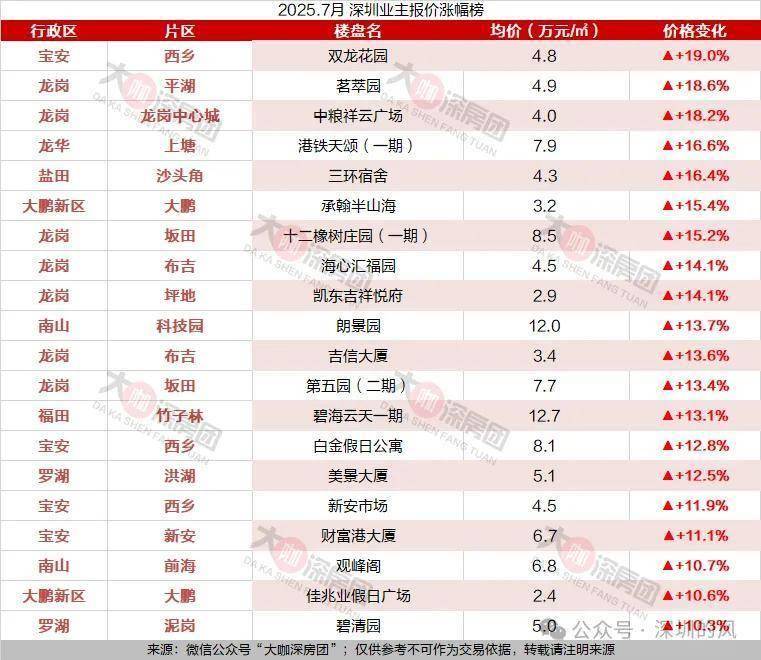
Core Insights - The Shenzhen real estate market is experiencing a significant increase in second-hand housing supply, with over 75,000 effective listings as of July 7, marking a rise of more than 3,000 units in two weeks, primarily driven by the Longgang, Baoan, and Futian districts contributing over 60% of the new supply [1] - Despite 71.8% of monitored areas seeing average prices decline, there are positive signals emerging, with the proportion of declining properties narrowing to 51.9% and the percentage of rising properties increasing to 36.2% [2] - Structural opportunities are becoming apparent, with resilient core area assets and significant price differentiation in peripheral regions, indicating a potential new phase of value discovery in the market [4] Market Dynamics - The market is characterized by three main features: enhanced resilience of core area assets, increased differentiation in peripheral regions, and a rising trend in the proportion of larger unit sales (over 120㎡) [4] - The policy environment continues to influence market expectations, with adjustments in second-hand housing reference prices and an increase in affordable housing construction, which is gradually diverting market demand [5] - The financial landscape shows a shift in funding preferences, with a notable increase in long-term loans and a high auction failure rate for luxury properties, indicating liquidity risks in high-value assets [5] Price Trends - The price increase leaderboard for July shows significant gains in various districts, with the highest increase of 19% in the Shuanglong Garden of Baoan district, reflecting a "low-price rebound" logic [3] - The market is expected to maintain a dual structure of stability in core areas and adjustments in peripheral regions as the traditional peak season approaches [5] - The overall market dynamics suggest that buyers should focus on specific district characteristics, such as industrial support and transportation planning, rather than solely on price [5]