模仿与创新

Search documents
小米潘九堂:模仿是创新基础,没有哪家成功的企业不模仿别人
Feng Huang Wang· 2026-01-14 11:08
Core Viewpoint - Imitation is a fundamental basis for innovation, and successful companies often engage in significant imitation of others while also incorporating their own innovations [1]. Group 1 - The progress of industries and social development is driven by intelligent individuals and companies that inspire each other through imitation and micro-innovation, leading to mutual advancement [1]. - Imitation, learning, and benchmarking are normal practices in business, and there is no need to stigmatize them [1]. - In response to rumors regarding competitors evaluating the Pro Max model, it was stated that benchmarking is a common business strategy, with major companies like Apple and Google also engaging in substantial buying and copying [5].


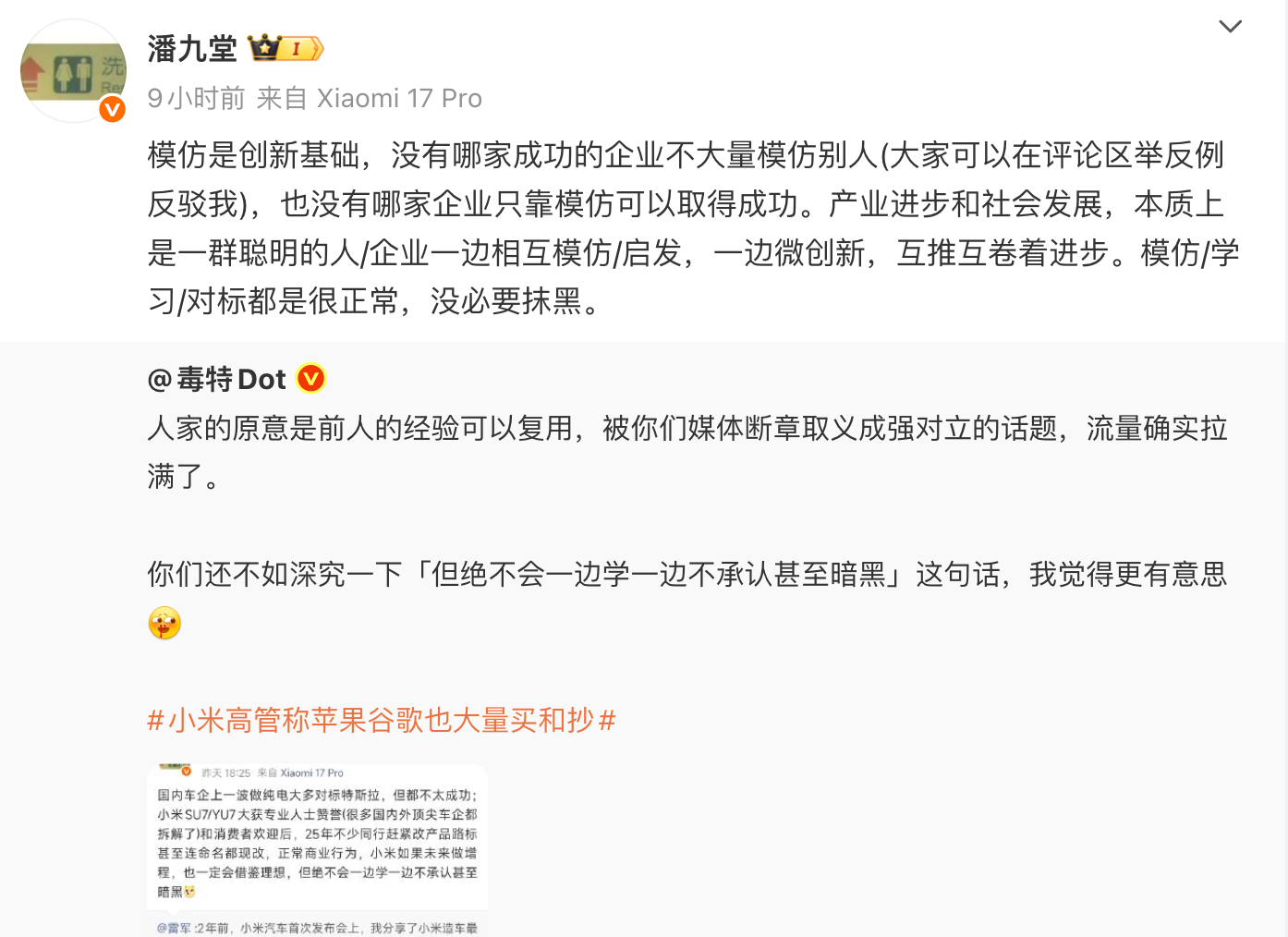
潘九堂:模仿是创新的基础,小米汽车如果未来做增程一定会借鉴理想
Huan Qiu Wang· 2026-01-14 06:52
Core Viewpoint - The commentary by Xiaomi's investment partner, Pan Jiutang, highlights the evolving landscape of the domestic electric vehicle (EV) industry, emphasizing that while many companies previously benchmarked against Tesla, the results have been limited. Xiaomi's SU7 and YU7 models have gained significant consumer recognition and attracted attention from leading domestic and international automakers [1][6]. Group 1 - Pan Jiutang noted that many car manufacturers are rapidly adjusting their product plans and even changing model naming strategies in response to Xiaomi's successful product launches, which he describes as a normal business reaction [6]. - He emphasized that if Xiaomi were to pursue an extended-range technology route in the future, it would carefully consider the experiences of Li Auto, while maintaining a respectful approach without denigrating competitors [6]. Group 2 - Pan Jiutang elaborated on the relationship between "imitation" and "innovation," asserting that imitation is a crucial foundation for innovation. He stated that no successful company has achieved its status without extensively learning from others [6]. - He argued that relying solely on imitation cannot lead to long-term success, and that industry progress and social development stem from a collaborative environment where companies inspire and push each other through micro-innovations [6]. - Pan Jiutang called for a rational perspective on benchmarking and learning behaviors within the industry, asserting that imitation, learning, and benchmarking are normal business practices that should not be stigmatized [6].

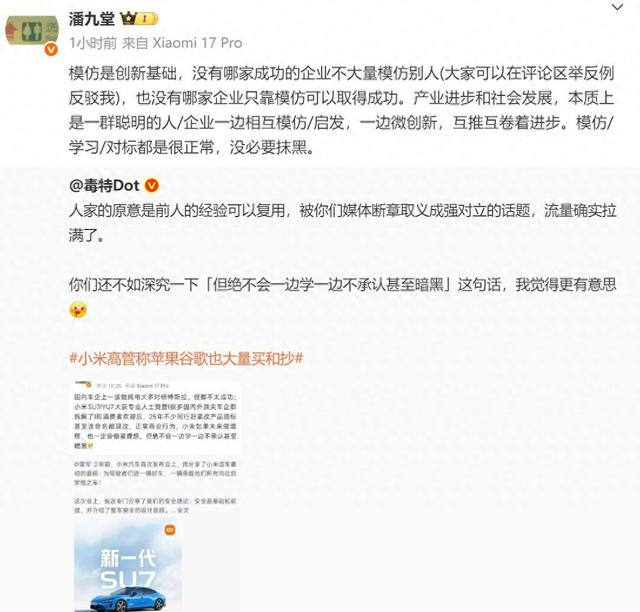
小米潘九堂:并非只有中国企业模仿,苹果也“买+抄”
Guan Cha Zhe Wang· 2026-01-14 02:52
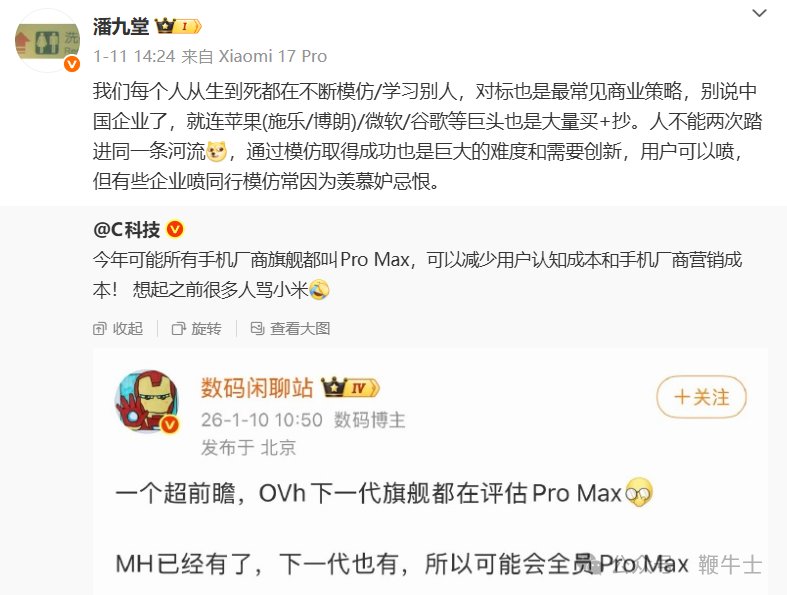
Core Viewpoint - The discussion around the naming convention "Pro Max" for flagship smartphones by Chinese manufacturers highlights the common practice of imitation in the tech industry, with Xiaomi's partner emphasizing that while imitation is a foundation for innovation, true success requires originality and adaptation [1][3]. Group 1: Industry Trends - Chinese smartphone manufacturers such as OPPO, vivo, and Honor are evaluating the "Pro Max" naming for their next flagship models, potentially leading to a unified naming strategy that could lower user recognition costs and marketing expenses [1]. - The trend of adopting similar naming conventions is not unique to Chinese companies; global giants like Apple, Microsoft, and Google also engage in imitation as a strategy for growth [1][3]. Group 2: Company Insights - Xiaomi's introduction of the "Pro Max" model in its 17 series and the Redmi K90 series has sparked significant discussion regarding naming strategies in the smartphone market [1]. - The company acknowledges that while it may draw inspiration from competitors, it aims to innovate rather than solely imitate, as seen in its approach to future products like range-extended vehicles [4].
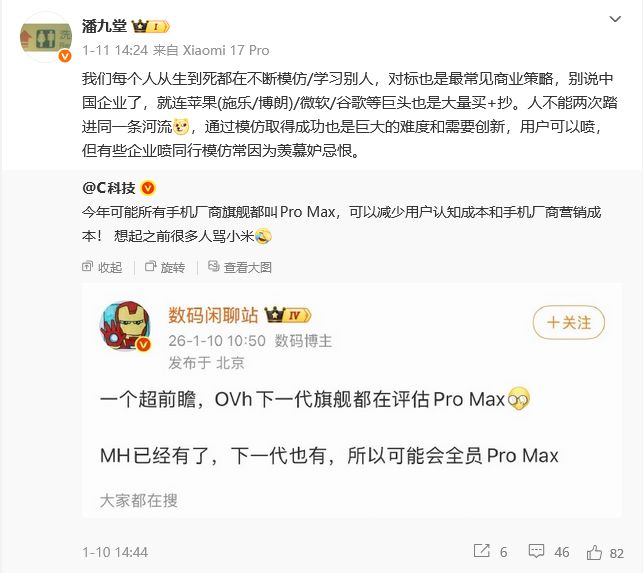
旗舰机纷纷对标Pro Max?小米潘九堂:对标很常见,苹果也搞抄袭
Xin Lang Cai Jing· 2026-01-13 11:54
Core Viewpoint - The practice of benchmarking flagship smartphone models against Apple's Pro Max is a common commercial strategy, utilized by major companies including Apple, Google, and others, which often involves imitation and adaptation [1][5]. Group 1: Industry Insights - Xiaomi's investment partner, Pan Jiutang, emphasizes that benchmarking is a prevalent business strategy, not limited to Chinese companies but also adopted by tech giants like Apple, Microsoft, and Google [1][5]. - Huang Xiaowen, co-founder and editor-in-chief of C Technology, suggests that many smartphone manufacturers may label their flagship models as Pro Max this year to reduce user recognition costs and marketing expenses [4][8]. Group 2: Company Specifics - The naming controversy surrounding Xiaomi's 17 series is highlighted, as it coincides with the launch of Apple's iPhone 17 series, leading some to accuse Xiaomi of riding on Apple's coattails [9]. - Xiaomi's mobile division president, Lu Weibing, clarifies that the naming of the Xiaomi 17 series was a result of long-term planning and not a hasty imitation, indicating that the decision was based on technological evolution and market strategy [9].

做生意想成功,能“抄袭”就不要去创新
Sou Hu Cai Jing· 2025-07-19 06:03
Group 1 - The essence of success in business is "copying reusable systems" rather than blind innovation, emphasizing the importance of learning from successful models and standardizing them for replication [6][9] - The concept of "private domain thinking" is crucial for managing interpersonal relationships, where trust and user retention are key to business growth [5][9] - Business leaders should act as "system architects" rather than mere executors, focusing on designing efficient operational systems rather than getting involved in every detail [5][9] Group 2 - The initial phase involves mimicking successful brands' product matrices and operational designs, which is akin to reusing successful codes [7] - The innovation phase requires localizing and optimizing the copied models to fit regional preferences and cultural elements [7] - Strategies such as offering small gifts and discounts enhance user engagement and loyalty, reflecting the principles of user lifecycle management [8]