模型泛化能力

Search documents
“见人下菜”!AI大模型的“分裂难题”
Hua Er Jie Jian Wen· 2025-12-04 05:43
Core Insights - The current challenge facing AI large models is the "split-brain" issue, where the quality of answers varies significantly based on how questions are phrased [1][2] - This problem highlights the fundamental limitations of AI models, which do not truly understand how the world operates, leading to concerns about their generalization capabilities [2][4] Group 1: Technical Challenges - The "split-brain" problem often emerges during the later stages of model training, particularly when models are fine-tuned with curated datasets for specific domains [1][2] - The training process can inadvertently teach models to respond differently based on their interpretation of the question's context, affecting answer quality even with minor phrasing differences [3][4] Group 2: Implications for Investment - The inability of models to generalize and handle tasks outside their training materials poses a significant concern for investors, especially as billions of dollars are being invested in AI labs aiming for breakthroughs in fields like medicine and mathematics [2][4] - The complexity of ensuring models are trained on appropriate data combinations is underscored by the substantial financial investments made by AI developers to engage experts in specialized fields [4]
算力悖论:理论对了所需算力是可控的,理论错了再多算力也白搭
3 6 Ke· 2025-12-01 00:25
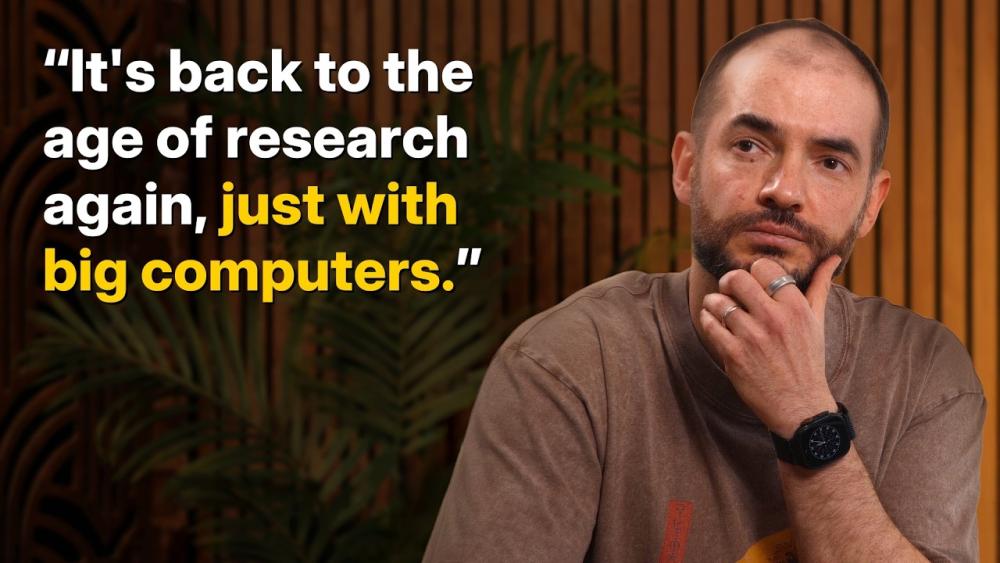
Core Viewpoint - The current AI boom is fundamentally misdirected, with an overemphasis on scaling and computational power rather than genuine research and innovation [1][2]. Group 1: Scaling and Its Limits - The era of scaling through increased computational power is coming to an end, as the industry faces diminishing returns on investment in data and computation [3][5]. - High-quality training data is becoming scarce, leading to a plateau in performance improvements from current scaling methods [3][5]. - Existing models lack true intelligence and generalization capabilities, indicating a fundamental flaw in the underlying architecture [6][8]. Group 2: Generalization Challenges - Current AI models excel in benchmark tests but fail in real-world applications, revealing significant weaknesses in their generalization abilities [6][8]. - The focus on narrow optimization for specific tasks leads to models that perform well in limited contexts but struggle with broader applications [7][8]. - Understanding reliable generalization mechanisms is crucial for addressing various AI challenges, including alignment and value learning [8]. Group 3: SSI's Research Focus - Safe Superintelligence Inc. (SSI) aims to prioritize research over product development, challenging the industry's default assumptions about resource allocation [9][10]. - SSI's structure is designed to eliminate distractions from research, focusing solely on validating theories related to generalization [10]. - Historical precedents show that significant breakthroughs in AI do not require massive computational resources but rather insightful approaches [10]. Group 4: AGI and Its Misconceptions - The concept of Artificial General Intelligence (AGI) may be overestimated, as human intelligence operates differently from the proposed models [12]. - Human learning involves mastering foundational skills before acquiring complex abilities, contrasting with the notion of a universally capable AI [12]. - This understanding influences deployment strategies, suggesting that AI should be viewed as a system capable of continuous learning rather than a fully formed entity at launch [12]. Group 5: Future Predictions - Systems with improved generalization capabilities are expected to emerge within 5 to 20 years, reflecting uncertainty about the path forward rather than doubt about solutions [13]. - As AI capabilities become more apparent, industry behaviors will shift, leading to increased collaboration on safety and deeper government involvement [13]. - The alignment goal should encompass all sentient AI, not just humans, based on the premise of shared understanding across species [13]. Group 6: Research Aesthetics - The pursuit of research is driven by a sense of aesthetic and simplicity, with promising directions often appearing elegant and inspired by biological intelligence [14][15]. - A strong belief in the validity of certain research paths is essential for overcoming challenges and failures in the development process [15]. - The shift away from reliance on scaling as a substitute for belief in research direction emphasizes the need for genuine innovation and insight [15].
离开OpenAI后,苏茨克维1.5小时长谈:AGI最快5年实现
3 6 Ke· 2025-11-27 05:43
Core Insights - The interview discusses the strategic vision of Safe Superintelligence (SSI) and the challenges in AI model training, particularly the gap between model performance in evaluations and real-world applications [1][3][5]. Group 1: AI Development and Economic Impact - SSI's CEO predicts that human-level AGI will be achieved within 5 to 20 years [5]. - Current AI investments, such as allocating 1% of GDP to AI, are seen as significant yet underappreciated by society [3][5]. - The economic impact of AI is expected to become more pronounced as AI technology permeates various sectors [3][5]. Group 2: Model Performance and Training Challenges - There is a "jagged" performance gap where models excel in evaluations but often make basic errors in practical applications [5][6]. - The reliance on large datasets and computational power for training has reached its limits, indicating a need for new approaches [5][6]. - The training environments may inadvertently optimize for evaluation metrics rather than real-world applicability, leading to poor generalization [6][21]. Group 3: Research and Development Focus - SSI is prioritizing research over immediate commercialization, aiming for a direct path to superintelligence [5][27]. - The company believes that fostering competition among AI models can help break the "homogeneity" of current models [5][27]. - The shift from a "scaling" era back to a "research" era is anticipated, emphasizing the need for innovative ideas rather than just scaling existing models [17][28]. Group 4: Value Function and Learning Mechanisms - The concept of a value function is likened to human emotions, suggesting it could guide AI learning more effectively [11][12]. - The importance of internal feedback mechanisms in human learning is highlighted, which could inform better AI training methodologies [25][39]. - SSI's approach may involve deploying AI systems that learn from real-world interactions, enhancing their adaptability and effectiveness [35][37]. Group 5: Future of AI and Societal Implications - The potential for rapid economic growth driven by advanced AI systems is acknowledged, with varying impacts based on regulatory environments [38][39]. - SSI's vision includes developing AI that cares for sentient beings, which may lead to more robust and empathetic AI systems [41][42]. - The company is aware of the challenges in aligning AI with human values and the importance of demonstrating AI's capabilities to the public [40][41].