价值函数

Search documents
llya 发言评述
小熊跑的快· 2025-12-02 07:12
Core Insights - The industry is transitioning from an era focused on "scaling" to one driven by "fundamental research" in AI development [1][2] - Ilya categorizes AI development into three phases: the Age of Research (2012-2020), the Age of Scaling (2020-2025), and a return to the Age of Research post-2025 [2] - Current AI models are facing limitations in scaling, necessitating a renewed focus on research methodologies similar to those used before 2020 [2][4] Group 1: Phases of AI Development - The Age of Research (2012-2020) was characterized by experimentation with new ideas and architectures, resulting in models like AlexNet, ResNet, and Transformer [2] - The Age of Scaling (2020-2025) introduced a straightforward yet effective approach of using more computational power, data, and larger models for pre-training, leading to significant advancements [2] - The anticipated return to the Age of Research suggests that the effectiveness of scaling is diminishing, prompting a need for innovative breakthroughs [2] Group 2: Critique of Current Approaches - Ilya questions the effectiveness of reinforcement learning and scoring methods, arguing they produce machines with limited generalization capabilities [3] - He emphasizes the importance of value functions in decision-making, likening human emotions to a simple yet effective value function that current large models struggle to replicate [3] - The concept of a new intelligent system capable of self-learning and growth is proposed, envisioning an AI akin to a 15-year-old capable of various tasks [3] Group 3: Industry Trends and Future Directions - Ilya's recent statements align with the industry's recognition of stagnation in large language models, attributed to data limitations [4] - Despite the diminishing returns of scaling, the focus should shift towards inference, with significant revenue projections for pure inference APIs and AI hardware rentals [4] - SSI, the company Ilya is associated with, prioritizes research and alignment, aiming to develop safe superintelligent systems without immediate commercial considerations [4][5]


Ilya辟谣Scaling Law终结论
AI前线· 2025-11-30 05:33
Core Insights - The era of relying solely on scaling resources to achieve breakthroughs in AI capabilities may be over, as stated by Ilya Sutskever, former chief scientist of OpenAI [2] - Current AI technologies can still produce significant economic and social impacts, even without further breakthroughs [5] - The consensus among experts is that achieving Artificial General Intelligence (AGI) may require more breakthroughs, particularly in continuous learning and sample efficiency, likely within the next 20 years [5] Group 1 - Ilya Sutskever emphasized that the belief in "bigger is better" for AI development is diminishing, indicating a shift back to a research-driven era [16][42] - The current models exhibit a "jaggedness" in performance, excelling in benchmarks but struggling with real-world tasks, highlighting a gap in generalization capabilities [16][20] - The focus on scaling has led to a situation where the number of companies exceeds the number of novel ideas, suggesting a need for innovative thinking in AI research [60] Group 2 - The discussion on the importance of emotional intelligence in humans was compared to the value function in AI, suggesting that emotions play a crucial role in decision-making processes [31][39] - Sutskever pointed out that the evolution of human capabilities in areas like vision and motor skills provides a strong prior knowledge that current AI lacks [49] - The potential for rapid economic growth through the deployment of advanced AI systems was highlighted, with the caveat that regulatory mechanisms could influence this growth [82]

AI大神伊利亚宣告 Scaling时代终结!断言AGI的概念被误导
混沌学园· 2025-11-28 12:35
Group 1 - The era of AI scaling has ended, and the focus is shifting back to research, as merely increasing computational power is no longer sufficient for breakthroughs [2][3][15] - A significant bottleneck in AI development is its generalization ability, which is currently inferior to that of humans [3][22] - Emotions serve as a "value function" for humans, providing immediate feedback for decision-making, a capability that AI currently lacks [3][6][10] Group 2 - The current AI models are becoming homogenized due to pre-training, and the path to differentiation lies in reinforcement learning [4][17] - SSI, the company co-founded by Ilya Sutskever, is focused solely on groundbreaking research rather than competing in computational power [3][31] - The concept of superintelligence is defined as an intelligence that can learn to do everything, emphasizing a growth mindset [3][46] Group 3 - To better govern AI, it is essential to gradually deploy and publicly demonstrate its capabilities and risks [4][50] - The industry should aim to create AI that cares for all sentient beings, which is seen as a more fundamental and simpler goal than focusing solely on humans [4][51] - The transition from the scaling era to a research-focused approach will require exploring new paradigms and methodologies [18][20]

离开OpenAI后,苏茨克维1.5小时长谈:AGI最快5年实现
3 6 Ke· 2025-11-27 05:43
Core Insights - The interview discusses the strategic vision of Safe Superintelligence (SSI) and the challenges in AI model training, particularly the gap between model performance in evaluations and real-world applications [1][3][5]. Group 1: AI Development and Economic Impact - SSI's CEO predicts that human-level AGI will be achieved within 5 to 20 years [5]. - Current AI investments, such as allocating 1% of GDP to AI, are seen as significant yet underappreciated by society [3][5]. - The economic impact of AI is expected to become more pronounced as AI technology permeates various sectors [3][5]. Group 2: Model Performance and Training Challenges - There is a "jagged" performance gap where models excel in evaluations but often make basic errors in practical applications [5][6]. - The reliance on large datasets and computational power for training has reached its limits, indicating a need for new approaches [5][6]. - The training environments may inadvertently optimize for evaluation metrics rather than real-world applicability, leading to poor generalization [6][21]. Group 3: Research and Development Focus - SSI is prioritizing research over immediate commercialization, aiming for a direct path to superintelligence [5][27]. - The company believes that fostering competition among AI models can help break the "homogeneity" of current models [5][27]. - The shift from a "scaling" era back to a "research" era is anticipated, emphasizing the need for innovative ideas rather than just scaling existing models [17][28]. Group 4: Value Function and Learning Mechanisms - The concept of a value function is likened to human emotions, suggesting it could guide AI learning more effectively [11][12]. - The importance of internal feedback mechanisms in human learning is highlighted, which could inform better AI training methodologies [25][39]. - SSI's approach may involve deploying AI systems that learn from real-world interactions, enhancing their adaptability and effectiveness [35][37]. Group 5: Future of AI and Societal Implications - The potential for rapid economic growth driven by advanced AI systems is acknowledged, with varying impacts based on regulatory environments [38][39]. - SSI's vision includes developing AI that cares for sentient beings, which may lead to more robust and empathetic AI systems [41][42]. - The company is aware of the challenges in aligning AI with human values and the importance of demonstrating AI's capabilities to the public [40][41].
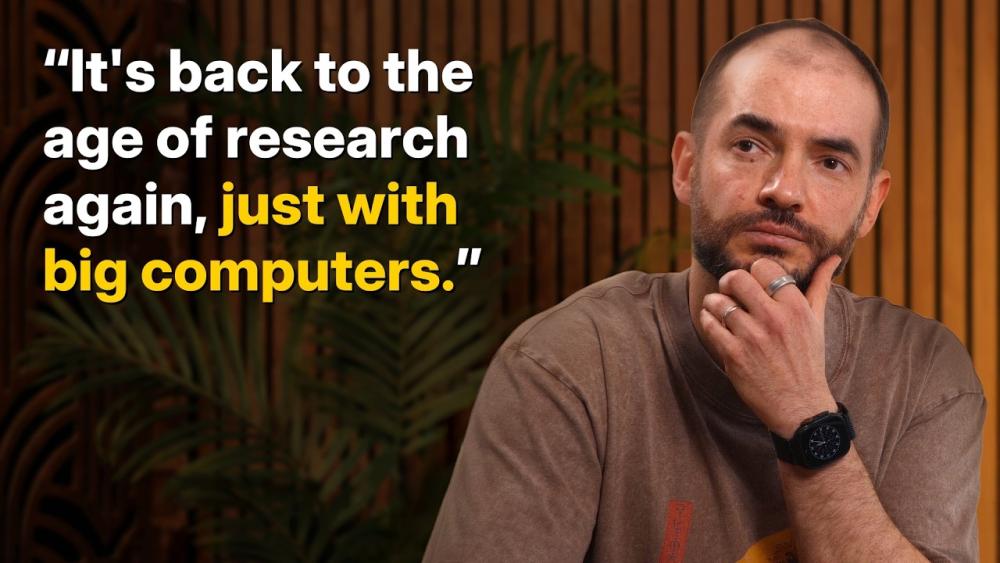
llya最新判断:Scaling Laws逼近极限,AI暴力美学终结
3 6 Ke· 2025-11-26 08:46
Core Insights - Ilya Sutskever, co-founder of OpenAI and a key figure in deep learning, has shifted focus from scaling models to research-driven approaches in AI development [1][2][3] - The industry is moving away from "scale-driven" methods back to "research-driven" strategies, emphasizing the importance of asking the right questions and developing new methodologies [2][3] - Sutskever argues that while AI companies may experience stagnation, they can still generate significant revenue despite reduced innovation [2][3] - The potential for narrow AI models to excel in specific domains suggests that breakthroughs may come from improved learning methods rather than merely increasing model size [3][4] - The emergence of powerful AI could lead to transformative societal changes, including increased productivity and shifts in political and governance structures [3][4] - Sutskever emphasizes the importance of aesthetic principles in research, advocating for simplicity and elegance in AI design [4] Industry Trends - The scaling laws that dominated AI development are nearing their limits, prompting a return to foundational research and exploration [2][28] - The current phase of AI development is characterized by a shift from pre-training to reinforcement learning, which is more resource-intensive [29][30] - The distinction between effective resource utilization and mere computational waste is becoming increasingly blurred in AI research [30][31] - The scale of computational resources available today is substantial, but the focus should be on how effectively these resources are utilized for meaningful research [42][44] Company Insights - Safe Superintelligence (SSI) has raised $3 billion, positioning itself to focus on foundational research without the pressures of market competition [45][46] - SSI's approach to AI development may differ from other companies that prioritize immediate market applications, suggesting a long-term vision for advanced AI [45][46] - The company believes that the true value lies not in the sheer amount of computational power but in the strategic application of that power to drive research [43][44]
Scaling时代终结了,Ilya Sutskever刚刚宣布
机器之心· 2025-11-26 01:36
Group 1 - The core assertion from Ilya Sutskever is that the "Age of Scaling" has ended, signaling a shift towards a "Research Age" in AI development [1][8][9] - Current AI models exhibit "model jaggedness," performing well on complex evaluations but struggling with simpler tasks, indicating a lack of true understanding and generalization [11][20][21] - Sutskever emphasizes the importance of emotions as analogous to value functions in AI, suggesting that human emotions play a crucial role in decision-making and learning efficiency [28][32][34] Group 2 - The transition from the "Age of Scaling" (2020-2025) to the "Research Age" is characterized by diminishing returns from merely increasing data and computational power, necessitating new methodologies [8][39] - Safe Superintelligence Inc. (SSI) focuses on fundamental technical challenges rather than incremental improvements, aiming to develop safe superintelligent AI before commercial release [9][11][59] - The strategic goal of SSI is to "care for sentient life," which is viewed as a more robust alignment objective than simply obeying human commands [10][11][59] Group 3 - The discussion highlights the disparity in learning efficiency between humans and AI, with humans demonstrating superior sample efficiency and the ability to learn continuously [43][44][48] - Sutskever argues that the current models are akin to students who excel in exams but lack the broader understanding necessary for real-world applications, drawing a parallel to the difference between a "test-taker" and a "gifted student" [11][25][26] - The future of AI may involve multiple large-scale AI clusters, with the potential for a positive trajectory if the leading AIs are aligned with the goal of caring for sentient life [10][11]