欧洲安全架构

Search documents
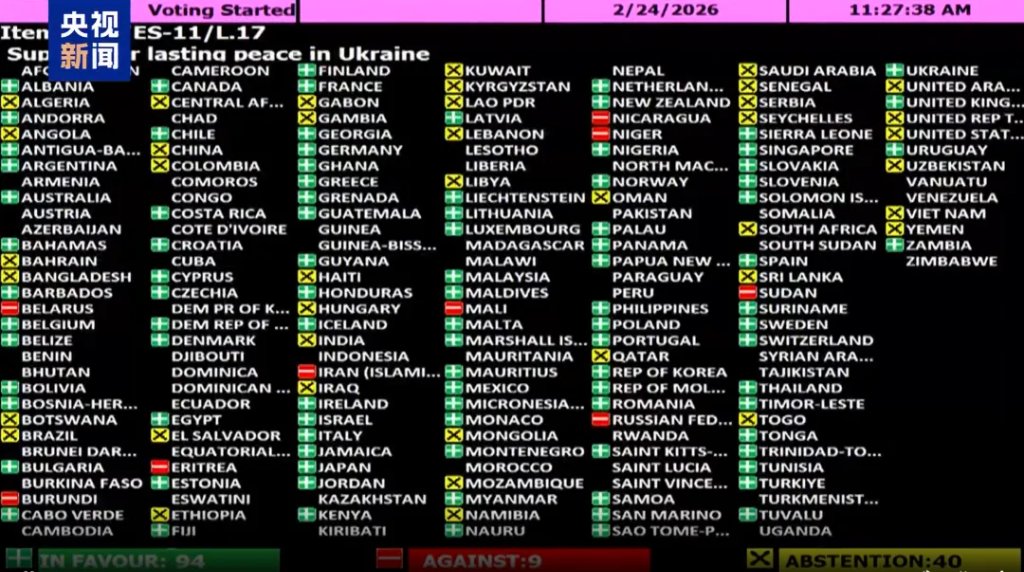
107票赞成,12票反对,联合国大会通过决议呼吁俄乌立即停火!俄方反对,中美投弃权票
Mei Ri Jing Ji Xin Wen· 2026-02-25 08:09
Core Viewpoint - The UN General Assembly passed a resolution titled "Support Ukraine in Achieving Lasting Peace," with 107 votes in favor, 12 against, and 51 abstentions, indicating a significant international stance on the Ukraine conflict [1]. Group 1: Voting Results - The resolution received support from countries such as the UK, France, Germany, Japan, South Korea, Ukraine, and Israel, while Russia and Iran opposed it [1]. - Notable abstentions included China, the US, India, Brazil, South Africa, and Saudi Arabia, reflecting a divided international response [1]. Group 2: Resolution Details - The resolution, initiated by Ukraine and Latvia, calls for an immediate and unconditional ceasefire between Ukraine and Russia, emphasizing the need for a comprehensive, just, and lasting peace based on international law and the UN Charter [3]. - It reiterates the call for a full exchange of prisoners and the release of all illegally detained individuals [3]. Group 3: China's Position - China expressed its position by abstaining from the vote, emphasizing the importance of respecting national sovereignty and territorial integrity, and supporting efforts conducive to a peaceful resolution of the crisis [4][6]. - China highlighted the critical phase for negotiations and encouraged the international community to create favorable conditions for political solutions [4][6]. Group 4: Ukraine's Stance - Ukrainian President Zelensky stated that Ukraine seeks lasting peace but requires clear, legally binding, and effective security guarantees [7]. - The Ukrainian government aims to fully integrate into the Euro-Atlantic political and security framework as a necessary condition for long-term peace in Europe and North America [9]. Group 5: Russia's Perspective - Russia maintains an active military stance, asserting that it has the upper hand in the conflict, with significant losses reported on the Ukrainian side [10]. - Russian officials have indicated a willingness to ensure Ukraine's security but question who will provide security guarantees for Russia, framing it as a challenge to NATO [13]. Group 6: US Policy Shift - The US has shifted its policy towards Ukraine from unwavering support to prioritizing negotiations with conditional support, reflecting a growing domestic sentiment for focusing on internal issues rather than international military commitments [14][17]. - This policy change is becoming a focal point in the upcoming US midterm elections, with debates on the balance between supporting Ukraine and addressing domestic concerns [16][17].

王毅:欧洲不应在菜单上,而应在餐桌旁
Xin Lang Cai Jing· 2026-02-14 14:33
Group 1 - The core viewpoint is that China advocates for dialogue and negotiation as a means to resolve regional conflicts, including the Ukraine issue, emphasizing that it is not a party to the conflict but can facilitate discussions [1] - China has expressed satisfaction with the recent initiation of dialogues regarding the Ukraine crisis, acknowledging that while there are significant differences among parties, dialogue is essential for achieving peace [1] - The Chinese government encourages and supports all efforts aimed at peace and intends to play a constructive role in promoting dialogue and negotiations [1] Group 2 - Europe should not remain a bystander in the negotiation process concerning the Ukraine conflict, as it is directly affected by the events occurring on its territory [2] - China supports Europe engaging in dialogue with Russia and encourages Europe to present its own proposals and solutions during negotiations [2] - The aim is to address root issues and establish a more balanced, effective, and sustainable European security framework to prevent similar conflicts in the future [2]
马克龙:每个人都应该向欧洲学习,欧洲应当感到自豪
Xin Lang Cai Jing· 2026-02-14 00:57
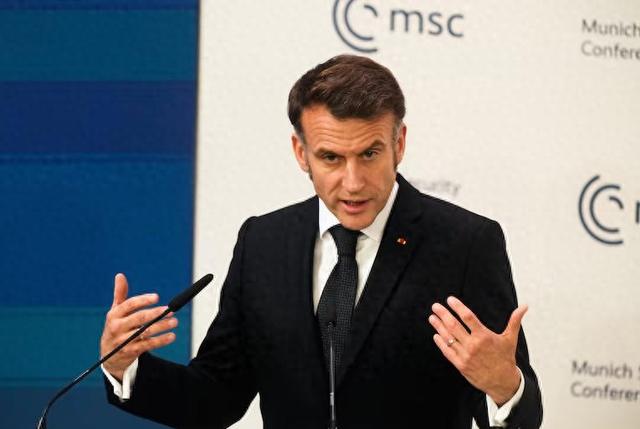
Core Viewpoint - French President Macron strongly defends Europe against claims of decline, emphasizing the need for Europe to be seen as a model rather than an aging and divided continent [1][3] Group 1: European Identity and Strength - Macron criticizes the portrayal of Europe as a "slow, divided, and marginalized" entity, arguing that such stereotypes undermine its strengths and self-confidence [1][3] - He calls for a more positive mindset towards Europe, highlighting the need to combat misinformation and social media narratives that distort its image [1][3] Group 2: Geopolitical Independence - Macron asserts that Europe must become an independent geopolitical force and develop its own security framework, especially in light of ongoing tensions with Russia [4][5] - He emphasizes that any future negotiations regarding Europe's security architecture must be led by Europeans themselves, reflecting their own interests and geographical realities [4][5] Group 3: Nuclear Strategy and Security Architecture - Macron announces plans to initiate a "new strategic dialogue" regarding nuclear weapons, indicating a shift in Europe's approach to security that moves away from Cold War-era frameworks [5][6] - He mentions ongoing discussions with European leaders about coordinating national security concepts within the constraints of constitutional obligations [5][6] Group 4: Economic Independence and Investment - Macron advocates for a new joint borrowing initiative among EU member states to fund strategic areas such as green technology and defense, aiming to enhance Europe's economic independence [7] - He warns that without decisive action, Europe risks being overshadowed by the economic powers of the US and China, reinforcing the urgency for reform and self-reliance [7]
马克龙:欧洲应建立新安全架构并考虑自身利益
Jing Ji Guan Cha Wang· 2026-02-13 20:47
Core Viewpoint - President Macron emphasizes the need for Europe to focus on long-term strategic thinking and to establish a robust European security framework, including the integration of France's nuclear deterrent capabilities into the EU's future security architecture [1] Group 1 - Macron asserts that it is time for Europe to demonstrate resolve and build a strong geopolitical entity, urging Europeans to base their actions on self-reflection and their own interests [1] - He highlights the necessity for a reassessment and restructuring of Europe's security architecture, which he claims is outdated and was designed during the Cold War [1] - France has initiated discussions with Germany and other European leaders regarding the future of European security, indicating ongoing efforts to advance this dialogue [1]
拉锯4年,这场冲突为何难终结?
Xin Hua Wang· 2025-12-31 06:34
Core Viewpoint - The Ukraine crisis, entering its fourth year in 2025, remains characterized by intense military confrontation and complex diplomatic negotiations, with a potential for a fragile ceasefire but significant challenges to achieving a lasting peace agreement [1][5]. Group 1: Military Situation - In 2025, both Russia and Ukraine continue to engage in fierce battles, utilizing missiles, drones, and electronic warfare, particularly in the Zaporizhzhia and Kupiansk regions, leading to a prolonged war of attrition [1]. - Russia maintains an offensive position while Ukraine is on the defensive, indicating a stalemate where no single battle can decisively shift the overall war dynamics [1]. Group 2: Diplomatic Efforts - The political landscape for resolving the Ukraine crisis has strengthened, with a notable "fighting while negotiating" approach emerging, especially after the Trump administration's shift in U.S. policy towards Ukraine [2][3]. - The U.S. has ceased unconditional aid to Ukraine and pressured it, causing Europe to accelerate its support for Ukraine to ensure its interests are represented in negotiations [2]. Group 3: Core Issues in Negotiations - Key unresolved issues include territorial claims, security guarantees, and the European security architecture, with Russia demanding full military control over the Donbas region and Ukraine seeking NATO membership and military support from the West [3]. - The lack of consensus on these core issues has hindered political resolution, with the U.S. struggling to exert effective pressure on both sides [3]. Group 4: Future Outlook - Despite indications from President Putin of a willingness to negotiate, achieving a comprehensive peace agreement remains highly challenging, with the potential for a fragile ceasefire in 2026 but no guarantee of lasting peace [5][7]. - The ongoing military and economic pressures on both Russia and Ukraine, along with the geopolitical dynamics involving the U.S. and Europe, will significantly influence the negotiation outcomes and the potential for future conflicts [7].
中方呼吁构建均衡、有效、可持续的欧洲安全架构
Yang Shi Xin Wen· 2025-12-09 21:55
Group 1 - The core viewpoint emphasizes the need for a balanced, effective, and sustainable European security architecture in light of the ongoing Ukraine crisis [1] - The situation in Ukraine has reached a critical stage for negotiation, with increasing international focus on peace talks and various stakeholders proposing initiatives for dialogue [1] - China welcomes the progress towards peace and urges all parties to seize the positive momentum, demonstrate political will, and work towards a fair, lasting, and binding peace agreement [1] Group 2 - China highlights the importance of addressing the root causes of the conflict and ensuring that security concerns of all parties are adequately resolved, referencing past agreements like the Minsk agreements [1] - Despite strong calls for peace, ground hostilities continue, and China calls for maximum restraint from the conflicting parties and adherence to international humanitarian law to protect civilians [1] - China reiterates its objective and consistent stance on the Ukraine issue, advocating for ceasefire, dialogue, and political resolution, and pledges to play a constructive role in facilitating these efforts [2]
芬兰总统称相当接近达成乌克兰和平协议 共涉及三份文件 包括20点计划
Xin Lang Cai Jing· 2025-12-09 17:05
Core Viewpoint - Finland's President Alexander Stubb stated that Ukraine is closer to peace than at any time since Russia's full-scale invasion in early 2022 [1][4]. Group 1: Negotiation Framework - Stubb mentioned that negotiations involve three documents, with the first being a framework document that has evolved into a 20-point plan from an initial 28-point plan [5][6]. - The original 28-point plan was deemed unacceptable as it included elements that would limit Ukraine's NATO membership and military size, which were seen as favorable to Russia [7]. Group 2: Security Guarantees - The second document being discussed involves security guarantees for Ukraine, distinguishing between "hard security guarantees" and "security arrangements," the latter referring to a "voluntary alliance" mechanism [8]. Group 3: Post-War Reconstruction - The third document focuses on the reconstruction of Ukraine after the war [9].
匈牙利外长:未来的欧洲安全架构必须将俄罗斯纳入其中
Jing Ji Guan Cha Wang· 2025-10-28 16:53
Core Viewpoint - The future European security architecture must include Russia, as its geographical presence and objective reality cannot be denied [1] Group 1: Statements from Hungarian Foreign Minister - Hungarian Foreign Minister Szijjártó emphasized the need for dialogue to explore various forms of coexistence among European countries [1] - He expressed the necessity of reaching a consensus despite existing disagreements on key issues [1] Group 2: Russia-Hungary Relations - Following discussions with Russian Foreign Minister Lavrov, Szijjártó indicated that if a summit between the Russian and U.S. presidents occurs, it would likely take place in Budapest [1] - Szijjártó revealed that Russia is prepared to continue supplying energy to Hungary [1]
中方敦促爱沙尼亚领空事件当事方保持冷静克制
Xin Hua She· 2025-09-22 21:05
Core Viewpoint - The Chinese representative at the UN, Geng Shuang, emphasized the need for calm and restraint regarding the recent airspace violation incident involving Estonia and Russia, linking it to the broader context of the Ukraine crisis and the complex security situation in Europe [1]. Group 1 - The airspace incident involving Estonia and the previous incident discussed regarding Poland are seen as manifestations of the spillover effects of the Ukraine crisis, highlighting a lack of mutual trust and increasing suspicions among involved parties [1]. - Geng Shuang stated that as long as the Ukraine crisis remains unresolved, similar incidents are likely to recur, indicating the urgency for a political resolution to the crisis [1]. - The fundamental strategy proposed is to establish a balanced, effective, and sustainable security framework in Europe to address the ongoing tensions [1]. Group 2 - China urges the involved parties to maintain calm and restraint, advocating for dialogue and communication to clarify facts and eliminate doubts, thereby preventing misunderstandings and escalation of the situation [1]. - The Chinese stance is to promote adherence to the purposes and principles of the UN Charter in handling international relations [1].
欧洲梦碎!几十万大军白准备,普京停火条件公布,提出俄保障方案
Sou Hu Cai Jing· 2025-08-25 08:48
Core Points - The article discusses the implications of Putin's four demands for a ceasefire in Ukraine, which significantly limit Ukraine's sovereignty and complicate European security dynamics [1][3][10] - The demands include the withdrawal of Ukrainian forces from the entire Donbas region, a ban on Ukraine joining NATO, restrictions on NATO or Western troops in Ukraine, and recognition of Crimea as Russian territory [3][5][10] - The situation reflects a broader challenge for Europe, as the potential for military intervention is stifled by these demands, leading to a reevaluation of European defense strategies and alliances [8][12] Summary by Sections Section 1: Ceasefire Demands - Putin's first demand requires the withdrawal of Ukrainian troops from the entire Donbas region, not just the contested areas, effectively pushing Ukraine to concede more territory [1] - The second demand prohibits Ukraine from joining NATO, which could permanently exclude Ukraine from Western alliances and complicate future negotiations [3][5] - The third demand restricts any NATO or Western military presence in Ukraine, undermining previous plans for European military support [3][7] - The fourth demand involves recognizing Crimea as part of Russia, further limiting Ukraine's negotiating power [3][10] Section 2: European Security Implications - The demands create a significant challenge for European defense integration, as they undermine the principle that countries can choose their alliances freely [8][10] - The inability to deploy European forces in response to the crisis raises questions about the effectiveness of NATO and the EU's collective security arrangements [8][12] - The situation may lead to a reevaluation of security strategies among Eastern European countries, particularly regarding their own defense postures against potential Russian aggression [10][12] Section 3: International Dynamics - The article highlights China's position as it navigates a complex relationship between supporting Russia and maintaining ties with the West [10][12] - The potential for a new geopolitical order is suggested, where smaller nations may have to choose between powerful states, reflecting a shift in international norms [12] - The ongoing crisis in Ukraine serves as a litmus test for the ability of major powers to establish new coexistence rules under the shadow of nuclear threats [12]