共同

Search documents
项昊宇:多极化时代更需要“校准航向”
Xin Lang Cai Jing· 2026-02-23 22:47
Group 1 - The world is undergoing a profound structural transformation since the end of the Cold War, characterized by frequent geopolitical conflicts and a resurgence of camp-based politics, leading to a disordered international system [1][2] - China's Foreign Minister Wang Yi's speech at the Munich Security Conference addresses the key issue of what order will emerge from the multipolarity, emphasizing the need for a reconstruction of order rather than a simple redistribution of power [1][4] - The rise of camp politics is marked by the strengthening of military alliances and the emergence of value-based diplomacy, which creates a new group-oriented tendency in international relations, potentially undermining the inclusiveness of the global system [2] Group 2 - China's emphasis on maintaining a UN-centered international system reflects a historical logic aimed at preventing a return to power politics, particularly for developing countries [2] - The limitations of traditional security concepts are evident in conflicts like the Russia-Ukraine war and the Middle East situation, prompting China to advocate for a security concept that is common, comprehensive, cooperative, and sustainable [3] - The increasing importance of emerging economies in energy markets and regional cooperation mechanisms highlights the need for a governance structure that allows broader participation, moving away from dominance by a few countries [3] Group 3 - The international community faces two paths: one leading to deepening fragmentation and insecurity, and the other promoting cooperation through institutional coordination to avoid uncontrolled conflict [4] - China's approach aims to foster more inclusive multilateral cooperation to prevent a return to historical patterns of conflict, emphasizing that the future direction of international relations depends on the willingness of countries to believe in cooperative governance over confrontation [4]
王毅在第62届慕尼黑安全会议“中国专场”上的主旨讲话(全文)
Xin Lang Cai Jing· 2026-02-14 14:35
Core Viewpoint - The speech emphasizes the need for reforming and improving global governance, advocating for multilateralism and cooperation among nations to address current international challenges and conflicts [1][2][3][4][5][6][7]. Group 1: Global Governance Reform - Reforming global governance requires revitalizing the United Nations system, which is seen as the most universal and authoritative intergovernmental organization [2]. - The current international system's inefficacy is attributed to some countries amplifying differences and pursuing national superiority, which undermines trust and cooperation [3]. - The call for true multilateralism is highlighted, with an emphasis on democratizing international relations and ensuring that all countries, especially smaller nations, have a voice and role in the global system [4][5]. Group 2: Peace and Conflict Resolution - The urgent need to stop wars and promote peace is underscored, with over 60 ongoing conflicts causing suffering and instability [6]. - The importance of dialogue and negotiation in resolving conflicts, such as the situations in Gaza, Iran, Ukraine, and Venezuela, is stressed as a collective responsibility of the international community [6]. Group 3: China's Role in Global Governance - China positions itself as a steadfast force for peace and stability, advocating for a peaceful development path and international fairness [7]. - The relationship between China and Europe is framed as a partnership in a multipolar world, emphasizing the importance of collaboration over competition [7].
中方敦促各国反对选择性反恐和双重标准
Xin Hua She· 2026-01-31 01:53
Core Viewpoint - The article emphasizes the need for international cooperation in combating terrorism, urging countries to reject selective anti-terrorism measures and double standards [1][2]. Group 1: Current Situation in Central Asia - Central Asia remains generally stable but is significantly affected by the spillover of terrorism threats, with recent attacks occurring in Syria, Afghanistan, and Pakistan [1]. - The international situation is increasingly turbulent, posing challenges to economic and social development, and the resurgence of global terrorism threatens international peace and security [1]. Group 2: China's Position and Initiatives - China appreciates the efforts of Central Asian countries in combating terrorism and has been providing support and assistance to these nations [1]. - China calls for enhanced communication and cooperation between the UN Counter-Terrorism Office, the Central Asia Preventive Diplomacy Center, and regional mechanisms such as the China-Central Asia mechanism and the Shanghai Cooperation Organization [1]. Group 3: Recommendations for International Cooperation - Countries are urged to adopt a common, comprehensive, cooperative, and sustainable security perspective to strengthen international anti-terrorism cooperation [1]. - The international community should work to de-escalate conflicts in affected regions and limit the operational space for terrorists [1]. - There is a call for increased engagement and cooperation with Afghanistan to prevent it from becoming a haven for terrorist organizations and to jointly address the return of foreign terrorist fighters [1].
中国力推“亚洲安全模式”,外交部:将同有关国家一道共同守护国际和平与安宁
Xin Lang Cai Jing· 2026-01-21 08:13
Group 1 - The core viewpoint emphasizes that Asia is recognized globally as a high ground for development and prosperity, which should be cherished amidst current global turmoil [1] - China advocates for adherence to the purposes and principles of the UN Charter, respecting national sovereignty and territorial integrity, and resolving conflicts through dialogue and negotiation [1] - The Chinese government aims to build a community of shared destiny rather than engaging in geopolitical competition or establishing spheres of influence [1] Group 2 - China positions itself as a steadfast defender of international peace and security, promoting a security concept that is common, comprehensive, cooperative, and sustainable [1] - The country is committed to implementing a global security initiative aimed at achieving universal and common security [1] - China seeks to collaborate with relevant countries to establish an Asian security model based on mutual security, seeking common ground while reserving differences, and dialogue and consultation [1]
“中国为各国发展繁荣提供宝贵机遇”——访叙利亚大马士革大学国际关系学教授沙赫尔
Ren Min Ri Bao· 2026-01-18 22:05
Group 1 - The core viewpoint emphasizes China's development experience, highlighting strong leadership, hardworking citizens, and long-term scientific planning as key elements of its success [1] - The concept of high-quality development is introduced, elevating "development" to a higher and deeper dimension, which is recognized as the main theme of China's new era [1] - The integration of technological and industrial innovation is underscored, with a focus on cultivating new productive forces characterized by high technology, efficiency, and quality [1] Group 2 - China's commitment to high-quality development and high-level openness is seen as providing valuable opportunities for global prosperity and creating a win-win situation [2] - The absence of political conditions in China's cooperation initiatives is noted, making them widely welcomed by various countries seeking shared opportunities [2] - China's role in international affairs is highlighted, advocating for a fair approach to resolving conflicts and promoting peace, stability, and development, particularly in the context of Syria [2]
外交部发言人:反对丛林法则,反对干涉内政,共同维护世界和平稳定
Xin Hua She· 2026-01-06 15:41
Core Viewpoint - The article discusses the recent large-scale military action by the United States against Venezuela, which has led to international condemnation and concerns regarding the violation of Venezuela's sovereignty [1][4]. Group 1: International Response - The majority of countries at the UN Security Council emergency meeting condemned the U.S. military action and supported Venezuela's sovereignty [2]. - China emphasized that military means are not a solution and that the abuse of force will lead to greater crises, advocating for dialogue and peaceful resolution of disputes [2][3]. Group 2: China's Position - China firmly supports the Venezuelan government and its people's right to maintain sovereignty and legitimate rights, and it is willing to work with regional countries and the international community to uphold peace and stability in Latin America and the Caribbean [2][4]. - China respects Venezuela's independent choice of development and opposes any country acting as an "international police" or self-proclaimed judge of international law [2][5]. Group 3: Legal and Sovereignty Issues - China criticized the U.S. for disregarding international concerns and violating Venezuela's sovereignty, calling for the UN Security Council to fulfill its primary responsibility in maintaining international peace and security [4]. - The Chinese government reiterated that no country should place its own rules above international law, urging the U.S. to release President Maduro and ensure his safety [5].
哪些措施可以阻止美国充当“世界治安官”?中方回应
Huan Qiu Wang· 2026-01-06 08:06
Group 1 - The Chinese government emphasizes that military means are not a solution to problems, and the abuse of force will only lead to greater crises [2][3] - China firmly supports the Venezuelan government and people in maintaining their sovereignty, security, and legitimate rights, as well as supporting regional countries in preserving peace in Latin America and the Caribbean [2][3] - China advocates for a security concept that is common, comprehensive, cooperative, and sustainable, respecting the sovereignty and territorial integrity of all countries, and emphasizes resolving international disputes through dialogue and negotiation [2][3] Group 2 - The Chinese government opposes the notion of any country acting as an "international police" or self-proclaiming as an "international judge," calling for adherence to international law and the principles of the UN Charter [2][3] - China expresses willingness to work with other countries to uphold the authority of international law, reject the "law of the jungle," and oppose interference in internal affairs [2][3]

社评:斡旋柬泰冲突,中国展现建设性角色
Xin Lang Cai Jing· 2025-12-19 15:19
Group 1 - The core viewpoint of the news is that the recent escalation of the Cambodia-Thailand border conflict has become one of the most severe armed conflicts among ASEAN member states since the end of the Cold War, significantly impacting regional security [1] - The conflict has resulted in civilian casualties, large-scale displacement, infrastructure damage, and disrupted border trade, leading to increasing economic and fiscal pressures on both countries [1] - The tourism industry, which both Cambodia and Thailand heavily rely on, is directly affected by the ongoing conflict, exacerbating historical grievances and complicating resolution efforts [1] Group 2 - There is a pressing need for a ceasefire and political resolution, which aligns with the common interests of both Cambodia and Thailand, as well as the broader regional expectations [2] - China's shuttle diplomacy aims to facilitate dialogue between the two nations, with recent communications indicating a willingness from both sides to de-escalate the situation [2] - China's approach to mediation is characterized by an objective and impartial stance, respecting the sovereignty of both nations and focusing on restoring dialogue without interference [2][3] Group 3 - The complexity of the Cambodia-Thailand border dispute, rooted in historical factors and multiple concerns, necessitates a peaceful resolution while emphasizing mutual security and cooperation [3] - The expectation for mediation should focus on preventing escalation and creating conditions for political solutions, with ongoing communication being crucial for peace [3][4] - ASEAN plays a vital role in maintaining regional stability and promoting dialogue, and China's involvement in mediation is coordinated with regional mechanisms to enhance inclusivity and sustainability [3]
中方呼吁构建均衡、有效、可持续的欧洲安全架构
Yang Shi Xin Wen· 2025-12-09 21:55
Group 1 - The core viewpoint emphasizes the need for a balanced, effective, and sustainable European security architecture in light of the ongoing Ukraine crisis [1] - The situation in Ukraine has reached a critical stage for negotiation, with increasing international focus on peace talks and various stakeholders proposing initiatives for dialogue [1] - China welcomes the progress towards peace and urges all parties to seize the positive momentum, demonstrate political will, and work towards a fair, lasting, and binding peace agreement [1] Group 2 - China highlights the importance of addressing the root causes of the conflict and ensuring that security concerns of all parties are adequately resolved, referencing past agreements like the Minsk agreements [1] - Despite strong calls for peace, ground hostilities continue, and China calls for maximum restraint from the conflicting parties and adherence to international humanitarian law to protect civilians [1] - China reiterates its objective and consistent stance on the Ukraine issue, advocating for ceasefire, dialogue, and political resolution, and pledges to play a constructive role in facilitating these efforts [2]
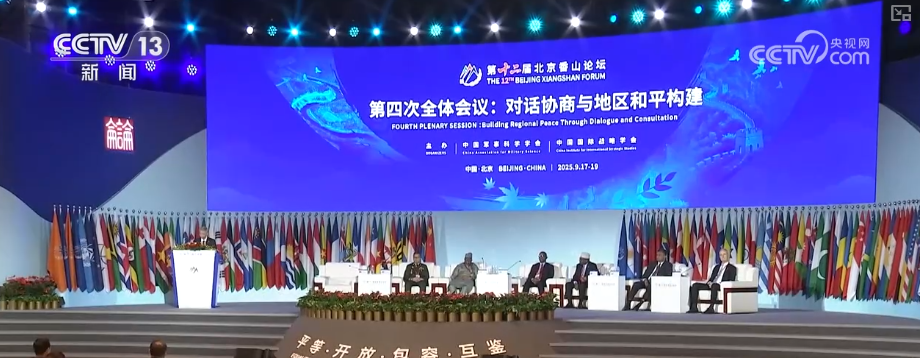
中国提出共同、综合、合作、可持续的安全观得到各方充分肯定
Yang Shi Wang· 2025-09-20 02:10
Core Points - The 12th Beijing Xiangshan Forum concluded successfully after its fourth plenary session on September 19 [1] - The forum lasted three days, featuring 4 plenary sessions and 8 parallel group meetings, where experts from defense agencies, military, academic institutions, international organizations, and think tanks engaged in open dialogue on peace and security issues [3] - China's proposed security concept of common, comprehensive, cooperative, and sustainable security was well received by all parties involved [3] Group 1 - Rwanda's Defense Minister, Juvenal Marizamunda, expressed confidence that China will continue to make significant contributions to global peace and stability [5] - Rwanda hopes that the Beijing Xiangshan Forum will become a more influential platform for international security dialogue and aims for deeper participation in the future [5] Group 2 - The forum emphasized the principles of fairness and justice, showcasing an open and inclusive attitude, and aimed to build consensus and deepen mutual trust [7] - The discussions were focused on jointly addressing global security challenges and promoting the construction of a community with a shared future for mankind [7]