正向经营杠杆

Search documents
“特朗普变量”搅局财报季!白宫施压信用卡利率,华尔街金融巨头们或将掀发债狂潮抽走流动性
Zhi Tong Cai Jing· 2026-01-13 00:44
Core Viewpoint - The upcoming bond issuance by Wall Street's financial giants is expected to be significantly larger than in previous periods due to pressure from the Trump administration, which may lead to a liquidity drain from the market and potential corrections in the stock and corporate bond markets [1][2]. Group 1: Bond Market Dynamics - Wall Street's "Big Six" financial giants, including JPMorgan Chase, Bank of America, Citigroup, Wells Fargo, Goldman Sachs, and Morgan Stanley, are anticipated to lead a busy investment-grade bond issuance week, with estimates around $60 billion [2]. - Barclays predicts that approximately $35 billion of bond issuance this month will come from these six financial giants, potentially rising to $55 billion by the end of the quarter [1][2]. - The issuance of high-rated bonds often creates short-term "supply pressure," which can tighten financial conditions and lead to a technical rise in credit spreads and liquidity premiums in the bond market [2]. Group 2: Impact of Regulatory Changes - Trump's proposal to cap credit card interest rates at 10% could significantly impact the profitability of the "Big Six," prompting them to issue bonds to cover potential losses from this regulatory pressure [4][5]. - The credit card business is a major profit center for these banks, with current rates around 21%, and a cap would compress their margins significantly [5][6]. - Analysts suggest that if the cap is implemented, banks may respond by tightening credit, reducing limits, or increasing fees, which could lead to a contraction in supply and a recovery of profitability pressure [6]. Group 3: Earnings Season and Market Expectations - The earnings season for major Wall Street banks is set to begin, with expectations that they will demonstrate strong performance, which is crucial for maintaining the bullish outlook for the S&P 500 index in 2026 [3][8]. - Analysts predict that the "Big Six" will collectively report profits of up to $157 billion in 2025, marking the second-highest annual profit in history [7]. - Goldman Sachs forecasts a constructive outlook for the banking sector, with expectations of continued growth in net interest income (NII) and resilience in capital markets and wealth management fees [9][10].


“特朗普变量”搅局财报季! 白宫施压信用卡利率 华尔街金融巨头们或将掀发债狂潮抽走流动性
Zhi Tong Cai Jing· 2026-01-13 00:20
Core Viewpoint - The upcoming bond issuance by Wall Street's financial giants is expected to be larger than usual due to pressures from the Trump administration, potentially draining market liquidity and leading to a correction in the currently high-performing corporate bond and stock markets [1][2]. Group 1: Bond Issuance and Market Impact - Wall Street's six major financial institutions are anticipated to lead a significant bond issuance, with estimates of around $60 billion this week, driven by the need to respond to operational pressures from the Trump administration [1][2]. - Barclays predicts that approximately $35 billion of bond issuance will come from these six financial giants this month, with the total potentially rising to $55 billion by the end of the quarter [1]. - The large-scale bond issuance may create short-term "supply pressure," tightening financial conditions and impacting credit spreads and liquidity premiums in the bond market [2]. Group 2: Financial Performance and Earnings Season - The earnings season for major Wall Street banks is set to begin, with analysts expecting a strong performance that could validate the bullish outlook for the S&P 500 index, projected to reach 8,000 points in 2026 [3]. - The financial giants are expected to report robust earnings, driven by a recovery in investment banking and increased trading volumes, which have pushed their stock prices to historical highs [3]. Group 3: Regulatory Pressures and Credit Card Rates - President Trump has called for a cap on credit card interest rates at 10%, which could significantly impact the profitability of Wall Street's financial giants, particularly in their credit card businesses [4][5]. - The proposed cap is seen as a direct threat to the high-margin credit card business, which typically has interest rates around 21%, and could lead banks to tighten credit and reduce customer benefits [5][6]. Group 4: Future Outlook and Investment Opportunities - Analysts expect that the demand for bank credit assets will remain strong, offsetting any supply reductions due to regulatory changes, with a projected issuance of approximately $188 billion in high-rated bonds by the six major banks in 2026, a 7% increase from the previous year [7][8]. - The outlook for the banking sector is constructive, with expectations of a recovery in net interest income (NII) and stable growth in capital markets and wealth management fees, which could support a positive operating leverage [9][10].
NII修复周期直奔2027年 财报季“打头阵”的华尔街巨头们将为美股牛市添把火
智通财经网· 2026-01-08 09:41
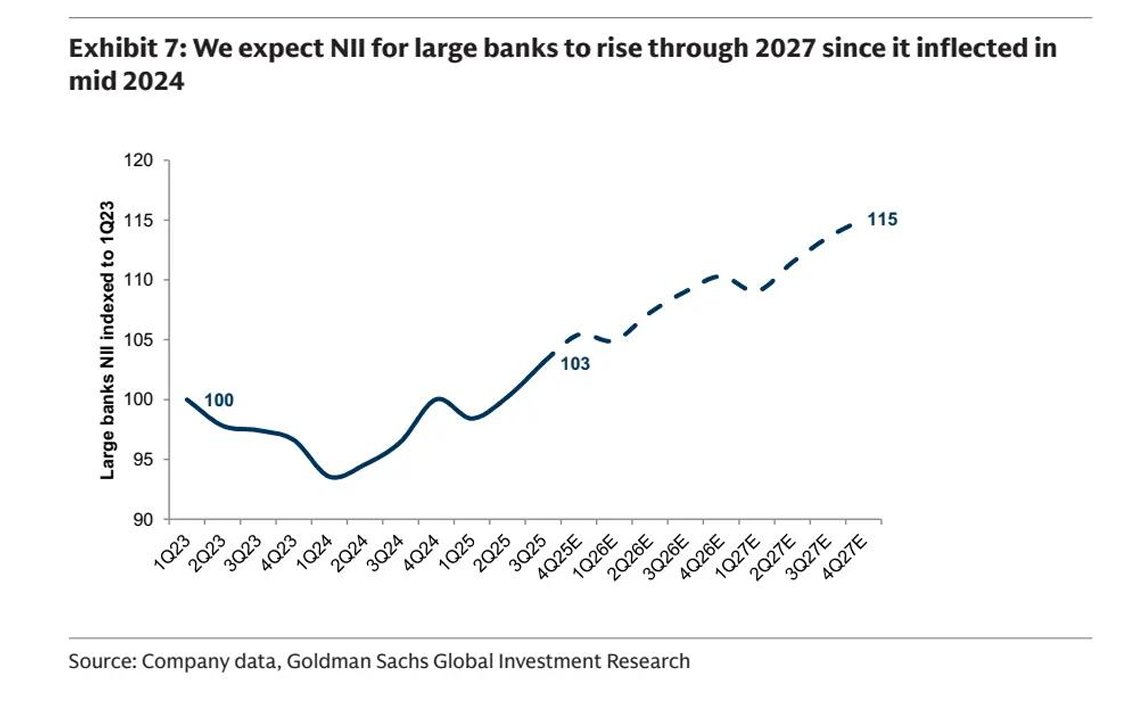
Core Viewpoint - Goldman Sachs has a constructive outlook for the U.S. banking sector in 2026, anticipating strong performance from major Wall Street banks like JPMorgan Chase and Bank of America during the upcoming Q4 2025 earnings season, which is expected to lay the groundwork for sustained profit expansion and a bull market in 2026 [1][2] Group 1: Earnings and Revenue Growth - The upcoming earnings season starting in mid-January will be crucial, with major banks expected to deliver better-than-expected growth and optimistic outlooks, significantly impacting the U.S. and global stock markets [1] - The primary drivers of growth for large banks in 2026 will be the recovery of net interest income (NII) and the resilience of investment banking, wealth management, and equity trading businesses [1][2] Group 2: Net Interest Income (NII) and Operating Leverage - Goldman Sachs expects NII to recover after hitting a low in mid-2024, continuing to rise until 2027, supported by stable expense growth and positive operating leverage [2][5] - The firm emphasizes that the NII recovery cycle remains strong and can extend into 2027, with sensitivity analyses indicating a potential 2% annualized increase in NII and a 3% contribution to earnings per share (EPS) from securities re-pricing [5][14] Group 3: Fee Growth and Cost Management - Core fees are projected to grow by approximately 7% year-over-year in 2026, driven by investment banking, wealth management, and card fees, contributing to overall revenue improvement [9][10] - Goldman Sachs anticipates that while expenses will not see explosive growth, they will remain stable, particularly in investment banking and capital markets [9] Group 4: Capital and Share Buybacks - Regulatory reforms under the Trump administration are expected to enhance capital returns, with potential buybacks projected to increase significantly to around $172 billion in 2026, representing a 24% year-over-year growth [11][18] - The current excess capital among major banks is estimated at $80 billion, which could rise to $205 billion with regulatory easing, providing substantial support for buybacks [11] Group 5: Preferred Bank Stocks - Based on the aforementioned factors, Goldman Sachs' preferred bank stock list includes Bank of America, Citigroup, JPMorgan Chase, U.S. Bancorp, and Wells Fargo, all of which are expected to benefit from improving NII, operational leverage, and strong capital positions [15][18] - The valuation metrics for these preferred stocks remain low, indicating potential for valuation recovery, especially in a declining interest rate environment [18]