
水泥产能置换

Search documents
中国建材涨超7% 公司在玻璃纤维领域具有领先优势
Zhi Tong Cai Jing· 2026-02-24 05:02
Group 1 - The core viewpoint of the article indicates that China National Building Material (CNBM) is experiencing a significant stock price increase, attributed to anticipated price hikes in fiberglass manufacturing due to rising costs and supply constraints [1] - The planned monthly price adjustment for fiberglass is expected to be between 10% and 15%, potentially leading to a price doubling by the end of the year [1] - CNBM holds a leading position in the fiberglass sector, with stakes of 60.24% in China National Materials (002080) and 29.22% in China Jushi (600176) [1] Group 2 - CNBM previously projected a shareholder loss of up to 4 billion yuan for 2025, primarily due to asset impairments related to cement capacity replacement, estimated between 6 billion to 8.3 billion yuan [1] - Bank of America Securities has reported that the loss magnitude exceeds their expectations, indicating potential risks to the anticipated 5% dividend yield for 2025 [1] - The asset impairment is considered a one-time event, and with the cement capacity replacement window closing at the end of March, further impairment is expected to be limited [1]
中国建材午前涨超7% 公司在玻璃纤维领域具有领先优势
Xin Lang Cai Jing· 2026-02-24 03:55
Core Viewpoint - China National Building Material (CNBM) shares rose by 7.23% to HKD 6.82, with a trading volume of HKD 290 million, amid expectations of a second round of price increases in fiberglass manufacturing due to rising costs and supply tightness [5]. Group 1: Price Increase Expectations - Suppliers and industry insiders anticipate a monthly price adjustment of 10% to 15% for fiberglass, potentially doubling prices by the end of the year if current plans proceed [5]. Group 2: Company Holdings and Market Position - CNBM holds a leading position in the fiberglass sector, owning 60.24% of China National Materials and 29.22% of China Jushi [5]. Group 3: Financial Forecasts and Risks - CNBM expects a maximum shareholder loss of approximately RMB 4 billion for 2025, primarily due to asset impairments related to cement capacity replacement, estimated between RMB 6 billion to 8.3 billion [5]. - Bank of America Securities reported that the loss exceeds their expectations and indicated that the anticipated dividend yield of about 5% for 2025 may face risks [5]. - The asset impairment is considered a one-time event, with limited further impairment expected as the cement capacity replacement window closes at the end of March [5].

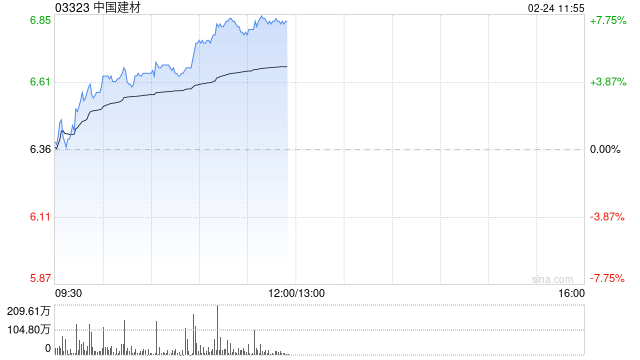
港股异动 | 中国建材(03323)涨超7% 公司在玻璃纤维领域具有领先优势
智通财经网· 2026-02-24 03:45
Group 1 - The core viewpoint of the article highlights that China National Building Material (CNBM) has seen its stock price increase by over 7%, currently trading at 6.8 HKD with a transaction volume of 265 million HKD, driven by anticipated price hikes in fiberglass manufacturing due to rising costs and supply constraints [1] - Suppliers and industry insiders expect a second round of price increases for fiberglass, with planned monthly adjustments ranging from 10% to 15%, potentially leading to a doubling of prices by the end of the year [1] - According to Huatai Securities, CNBM holds a leading position in the fiberglass sector, owning 60.24% of China National Materials and 29.22% of China Jushi [1] Group 2 - CNBM previously projected a shareholder loss of up to 4 billion CNY by 2025, primarily due to asset impairments related to cement capacity replacement, estimated between 6 billion to 8.3 billion CNY [1] - Bank of America Securities reported that the loss magnitude exceeds their expectations, indicating that the anticipated dividend yield of approximately 5% for 2025 may face risks [1] - The asset impairment is considered a one-time event, and with the cement capacity replacement window closing at the end of March, further impairment potential is limited [1]
中国建材再涨超10% 资产减值属单次 反内卷下行业盈利能力有望温和回升
Zhi Tong Cai Jing· 2026-02-11 03:43
Group 1 - China National Building Material (03323) saw a stock increase of 10.76%, reaching HKD 6.28, with a trading volume of HKD 541 million [1] - The company issued a profit warning, expecting a shareholder loss of up to approximately RMB 4 billion in 2025, primarily due to asset impairment related to cement capacity replacement, estimated between RMB 6 billion to 8.3 billion [1] - Bank of America Securities reported that the loss magnitude exceeds their expectations, indicating that the anticipated dividend yield of around 5% for 2025 may face risks [1] Group 2 - Zhongtai Securities noted that the cement industry is actively implementing strict production regulations according to designed capacity, reducing actual clinker capacity from 2.1 billion tons to 1.6 billion tons, which is expected to improve industry capacity utilization [1] - Although there is still a mismatch between supply and demand, higher capacity utilization is likely to facilitate off-peak production, leading to a continuous increase in industry net profit per ton and overall industry profitability [1]
多地公示水泥产能置换方案 行业转型步入深水区
Sou Hu Cai Jing· 2026-01-12 22:25
Core Insights - The cement industry is undergoing a deep transformation centered on capacity replacement due to shrinking market demand and pronounced supply-demand contradictions [1] - Recent announcements of capacity replacement plans by multiple provinces signal a response to national capacity control policies and indicate a shift towards compliant, high-quality development in the industry [1][3] - The industry is transitioning from an incremental market to a stock market, with dual forces of policy guidance and market competition reshaping the industry landscape [1] Capacity Replacement Plans - Several provinces, including Zhejiang and Shandong, have recently published capacity replacement plans for cement companies [2] - Other regions such as Yunnan, Guangdong, and Hubei have also issued similar announcements, indicating a widespread push for capacity replacement [3] Industry Challenges - The cement and building materials sector faces multiple pressures, including declining market demand and structural supply-demand contradictions, exacerbated by a sluggish real estate market and slowing infrastructure investment [3] - Many leading cement companies reported losses in the first half of 2025, highlighting the economic strain on the industry [3] Policy Changes - The Ministry of Industry and Information Technology, along with other departments, has introduced a plan for the cement industry that emphasizes capacity control as a core measure for stabilizing growth [3] - The policy shift from encouraging technological upgrades to strictly regulating registered capacity marks a new phase of high-quality development in the cement industry [4] Market Dynamics - The tightening of capacity replacement policies is accelerating the elimination of inefficient production capacity and intensifying regional disparities in development [5] - The capacity replacement process shows a clear trend of resource concentration from northern to southern regions, indicating a shift towards more advantageous areas [5] Long-term Outlook - The cement industry is expected to gradually transition towards a more intensive and low-carbon model, with leading companies likely to achieve high-quality development through regional capacity integration and expansion into green building materials [6] - Despite ongoing policy efforts, the industry is projected to maintain a surplus capacity of around 30% due to persistent demand decline, with a forecasted 5% decrease in national cement demand in 2026 [6][9] Price Trends - In 2025, cement prices are expected to experience a downward trend, reaching the lowest levels in recent years due to reduced demand from real estate and infrastructure investments [8] - However, as capacity replacement progresses and compliance in production strengthens, a rebound in cement prices is anticipated, particularly in the latter half of 2026 [8] Profitability Projections - The industry's profit margin is expected to remain around 3% in 2026, with limited recovery potential due to ongoing demand decline and constrained price increases [9] - The low-price cycle from 2026 to 2027 may drive inefficient capacity out of the market, leading to increased industry concentration and potential price recovery by 2028 [9]
工信部要求骨干企业严格落实水泥产能置换等政策
Zhong Guo Xin Wen Wang· 2025-10-20 11:58
Core Points - The Ministry of Industry and Information Technology (MIIT) of China emphasizes the strict implementation of cement capacity replacement policies by key enterprises [1] - A meeting was held to discuss the "Building Materials Industry Stabilization and Growth Work Plan (2025-2026)", which prohibits the addition of new cement clinker capacity [1] Group 1 - The MIIT highlights the need to address the prominent supply-demand imbalance in the cement industry, aiming for dynamic balance and industrial transformation [1] - Key enterprises are required to develop capacity replacement plans for excess registered capacities by the end of 2025, ensuring alignment between actual and registered capacities [1] - Industry associations are tasked with enhancing self-regulation, conducting regional market supply-demand balance studies, and organizing staggered production in the cement industry [1] Group 2 - The meeting included participation from various organizations such as the China Cement Association and major cement companies like Anhui Conch Group and China National Building Material Group [2]
工业和信息化部:在2025年底前对超出项目备案的水泥产能制定产能置换方案
Xin Hua Cai Jing· 2025-10-20 09:11
Core Viewpoint - The meeting organized by the Ministry of Industry and Information Technology emphasizes the importance of stabilizing growth in the cement industry as a key measure to implement the decisions of the central government, ensuring the safety and stability of the industrial supply chain [1][2]. Group 1: Industry Growth and Policy Implementation - The meeting highlighted the need to accelerate the implementation of the "Cement Industry Stabilization Growth Work Plan (2025-2026)" to enhance the quality and efficiency of the cement industry, promoting stable operations and structural optimization [1]. - It was noted that there is a significant imbalance between supply and demand in the cement industry, with a focus on achieving dynamic balance and promoting industrial transformation and upgrading [1][2]. - The meeting called for a prohibition on new production capacity, regulation of existing capacity, and the elimination of outdated capacity to address the supply-demand contradiction [1]. Group 2: Role of Key Enterprises and Associations - Key enterprises are urged to play a leading role by strictly implementing policies related to cement capacity replacement and regulation, with a deadline set for the end of 2025 to develop capacity replacement plans for excess registered capacities [2]. - Industry associations are tasked with enhancing self-discipline, conducting research on regional market supply and demand balance, and organizing staggered production in the cement industry to prevent unfair competition and promote a favorable development environment [2].