汽车品牌改革

Search documents
广汽“勒紧裤腰带”
Hua Er Jie Jian Wen· 2025-12-20 03:55
Core Viewpoint - GAC Group has announced a reform of its independent brand business units (BUs), notably merging the Haobo brand with Aion, indicating a strategic shift in response to market challenges and performance pressures [2][3]. Group 1: Brand and Market Performance - Haobo was initially launched as a high-end sub-brand of Aion, with aspirations to become "the Porsche of China," but has struggled to meet sales expectations, selling only 15,483 units from January to November, a year-on-year decline of approximately 3% [3]. - Aion's sales also faced challenges, with 247,900 units sold during the same period, reflecting a 19.29% decrease compared to the previous year [3]. - The merger aims to consolidate resources and improve efficiency in a competitive market characterized by price wars and declining profits [3][4]. Group 2: Strategic Reforms and Operational Efficiency - GAC Group's reform strategy involves a 2+3+X phased approach, with the Haobo-Aion BU merger being a key pilot project aimed at breaking down silos in research and development [4]. - The new BU structure will enhance collaboration across core functions such as strategy, product development, and sales, ultimately aiming to reduce costs and improve market competitiveness [4][5]. - The integration will allow Haobo to leverage Aion's extensive distribution network, increasing its sales points from approximately 200 to over 1,000 by 2026, thereby enhancing market penetration [5]. Group 3: Future Product Plans and Goals - The Haobo-Aion BU plans to launch six new models next year, including the Aion N60 and the Haobo A800 developed in collaboration with Huawei [8]. - GAC aims to achieve an annual sales target of 2 million units for its independent brands by 2027, supported by the implementation of the Huawei-derived IPD system, which has already reduced product development cycles and costs [9][10]. - The strategic combination of Haobo and Aion is seen as a way to maintain competitiveness in a market that is increasingly focused on efficiency and resource sharing [6][10].


与京东合作,昔日“网约车之王”埃安的艰难变革
3 6 Ke· 2025-11-13 10:33
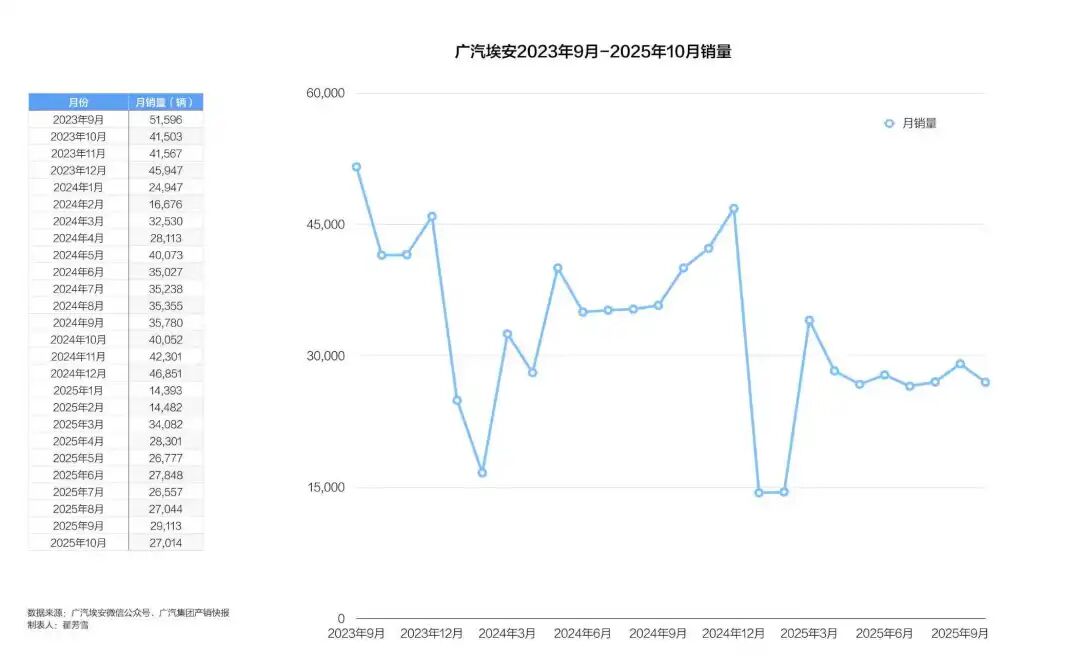
Core Viewpoint - The automotive industry is experiencing a surge in sales due to increased promotional efforts and the impending expiration of tax exemption policies, with many companies achieving record sales in October. However, GAC Aion's performance stands out negatively, showing significant declines in both sales and financial results [1][2]. Sales Performance - SAIC Passenger Cars saw a substantial increase in domestic market sales by 234.4%, while BYD's sales grew approximately 11.47%, reaching a new high for the year. Geely's monthly sales exceeded 300,000 units for the first time, and Chery's new energy vehicle sales rose by 54.7% year-on-year, surpassing 110,000 units in a single month [1]. - GAC Aion's October sales were 27,014 units, reflecting a 7.2% decrease month-on-month and a 32.6% year-on-year decline, contrasting sharply with the overall industry growth [1][2]. Financial Results - GAC Group reported third-quarter revenue of 24.106 billion yuan, a year-on-year decline of 14.62%, with a net loss attributable to shareholders of 1.774 billion yuan, worsening from the previous year. For the first three quarters, revenue decreased by 10.49%, and net profit turned from a profit of 120 million yuan to a loss of 4.312 billion yuan, a staggering drop of 3693.3% [1][2]. Market Dynamics - GAC Aion's struggles are attributed to intense competition in the domestic automotive market and rapid changes in demand structure. The brand, once dominant in the ride-hailing market, is now facing unique challenges as the market evolves [2][6]. - The ride-hailing market saw a significant slowdown, with GAC Aion's share of new ride-hailing vehicles dropping as the overall market contracted. In 2023, GAC Aion accounted for 220,000 of the 850,000 new ride-hailing vehicles, representing 45% of its total sales for the year [6]. Product Strategy and Challenges - GAC Aion's sales have halved over two years, with average monthly sales dropping from over 40,000 units in 2023 to 20,000 units in 2025. The brand's reliance on pure electric vehicles limits its competitiveness, especially in northern markets where hybrid models are preferred [3][7]. - Despite launching new models aimed at private consumers, such as Aion Bawanglong, Aion RT, and Aion UT, these vehicles have not met sales expectations, with monthly sales remaining between 3,000 and 6,000 units [8][12]. Organizational Changes and Future Outlook - GAC Group is undergoing internal reforms to enhance efficiency, including the integration of marketing resources across brands. However, the pace of these reforms has been slow, leading to challenges in decision-making and execution [11][12]. - The introduction of a new brand focused on B-end markets (ride-hailing and taxis) is planned, but has yet to materialize. Meanwhile, GAC Aion has partnered with JD.com and CATL to launch the Aion UT Super, which has generated significant market interest despite potential infrastructure limitations [13][15].