汽车安全设计

Search documents
门把手不再隐藏,让安全看得见
2 1 Shi Ji Jing Ji Bao Dao· 2026-02-09 22:50
Core Viewpoint - The introduction of the mandatory national standard for automotive door handles signifies a shift towards prioritizing safety over design aesthetics in the automotive industry, particularly addressing the issues associated with hidden and purely electronic door handles [1][2][4]. Group 1: New Standards Implementation - The new mandatory national standard, effective from January 1, 2027, requires all car doors to have mechanical release handles, ensuring accessibility even in power failure situations [1][2]. - The standard mandates that each car door must be equipped with a mechanical release handle that can withstand a force of at least 500 Newtons without failure [1][2]. - The phased implementation schedule allows new models to comply with most requirements by 2027 and all requirements by 2028, while existing models must comply by 2029 [3]. Group 2: Industry Impact and Consumer Safety - The standard reflects a significant regulatory response to safety concerns, as evidenced by rising complaints about hidden door handles, particularly in cold climates where they can freeze [2][4]. - Approximately 60% of the top 100 electric vehicle models in China currently feature hidden door handles, indicating a substantial number of vehicles will need modifications to comply with the new standards [2]. - The automotive industry is recognizing the importance of mechanical redundancy as a critical safety feature, emphasizing that design should not compromise user safety [3][4]. Group 3: Design Philosophy Shift - The automotive industry is urged to focus on safety rather than merely aesthetic or energy-efficient designs, as sacrificing safety for minor energy savings is deemed unacceptable [4][5]. - There is a call for a unified approach to automatic locking and unlocking mechanisms in vehicles to prevent issues such as accidental locking or failure to unlock after an accident [4].
汽车帮热评:全球首禁!工信部开始整顿全隐藏式门把手
2 1 Shi Ji Jing Ji Bao Dao· 2026-02-04 12:49
Core Viewpoint - The implementation of the "Automotive Door Handle Safety Technical Requirements" by the Ministry of Industry and Information Technology in China, effective January 1, 2027, aims to enhance vehicle safety by regulating hidden door handles, which have been linked to safety hazards in emergency situations [1]. Group 1: Industry Impact - The new regulation will require all vehicle doors to have an independent mechanical release device, ensuring that doors can be opened even if the vehicle is completely powered down or in a thermal runaway situation [1]. - As of April 2025, 60% of the top 100 selling new energy vehicles in China are equipped with hidden door handles, with the total stock of such vehicles exceeding 10 million [1]. - The regulation is expected to influence global automotive design trends, as China is the first country to implement such measures, prompting other regions, including Europe, to consider similar restrictions [1]. Group 2: Safety Concerns - There has been a significant increase in safety complaints related to hidden door handles, with a 132% year-on-year rise in 2024, highlighting the urgent need for regulatory intervention [1]. - The new rules will also specify requirements for the size and installation position of internal door handle indicators, ensuring better accessibility in emergencies [1]. - A compromise design of semi-hidden and mechanical emergency options is becoming mainstream, as it only slightly increases drag coefficient by 0.002 compared to fully hidden designs, prioritizing safety over aesthetics [1].
中国禁止隐藏式车门把手 成全球首例
Xin Lang Cai Jing· 2026-02-04 04:01
Core Viewpoint - The Ministry of Industry and Information Technology (MIIT) of China has announced new safety regulations for car door handles, mandating that all car doors, except for the tailgate, must have mechanical exterior and interior handles that can be manually opened even when locked, marking a ban on hidden door handles used in electric vehicles [1] Group 1: Regulatory Changes - The new regulations will take effect on January 1, 2027, and vehicles approved by regulatory authorities for the Chinese market must modify their designs to comply by January 2029 [1] - This makes China the first country to gradually phase out the design of hidden door handles [1] Group 2: Industry Impact - Hidden door handles, first introduced by Tesla, have been adopted by several Chinese electric vehicle brands and are a significant design feature distinguishing new energy vehicles from traditional fuel vehicles [1] - Approximately 60% of the top 100 selling new energy models in China were reported to have hidden door handles as of April last year [1] Group 3: Safety Concerns - The design has raised safety concerns in both the U.S. and China, particularly regarding the potential risks in escape and rescue situations during accidents or fires [1] - Tesla's hidden door handles are currently under safety investigation by U.S. authorities, and European regulators are also considering similar regulations [1]

事关汽车门把手安全,强制性国家标准发布
券商中国· 2026-02-02 14:43
Core Viewpoint - The mandatory national standard for automotive door handle safety, titled "Technical Requirements for Automotive Door Handles" (GB 48001-2026), will be implemented starting January 1, 2027, to enhance vehicle safety in response to advancements in electrification technology [2][3]. Summary by Sections Standard Overview - The standard was approved by the National Market Supervision Administration and the National Standardization Management Committee on January 28, 2026, and aims to regulate the design of automotive door handles to improve safety [2]. Background of Development - The development of this standard is driven by the evolution of electric vehicle technology and the need for enhanced safety features in critical components like door handles [3]. Development Process - The standard's formulation involved collaboration among over 40 domestic vehicle manufacturers, parts suppliers, and testing organizations, with multiple rounds of discussions among industry experts to finalize the draft [4]. Scope of the Standard - The standard applies to M1 and N1 class vehicles and multipurpose trucks, with provisions for other vehicle types to follow suit [8]. Safety Requirements for Exterior Door Handles - Each vehicle door (excluding the tailgate) must be equipped with a mechanical release for the exterior door handle, ensuring it can be opened in emergencies, such as after an irreversible constraint or thermal runaway of the battery [11]. - The exterior door handle must be located within a specified shadow area to ensure accessibility [13]. - The design must allow for sufficient hand operation space to facilitate the mechanical release function [15]. Technical Requirements for Exterior Door Handles - The exterior door handle must withstand a force of at least 500N without breaking or detaching, and it should allow the door to be opened without tools after testing [19]. Safety Requirements for Interior Door Handles - Each vehicle door must have at least one mechanical release interior door handle that can independently open the corresponding door [20]. - The installation location of the interior door handle must be visible and accessible, with specific distance requirements from the door edge [20]. Marking and Instruction Requirements for Interior Door Handles - Interior door handles must have permanent markings that are easily identifiable and visible in low-light conditions, along with clear operational instructions nearby [21]. Technical Requirements for Interior Door Handles - Similar to exterior handles, the interior door handles must also be tested to ensure they can be operated without tools [22].


央视网评| 告别“隐藏式”门把手
Yang Shi Wang· 2025-12-23 04:51
Core Viewpoint - The Ministry of Industry and Information Technology has released a draft for mandatory national standards regarding automotive door handles, which will phase out fully concealed door handles by January 2027, reflecting a strong emphasis on automotive safety and design standards [1] Group 1: Policy Changes - The withdrawal of fully concealed door handles is a response to safety concerns, as these designs have been linked to issues such as ice formation in low temperatures, electronic system failures during collisions or power outages, and risks of emergency rescue difficulties and child injuries [1] - The draft requires that door handles maintain reasonable operational space and must include a mechanical release function, reinforcing the principle of "safety first" in automotive design [1] Group 2: Regulatory Efficiency - The rapid advancement of this new regulation demonstrates an efficient regulatory mechanism, completing the standard-setting process in less than three years, significantly shorter than previous cycles [2] - The efficiency is attributed to the regulatory body's keen market awareness and the establishment of a "green channel" for urgently needed standards [2] - The draft also proposes differentiated transition periods for new and approved models, allowing time for technical modifications while minimizing market disruption [2] Group 3: Implementation and Oversight - Effective implementation of the new standards requires a robust mechanism that includes standard guidance, regulatory oversight, and industry self-discipline [2] - During the transition phase, it is essential for relevant departments to provide comprehensive guidance to automotive companies, particularly regarding technical requirements for mechanical release devices and precise measurements of operational space [2] - A tracking mechanism for corporate compliance with the new standards should be established, with reminders for companies lagging in progress to ensure a smooth transition [2] Group 4: Safety and Innovation Balance - The automotive industry must prioritize safety over innovation, as the departure from concealed door handles does not eliminate the ongoing "technology anxiety" related to other potentially hazardous designs [3] - There is a need for continuous exploration to balance technological innovation and user experience, particularly in the competitive electric vehicle sector [3] - Collaboration among policies, companies, and consumers is essential to foster healthy competition and sustainable development within the industry [3]
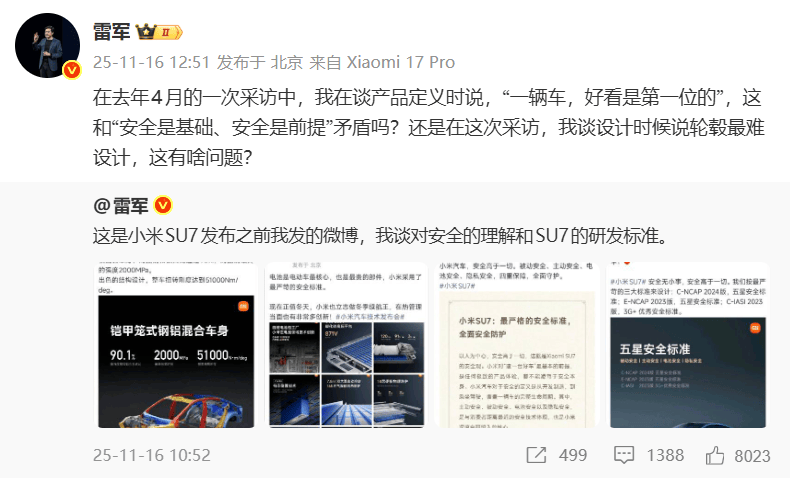
雷军怒了!连发多条动态硬刚,正面回应争议!
Sou Hu Cai Jing· 2025-11-17 05:00
Core Points - Lei Jun emphasized the importance of aesthetics in the design of the Xiaomi SU7, stating that "looks are paramount" in the product definition [7][8] - The controversy arose from a previous interview where Lei Jun's comments were interpreted as prioritizing aesthetics over safety, leading to public debate [6][8] - Lei Jun clarified that Xiaomi's automotive design adheres to stringent safety standards, including the 2024 version of C-NCAP and the 2023 version of Euro NCAP, asserting that "safety is paramount" [16][11] Summary by Sections - **Product Design Philosophy** - Xiaomi's approach to the SU7 emphasizes visual appeal as the primary design criterion, differing from their previous mobile phone strategies [7] - The focus on aesthetics has been misinterpreted by some as neglecting safety considerations [8] - **Safety Standards** - Lei Jun reiterated that Xiaomi vehicles are designed with the highest safety standards in mind, aiming for top ratings in established safety tests [16] - The company aims to balance aesthetics and safety, arguing that both can coexist in automotive design [17]


雷军怒了!刚刚连发多条微博!评论区炸锅
Sou Hu Cai Jing· 2025-11-16 11:41
Core Viewpoint - Lei Jun, the founder of Xiaomi, reiterated the company's commitment to safety in automotive design, emphasizing that aesthetics should not compromise safety standards [1][10]. Group 1: Safety Standards - Xiaomi's SU7 is designed according to the strictest safety standards, including the 2024 C-NCAP five-star rating, 2023 Euro NCAP five-star rating, and C-IASI 3G+ as the baseline [6]. - The vehicle's structure features a steel-aluminum hybrid body with high-strength steel and aluminum alloy making up 90.1%, achieving a maximum strength of 2000 MPa and a torsional rigidity of 51,000 N·m/deg [6]. Group 2: Battery Safety - The company has developed its own battery pack factory, implementing 14 layers of physical protection, 17 layers of high-voltage insulation, and dual large-area active cooling systems [8]. - The battery pack has undergone over 1,000 safety tests, which is 20 times the national standard, and features industry-first technology to ensure that thermal runaway does not affect the passenger cabin [8]. Group 3: Public Reaction - There has been significant public discourse, with some netizens accusing others of misinterpreting Lei Jun's statements regarding the prioritization of aesthetics over safety [9][10]. - Lei Jun responded to these accusations by reaffirming that safety is the foundation and premise of automotive design [10][11].


雷军怒了!接连发问
券商中国· 2025-11-16 09:48
Core Viewpoint - Lei Jun emphasizes that safety is the top priority in the design of Xiaomi's vehicles, particularly the Xiaomi SU7, which adheres to the strictest safety standards [9][14]. Design Standards - Xiaomi SU7 is designed according to the most stringent three safety standards: C-NCAP 2024 version five-star, Euro NCAP 2023 version five-star, and C-IASI 2023 version 3G+ [9][14]. - The vehicle's body structure utilizes a steel-aluminum hybrid design, with high-strength steel and aluminum accounting for over 90% of the materials used, and the maximum strength reaching 2000 MPa [10][14]. Safety Features - The overall torsional rigidity of the vehicle reaches 51,000 N·m/deg, indicating a robust structural design [10][14]. - The battery safety features include a self-developed battery pack factory, 14 layers of physical protection, 17 layers of high-voltage insulation, and a dual large-area active cooling system [14]. - The innovative battery cell inversion technology ensures that in the event of thermal runaway, the ejection direction is away from the passenger compartment, achieving "no open flame, no heat spread" [14]. Testing and Validation - The battery pack has undergone IP6K9K sealing tests and has experienced over 1,000 safety tests, which is 20 times the number required by national standards [14].

雷军怒了,连发多条微博回应质疑
21世纪经济报道· 2025-11-16 09:12
Core Viewpoint - The article emphasizes Xiaomi's commitment to safety in its automotive design, highlighting that safety is the foundation and priority in their vehicle development strategy [1][4]. Group 1: Safety Standards - Xiaomi's vehicles are designed using the most stringent safety standards, with a steel-aluminum mixed body composition where high-strength steel and aluminum account for over 90% [4]. - The structural design of the vehicle achieves a torsional rigidity of 51,000 Nm/deg, indicating a robust construction [4]. - The highest strength of the high-strength steel used in the vehicle reaches 2000 MPa, showcasing the material's durability [4]. Group 2: Battery and Performance - The battery is identified as the most critical and expensive component of electric vehicles, and Xiaomi applies the strictest safety standards to its battery design [4]. - Xiaomi aims to be the leader in winter driving range, indicating ongoing innovations in thermal management for their electric vehicles [4]. Group 3: Comprehensive Safety Measures - Xiaomi's safety approach includes four layers of protection: passive safety, active safety, battery safety, and privacy safety, ensuring comprehensive safeguarding for users [4]. - The founder, Lei Jun, reiterated that "safety is the foundation, safety is the premise," responding to criticisms and affirming the company's dedication to safety [6].

雷军,怒了!刚刚接连发问
Sou Hu Cai Jing· 2025-11-16 07:45
Core Viewpoint - Lei Jun, the founder of Xiaomi, emphasizes the importance of safety in the design of Xiaomi's automotive products, particularly the SU7 model, countering claims that aesthetics are prioritized over safety [1][4][5]. Group 1: Safety Standards - The Xiaomi SU7 is designed according to the strictest safety standards, including the 2024 version of C-NCAP five-star rating, the 2023 version of Euro NCAP five-star rating, and C-IASI 3G+ as the design baseline [5]. - The vehicle incorporates four layers of protection: passive safety, active safety, battery safety, and privacy safety [5]. Group 2: Structural Integrity - The SU7 features a MI armor cage structure made of a steel-aluminum hybrid body, with high-strength steel and aluminum alloy making up 90.1% of the vehicle, achieving a maximum strength of 2000 MPa [5]. - The torsional rigidity of the entire vehicle reaches 51,000 N·m/deg, indicating a robust structural design [5]. Group 3: Battery Safety Innovations - Xiaomi has developed its own battery pack factory, implementing 14 layers of physical protection, 17 layers of high-voltage insulation, and dual large-area active cooling with a water cooling area of 7.8 square meters [7]. - The battery pack features an industry-first cell inversion technology to ensure that during thermal runaway, the spray direction is away from the passenger compartment, achieving no open flames and no thermal propagation [7]. - The battery pack has passed IP6K9K sealing tests and has undergone over 1,000 safety tests, with the number of projects being 20 times that of national standards [7].